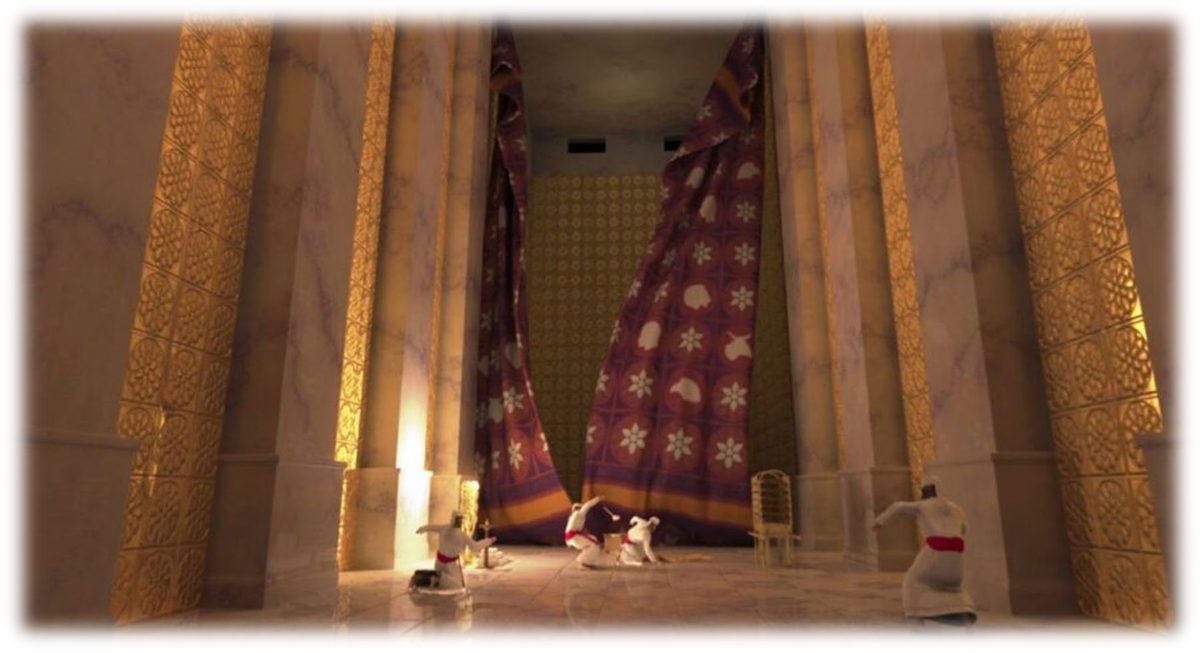
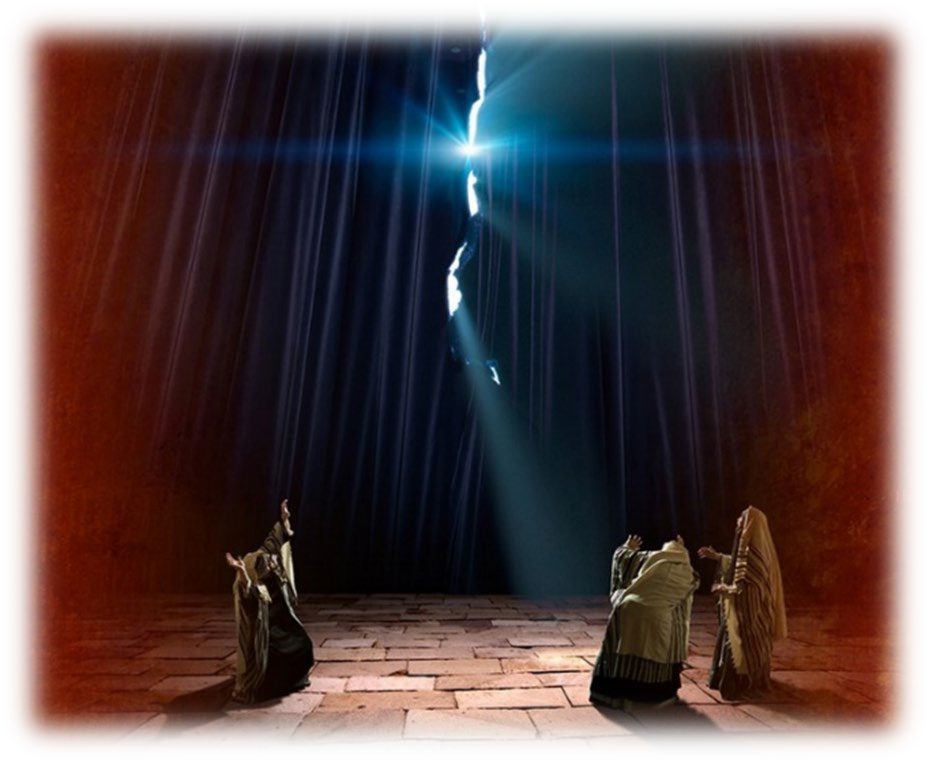
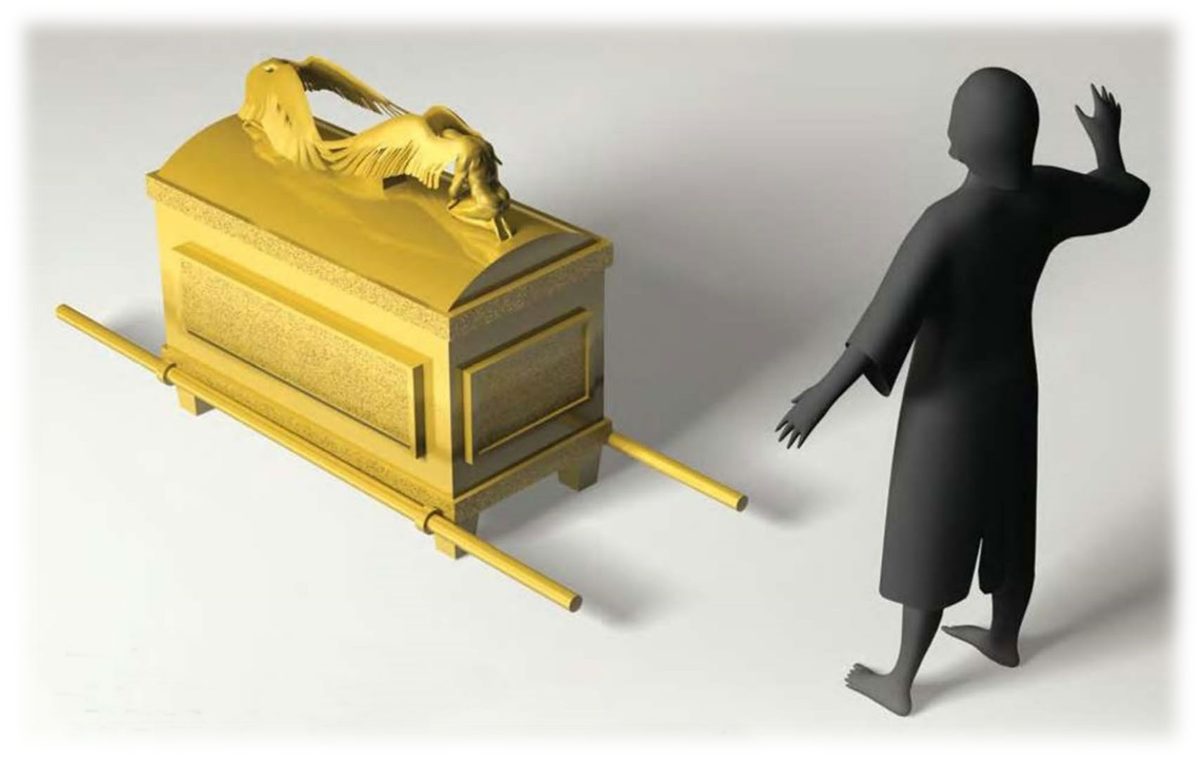
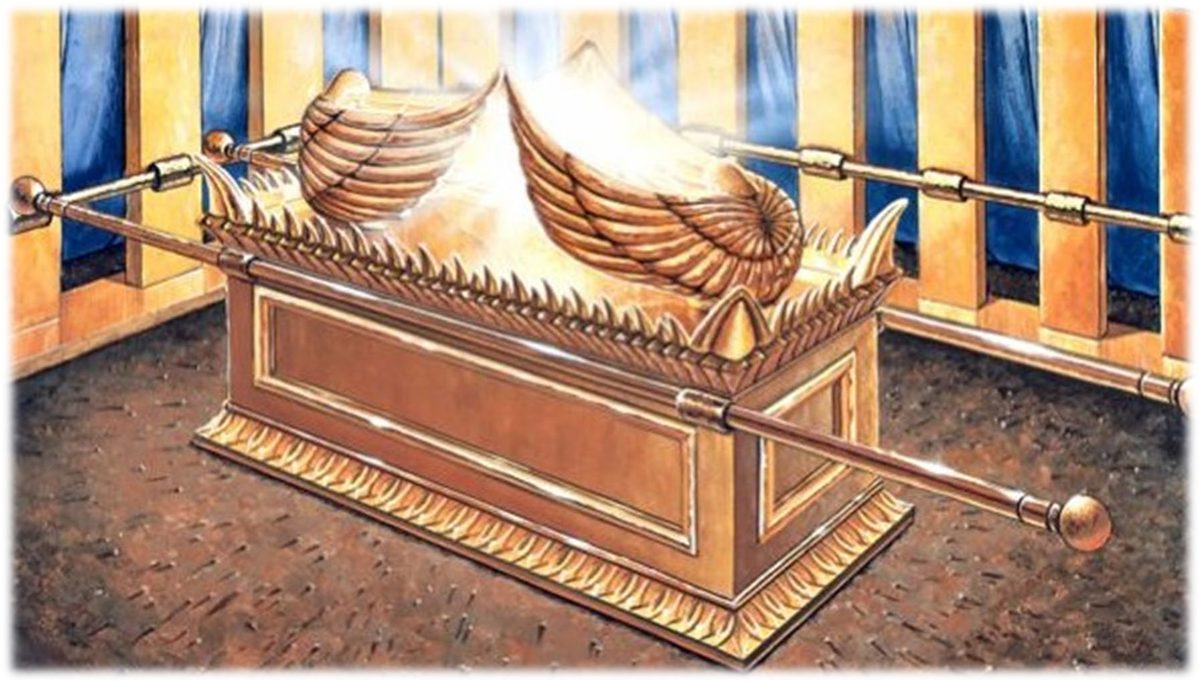
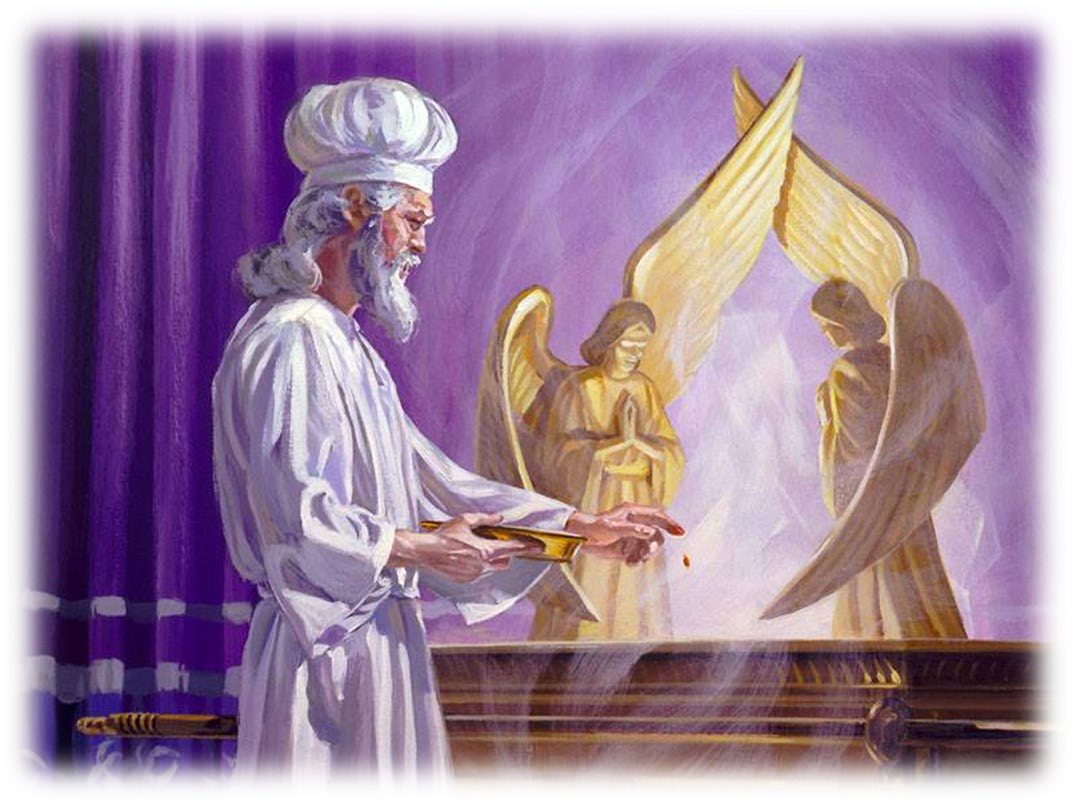
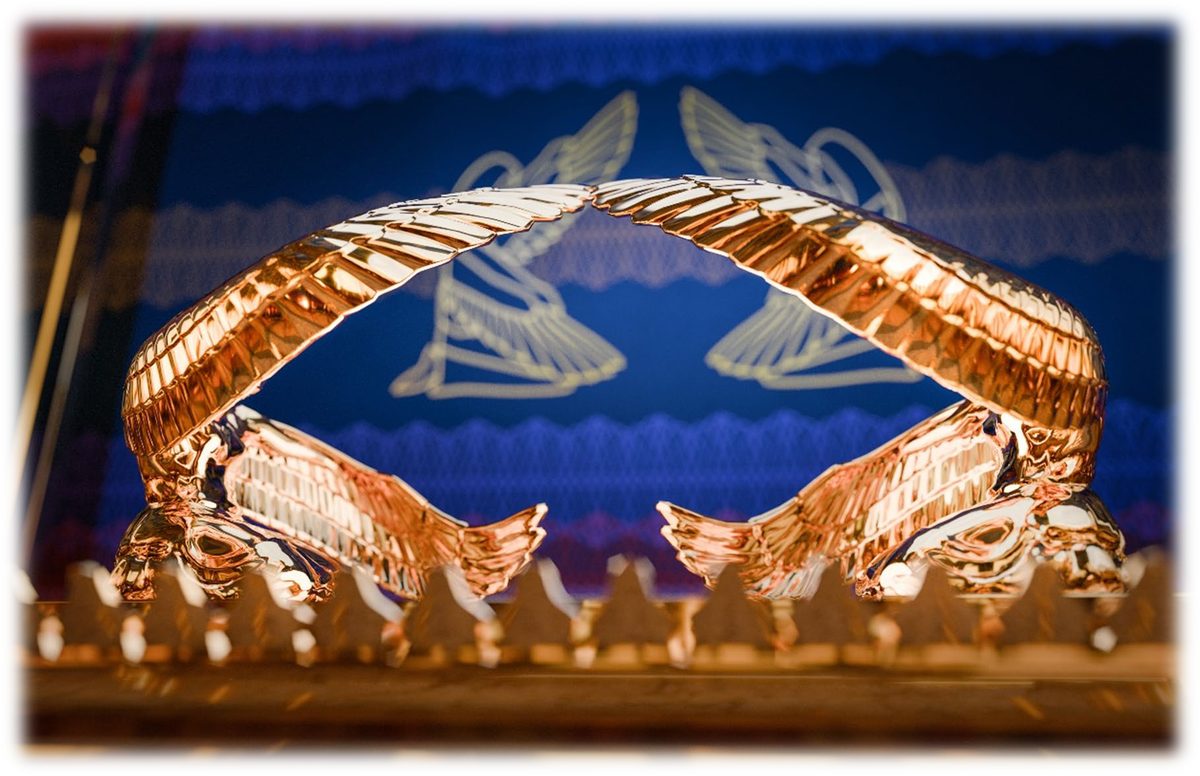
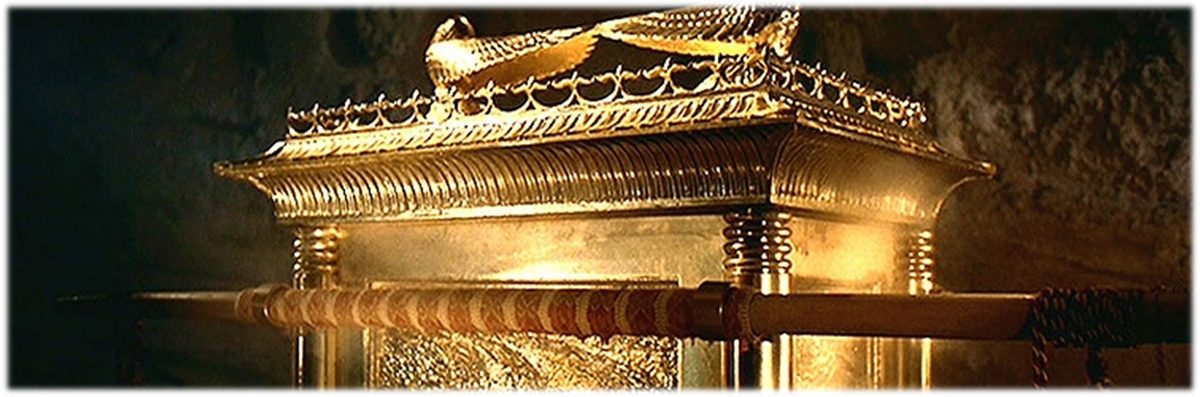
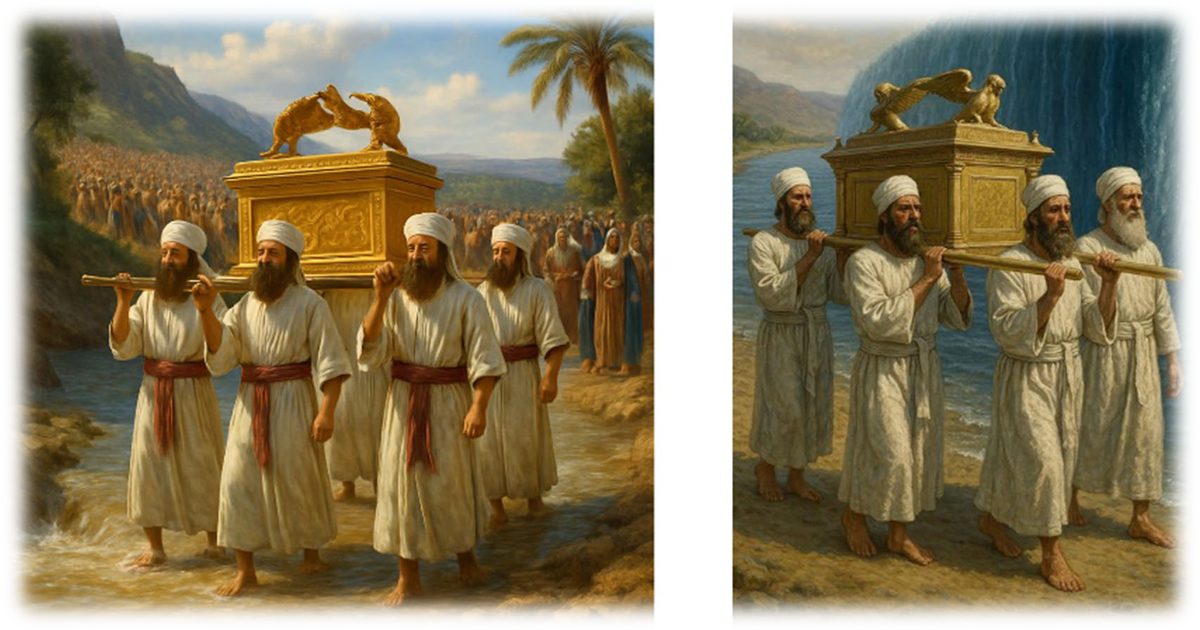
Each class follows one chapter of the book, that is, one part or article of the Tabernacle; the two longest chapters, the Golden Altar and the Ark, are taken in two classes each. Read the lesson, with the book’s own pictures and diagrams, work the practice exercises with immediate feedback, then take the graded test. Your place and your scores are kept on this device, so you can leave and come back.
Classes passed0 of 0
Practice
Work the Text
Test
Class Test
Your result
0 / 0
Audio
Listen to the Series
My record
Progress Across the Classes
Everything here is kept on this device only. Copy the record to send it to a class leader.
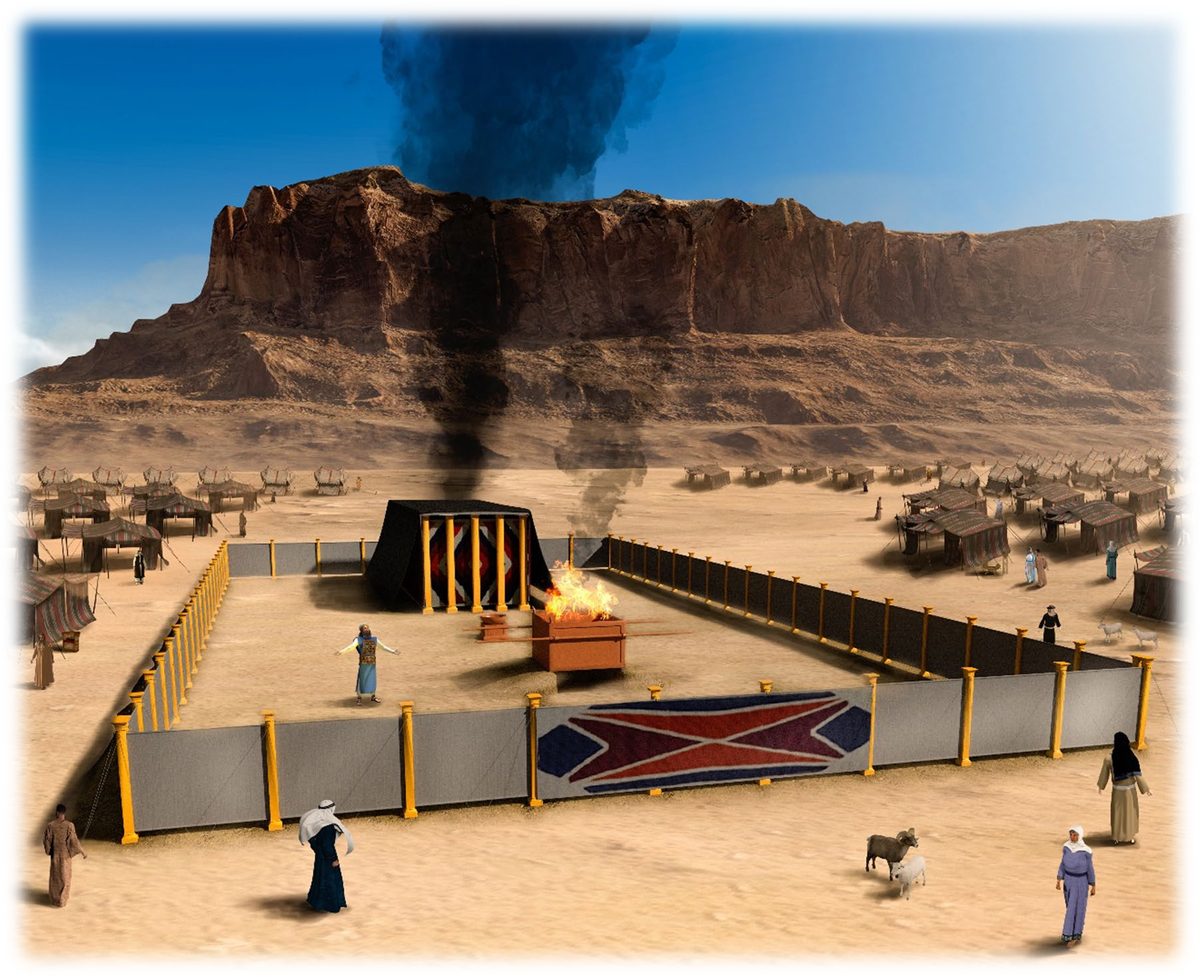
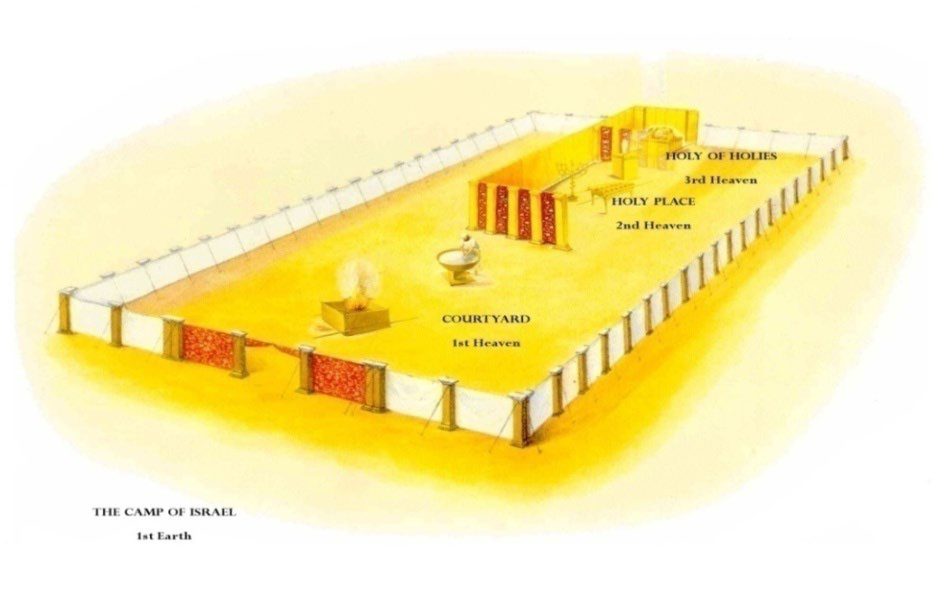
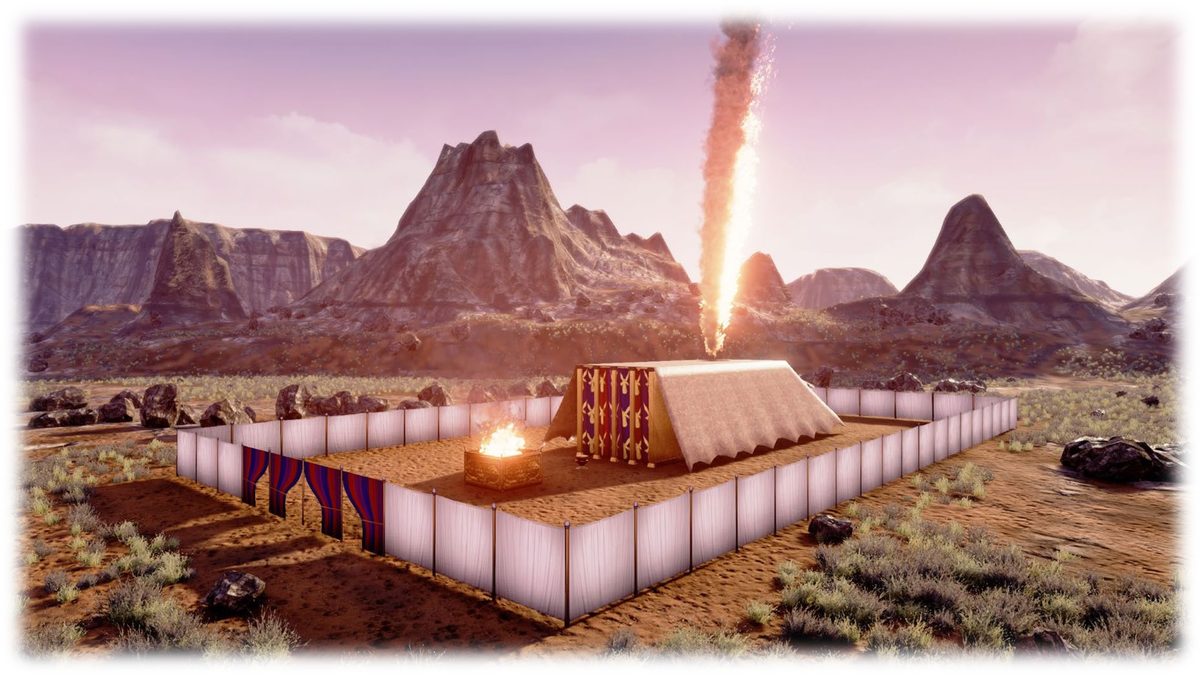
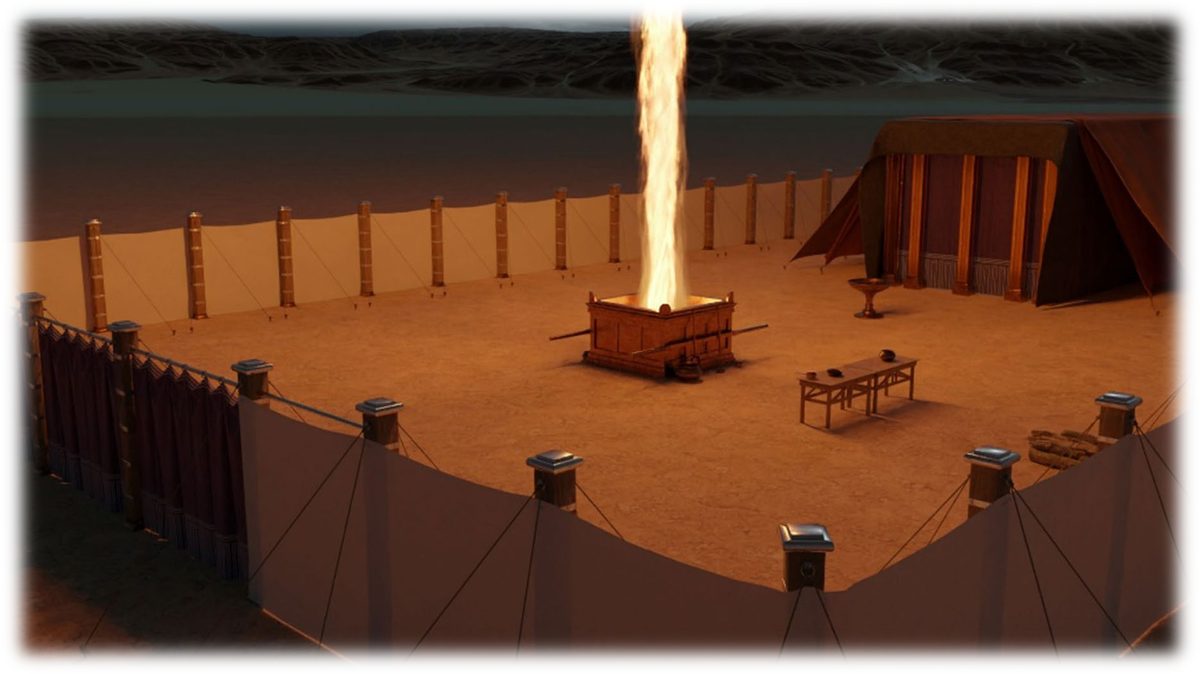
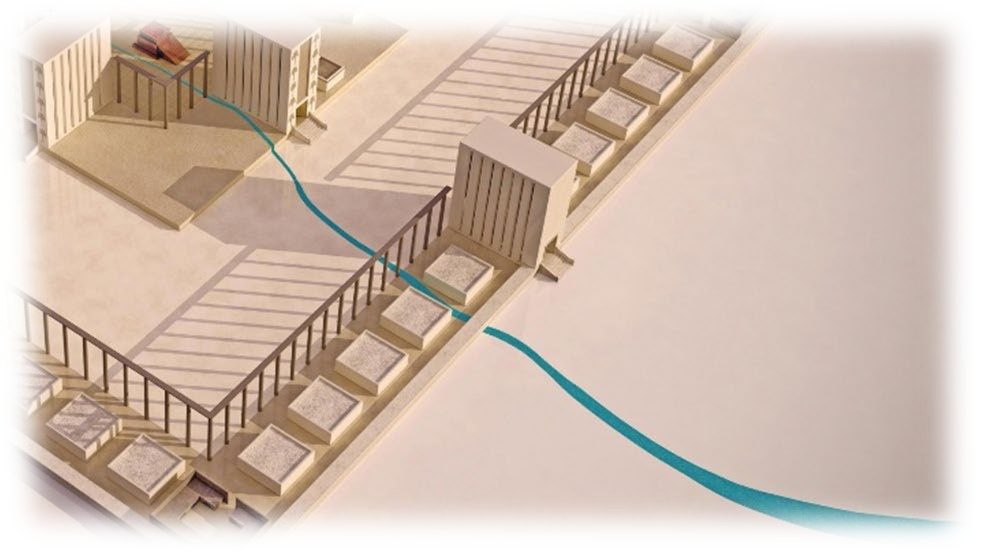
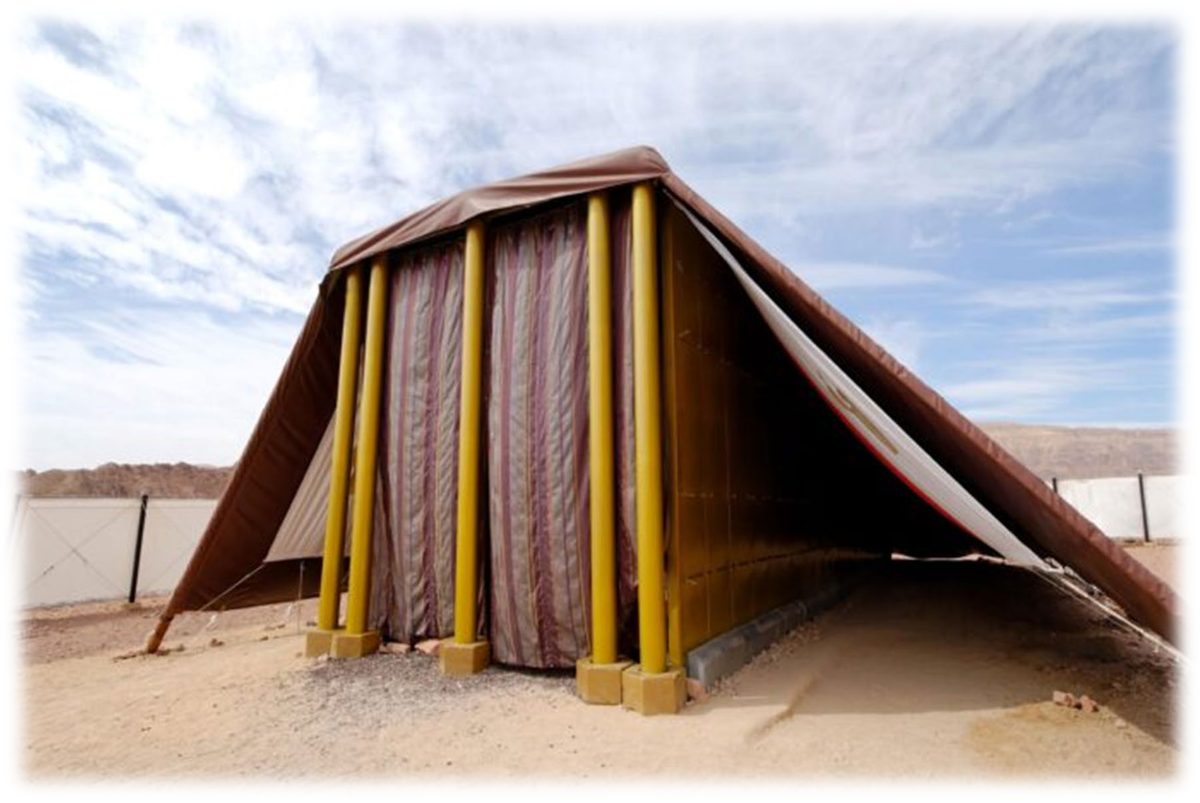
Figure 1. The Tabernacle in the wilderness: the linen court and its gate, the Brazen Altar with its smoke, and the covered building, with the camp of Israel pitched about it (book, page 20).
The most precisely described structure in the Bible
Though many books and studies have been written on the Tabernacle, it remains an area of great interest, particularly to those who have sought to mine its rich depth of typological symbolism. Our purpose in this study is to present the varied perspectives many have taken on the Tabernacle’s structure and history, and to peel back the layers of its symbolic shadows further still, by what we pray has been the light of the Holy Ghost. It is intended to complement the work of those who have gone before, not to replace it, and it is the fruit of hundreds of hours spent plumbing the depths of the subject.
The Tabernacle in the wilderness was one of the most intricate and precision-designed symbolic structures in the Bible. More information was conveyed about its materials, measurements, maintenance, administration, and activity than about any other single structure or object in the Scripture. Clearly, its design and operation were of critical importance to God, and not only for the limited period during which it was used under the dispensation of the Law, but also for conveying deep symbolic truths regarding God’s plan and purpose for mankind in a broader sense. Hidden within the lines and layers of its precincts is the underlying outline of God’s intent for mankind, from the details of His precise plan to the Person who would carry it out.
God speaks in pictures, and reveals Himself progressively
The Old Testament is rich with pictorial stories and with metaphorical and allegorical lessons. God often spoke to His people in symbolic communication to convey complex thoughts and applications, and He frequently used typological foreshadowing, structures and objects that represented concepts He wished to express indirectly, or for a future generation. He revealed His way and His will to men progressively in this sense: as more light was given, more knowledge and understanding of God were revealed.
Psalm 36:9 For with thee is the fountain of life: in thy light shall we see light.
Proverbs 4:18 But the path of the just is as the shining light, that shineth more and more unto the perfect day.
Paul’s use of types and shadows
The apostle Paul continued this established biblical precedent in his use of types and shadows to define the revelation of deeper truth. As one of the most brilliant students of the Mosaic Law and the Prophets, he was in a unique position to define and delineate the Old Covenant pictures through the illuminating light of the Holy Ghost. The things that happened to Israel “happened unto them for ensamples: and they are written for our admonition” [1 Corinthians 10:11], and the meats, drinks, holydays, new moons and sabbaths of the Law “are a shadow of things to come; but the body is of Christ” [Colossians 2:16–17]. When Paul addresses the rituals and ordinances of the Law, and the structure and operation of the Tabernacle in particular, he gives us their true and purest purpose:
Hebrews 8:3–5 For every high priest is ordained to offer gifts and sacrifices: wherefore it is of necessity that this man have somewhat also to offer. For if he were on earth, he should not be a priest, seeing that there are priests that offer gifts according to the law: Who serve unto the example and shadow of heavenly things, as Moses was admonished of God when he was about to make the tabernacle: for, See, saith he, that thou make all things according to the pattern shewed to thee in the mount.
Hebrews 9:8–10 The Holy Ghost this signifying, that the way into the holiest of all was not yet made manifest, while as the first tabernacle was yet standing: Which was a figure for the time then present, in which were offered both gifts and sacrifices, that could not make him that did the service perfect, as pertaining to the conscience; Which stood only in meats and drinks, and divers washings, and carnal ordinances, imposed on them until the time of reformation.
Hebrews 9:23–24 It was therefore necessary that the patterns of things in the heavens should be purified with these; but the heavenly things themselves with better sacrifices than these. For Christ is not entered into the holy places made with hands, which are the figures of the true; but into heaven itself, now to appear in the presence of God for us:
Hebrews 10:1 For the law having a shadow of good things to come, and not the very image of the things, can never with those sacrifices which they offered year by year continually make the comers thereunto perfect.
Notice the words Paul uses for the Tabernacle: a “shadow” of heavenly things, a “figure” for the time then present, the “figures of the true”, and the “example” and “patterns” of things in the heavens. A shadow is the image or outline cast by a real object when light is shone on it: it is a true shape of the reality, but it lacks depth, it lacks color, and it has no substance of itself, requiring the real thing to be in existence. The real thing, of which the Tabernacle is a shadow, a figure, a copy and a pattern, is heaven itself and heavenly things. It is a figure of heavenly things, not earthly things. Here, in a form that men and women can understand, is pictured how to approach God and have fellowship with Him, the reality of which is found not in the Tabernacle made with hands but in the true Tabernacle above, which the Lord pitched and not man. As Loraine Boettner noted, we get some idea of the importance God attached to it from the fact that approximately one third of the book of Exodus, all of Leviticus, and a considerable part of Numbers are devoted to the Tabernacle and its ritual, and two thirds of the account of the events at Sinai. As the Tabernacle was set up, God was in the Holy of Holies and man was outside the enclosure, and the way is explained step by step as we go from the door back into the holiest of all, to the Ark and the Mercy Seat and the Shekinah light that was the visible presence of God. Here the mystery of how a holy God can dwell with sinful man, and how sinful man is enabled to come into the presence of a holy God, is solved.
Our right and our responsibility
The beautiful pictures and symbolism of the Old Testament, contained in the rituals, ordinances, operations and design of the Law and its structures and implements, are intended to convey to us a deeper, richer tapestry of truth than is seen at first glance. It is our right and our responsibility to search out the deeper truths hidden within the threadwork of the tapestry of God’s word.
Deuteronomy 29:29 The secret things belong unto the LORD our God: but those things which are revealed belong unto us and to our children for ever, that we may do all the words of this law.
Proverbs 25:2 It is the glory of God to conceal a thing: but the honour of kings is to search out a matter.
The presupposition we are operating from
We believe that the Tabernacle types and shadows are and were symbolically fulfilled in the New Covenant unfolding of God’s plan in Christ and through his Church. The anti-types of the Tabernacle were first brought to fruition in Christ’s life, death and resurrection, and were fully realized in the blueprint of the New Covenant order. We believe that we are still operating under the typological Tabernacle order, and will be until the establishment (and fulfillment) of the Temple order’s types and shadows during the Millennial Reign, when the anti-typical Temple order will eclipse the Tabernacle typology. Regarding the rich tapestry of typology in the Tabernacle, then, we are operating from the presupposition that the intricate fabric of symbolism within it has been and is to be fully fulfilled in Christ and his Body.
A study of the Tabernacle types and shadows is critical to bring distinction and illumination to the doctrine and order of the New Covenant. The symbolic gridwork of the Tabernacle, laid over the simple truths of the New Testament’s doctrines and teachings, creates a lens that brings those truths into powerful clarity: doctrinal definition rather than carnal confusion is created by correctly understanding the typological framework of the Tabernacle, the shadow of which came to its fulfillment in the coming of Christ and the establishment of the New Covenant plan and people. This book is not intended to be a full or final compilation of all the views and perspectives on the Tabernacle. As the light of the Spirit of God further illuminates and defines its types and shadows, our prayer is that this treatise and others will grow and develop organically; we have strived to avoid all interpolation and excessive extrapolation, and we welcome the input of any further insights or elucidation.
The primary and physical purpose of the Tabernacle was to provide a place of habitation for the presence of God:
Exodus 25:8 And let them make me a sanctuary; that I may dwell among them.
We call the Tabernacle a temporal dwelling place because it was never intended to be a permanent house for God’s presence: it was a physical place and a spiritual process through which Israel could relate and be restored to God, through the atoning work and the governmental operation of the order of God, during the dispensation of the Law. During the wilderness wanderings it was the central place of worship, spiritual communication, direction and government, and the center of the camp both literally and figuratively, for all of Israel’s hope and help lay within its linen walls. It remained the primary center of worship and religious order for Israel for about 480 years, from the Exodus until the building of Solomon’s Temple, and when the foundation of the Temple was laid the portable sanctuaries previously used became defunct. The two chronologies we cite date it as follows:
Table 1. Two chronologies for the Tabernacle and the Temple of Solomon.
Chronology
Tabernacle set up or completed
Solomon’s Temple completed
Ussher
1490 B.C.
1005 B.C.
Wetzel
1461 B.C.
975 B.C.
The spiritual, symbolic and eternal purpose
The Tabernacle was also a symbolic window into the order and operation of God’s restorative plan for mankind: cloaked within its specific materials and precise measurements, its design and its development contain the hidden truths of God’s redemptive process and His Kingdom order. In the same sense that the Law was a schoolmaster to bring us to Christ [Galatians 3:24–25], the Tabernacle was both a textbook and a tool: a textbook for defining the plan and operation of God, and a tool by which that plan and operation were carried out. That is, it was the mechanism of God’s order and operation for the Church in the wilderness, and it described the method by which the mechanism operated, the way and means to maintain a divine relationship through progressive growth toward God.
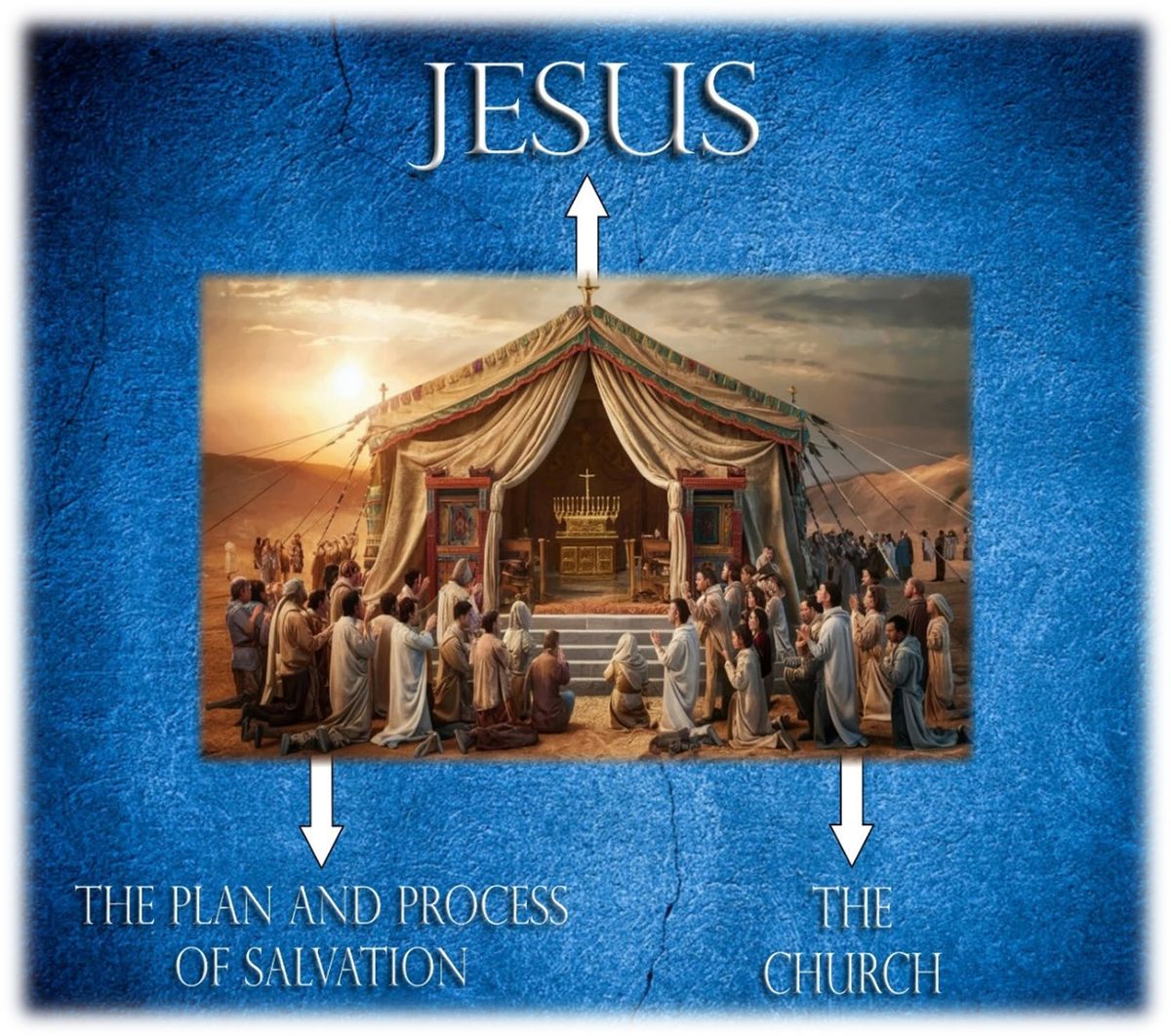
So we speak of the Tabernacle as a symbolic blueprint, a spiritual overlay and a map, delineating and defining God’s relationship to mankind and His restoration of mankind, and in this sense it contained three prophetic and structural types and shadows: Jesus Christ in an individual sense, the Body of Christ (the Church) in a corporate sense, and the plan and process of the salvation of God in both an individual and a corporate sense.
Figure 1. The three things the Tabernacle pictures at once: Jesus Christ, his Church, and the plan and process of salvation (book, page 23).
We are justified in reading it this way. Israel is spoken of in the New Testament as the “Church in the wilderness”, and so natural Israel is set forth as a type and shadow of the New Testament Church, the spiritual Israel of God [Romans 9:6–8; Galatians 6:16]. The principle of interpretation is Paul’s own, that the natural precedes and points to the spiritual [1 Corinthians 15:46–47]; and because everything that happened to natural Israel happened to them for types and ensamples, written for our admonition [1 Corinthians 10:11], we are justified in looking at the truth in the Tabernacle as a type and shadow of the good things to come in the New Covenant Church. Kevin Conner, who wrote one of the best studies on the Tabernacle outside of our churches, stated the principle in just these terms.
Jesus, the author of the New Covenant
How can one structure represent Christ, his Church and the plan of salvation all at the same time? Consider their interconnected nature. Jesus and his Church are the tools of God created to carry out His covenant plan for mankind, and the Church, which is called the Body of Christ, represents Christ to the world: it is through the Church that the world sees Christ, both individually in its members and corporately in his Body. And the New Covenant plan of God is chiefly expressed and made known through Jesus, who is the progenitor and author of the New Covenant, “the author and finisher of our faith” [Hebrews 12:2]:
Hebrews 5:8–9 Though he were a Son, yet learned he obedience by the things which he suffered; And being made perfect, he became the author of eternal salvation unto all them that obey him;
Jesus both instituted and fulfilled the plan of salvation, and we can put it in three words. Jesus is the expression of the New Covenant, in a communicative sense, in his role as Messiah and Mediator; he is its embodiment, through his perfect life, his overcoming of death and the testimonial witness of his resurrection; and he is its epitome, the yardstick by which its fruit is to be measured. Thus the order and plan of salvation revealed in the Tabernacle were fulfilled first in Christ himself, and Christ brought the New Covenant into being and, through it, his Church: one structure can picture all three because the three are joined in one work.
A shadow of the heavenly order
The Tabernacle was a physical shadow and reflection of the true spiritual reality of the heavenly order and government of God. Three passages in Hebrews establish this, and we rest on them throughout: the true tabernacle which the Lord pitched and not man, whose pattern Moses was shown in the mount [Hebrews 8:1–5]; the first Tabernacle, “a figure for the time then present”, set beside the greater and more perfect tabernacle by which Christ has come [Hebrews 9:1–12]; and the holy places made with hands, “the figures of the true”, which Christ passed by for heaven itself [Hebrews 9:23–24].
Hebrews 8:2, 5 A minister of the sanctuary, and of the true tabernacle, which the Lord pitched, and not man. … Who serve unto the example and shadow of heavenly things, as Moses was admonished of God when he was about to make the tabernacle: for, See, saith he, that thou make all things according to the pattern shewed to thee in the mount.
Hebrews 9:11–12 But Christ being come an high priest of good things to come, by a greater and more perfect tabernacle, not made with hands, that is to say, not of this building; Neither by the blood of goats and calves, but by his own blood he entered in once into the holy place, having obtained eternal redemption for us.
The dwelling place of God in two dimensions
Just as there was a physical, literal Tabernacle where God dwelt during the early days of Israel, so there has to be a spiritual tabernacle where God dwells during the Church Age, for more than any other element the Tabernacle represents the dwelling place of God among His people. Under the order of the Mosaic Covenant there was only one place at one time that God made His visible, earthly habitation, first in the Tabernacle and later in the Temple, and neither the Tabernacle nor the Temple was a dwelling of God until it was filled with His Spirit.
Under the New Covenant there are two dimensions to the dwelling place of God. The Church in a corporate sense is the Spirit-filled dwelling place of God, the assembly of God’s people; and in a singular sense the individual Spirit-filled people of God who constitute the Church are each a dwelling place of God as well. Both had their establishment on the Day of Pentecost, through the impartation and indwelling of the Holy Spirit. The scriptures that call the Church and the children of God a tabernacle or temple are many: among them 1 Corinthians 3:12–17, “ye are the temple of God”; 1 Corinthians 6:19, “your body is the temple of the Holy Ghost”; 2 Corinthians 6:16; Hebrews 3:4–6, “whose house are we”; and 1 Peter 2:5. Paul sets both dimensions in one passage:
Ephesians 2:19–22 Now therefore ye are no more strangers and foreigners, but fellowcitizens with the saints, and of the household of God; And are built upon the foundation of the apostles and prophets, Jesus Christ himself being the chief corner stone; In whom all the building fitly framed together groweth unto an holy temple in the Lord: In whom ye also are builded together for an habitation of God through the Spirit.
God’s presence is the proof
It is God’s presence in a place or a people that testifies to whether that place or people are His. Moses understood this when he refused to go up from Sinai without it:
Exodus 33:14–16 And he said, My presence shall go with thee, and I will give thee rest. And he said unto him, If thy presence go not with me, carry us not up hence. For wherein shall it be known here that I and thy people have found grace in thy sight? is it not in that thou goest with us? so shall we be separated, I and thy people, from all the people that are upon the face of the earth.
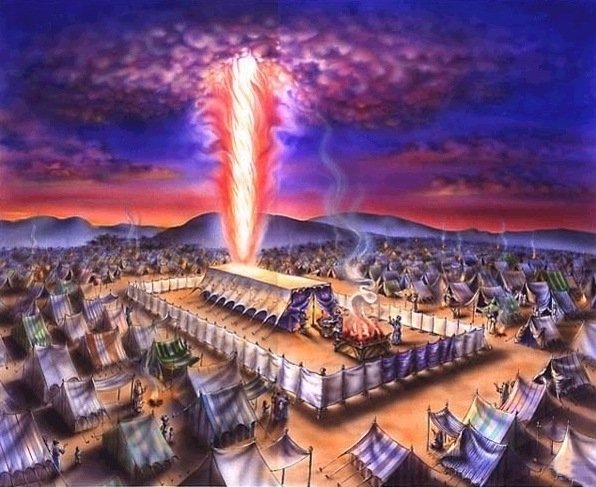
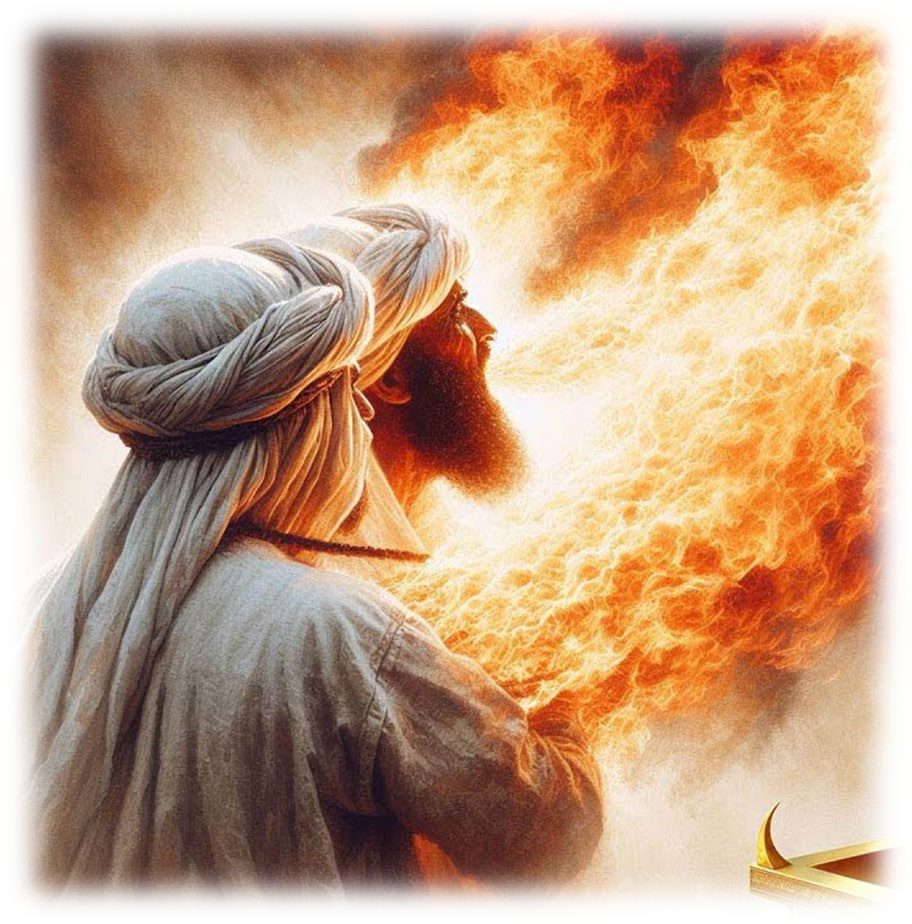
Figure 2. The pillar of fire over the Tabernacle in the midst of the camp of Israel: His cloud and His fire were the visible testimony of His presence among His people (picture library).
We believe the same test stands in this last day: when there is a church fully restored to God, operating in the power and purity of the first church (the Early Church), on which His cloud and His fire descend and His presence remains, the world will know where, and in whom, God has placed His name. And after the final judgment and the establishment of the New Heavens and the New Earth, the first purpose of God, which is also His final purpose, will be reestablished: God will dwell literally and physically among men [Revelation 21:1–4; 7:15].
Mishkan, shakan and Shekinah
The word most often translated “tabernacle” is the Hebrew word mishkan, which refers to a dwelling place, habitation or residence. The Hebrew word ohel, meaning “tent”, is also used to refer to the Tabernacle; the words translated “tent” and “tabernacle” in the title “tent of the congregation” are both this one word. Now mishkan comes from the root word shakan, which means to abide, reside or dwell, and it is from this root that the word Shekinah comes.
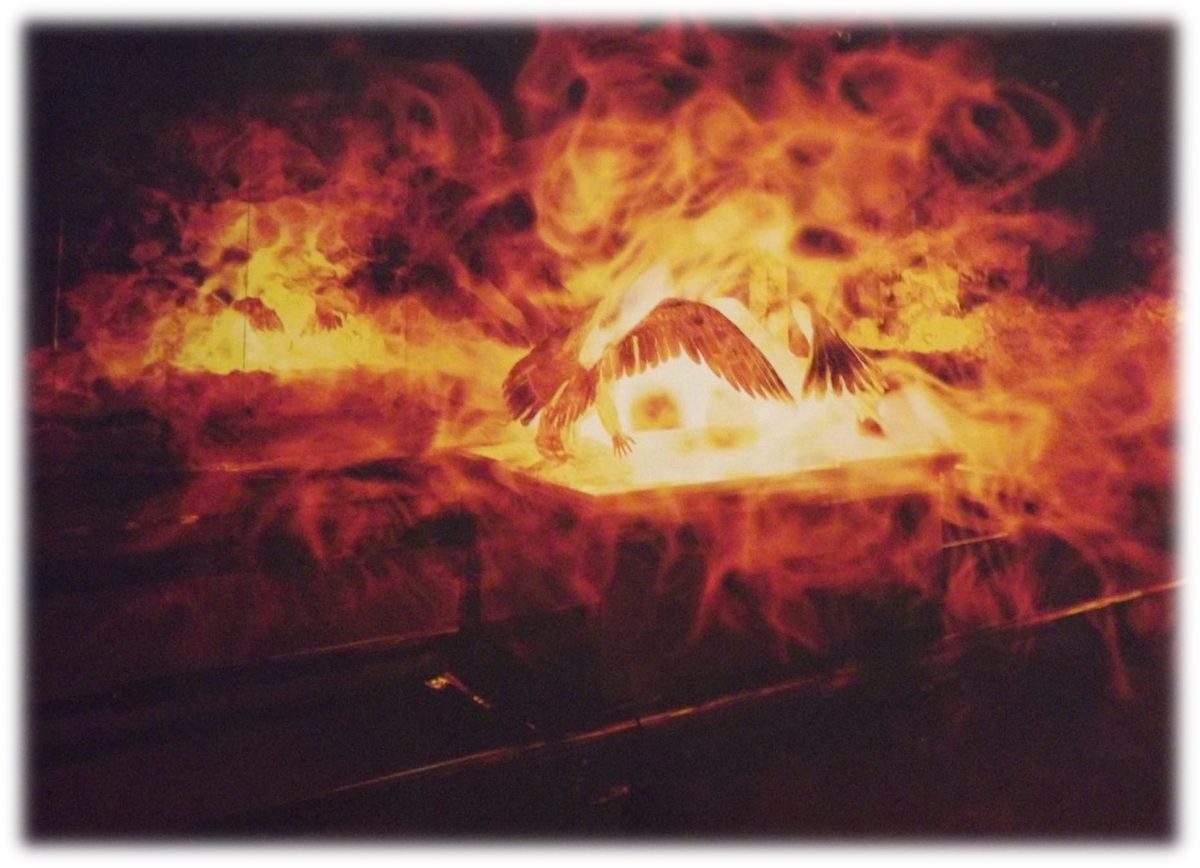
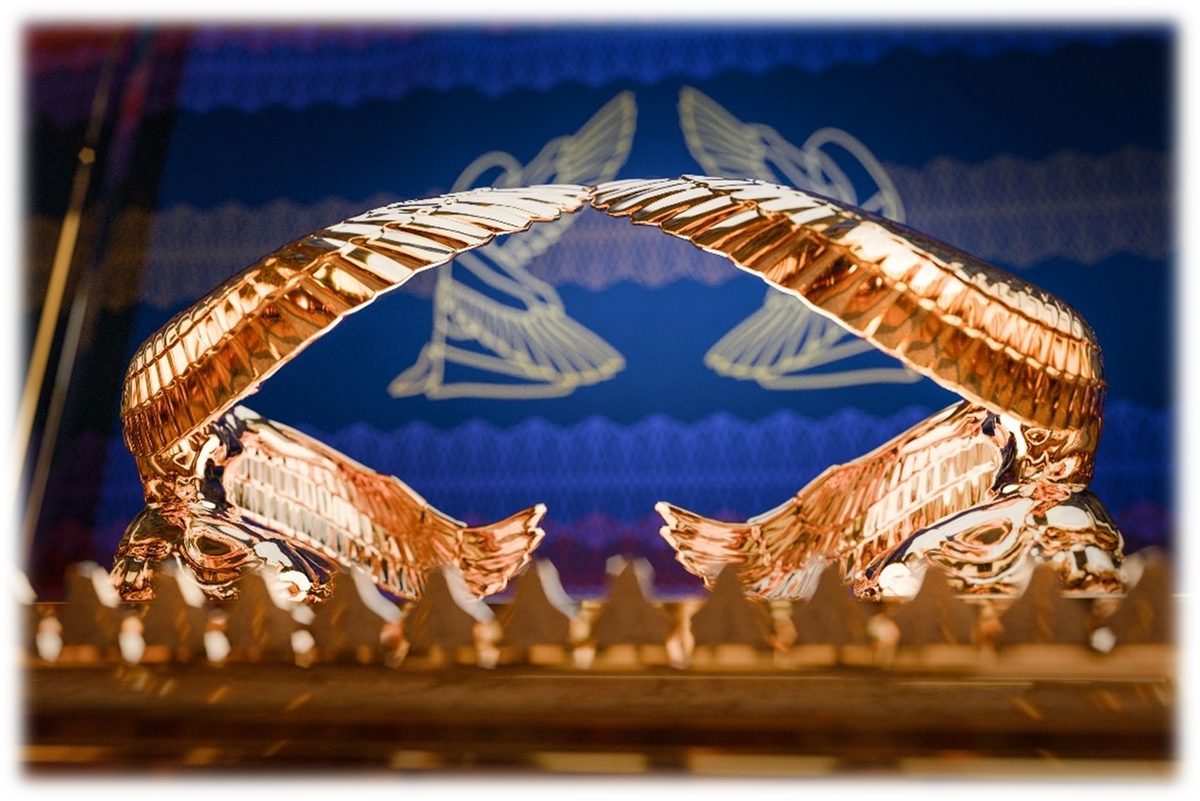
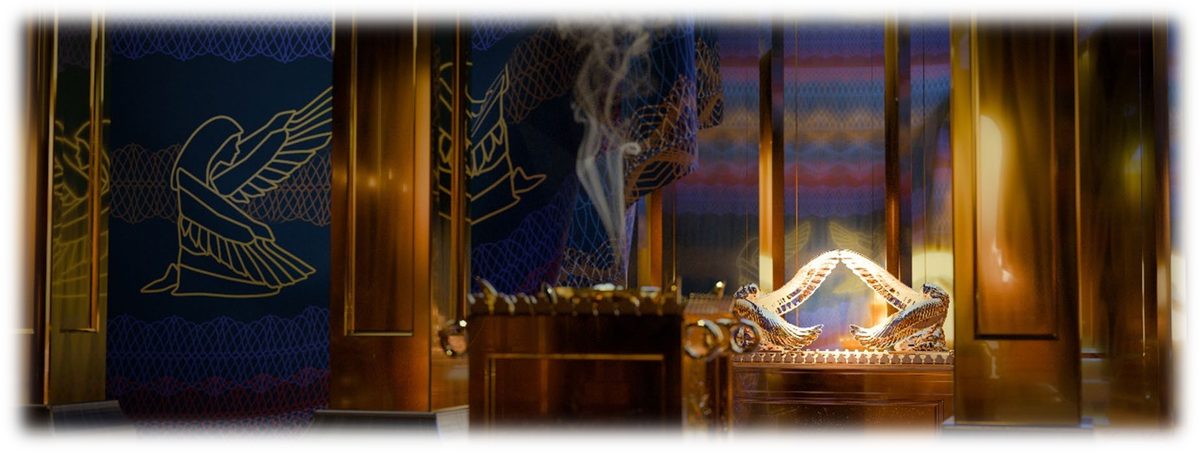
Figure 3. The Shekinah: the Mercy Seat and its cherubim enveloped in fire, picturing the present, dynamic glory of God that inhabited the Tabernacle and the Temple in the cloud and the fire (book, page 28).
Shekinah is the term for the present, dynamic glory of God that inhabited the Tabernacle and the Temple, as seen in the cloud and the fire; it means “that which dwells” or “that which inhabits”. The word itself is not found in the Bible: it first appears in the Jewish Targums, which probably began to be compiled in Ezra’s day. The point of the word study is this: the Shekinah has to dwell in the mishkan in order for it to be the dwelling place of God. God’s presence has to be in God’s house.
Who shall abide in thy tabernacle?
Under the Old Covenant God alone resided in the Tabernacle, for man could not exist in close proximity to God. Under the New Covenant a way was opened to allow us to enter into a cohabitation with God, to dwell in His house (and for God to dwell in our house), and this is what is foreshadowed in Psalm 15 and Psalm 24, and elsewhere in the Old Testament:
Psalm 15:1 LORD, who shall abide in thy tabernacle? who shall dwell in thy holy hill?
Psalm 24:3 Who shall ascend into the hill of the LORD? or who shall stand in his holy place?
These are strange statements to be made by people who could not “live” in the physical Tabernacle or Temple, and David presses further still: “that I may dwell in the house of the LORD all the days of my life” [Psalm 27:4–5], and “I will abide in thy tabernacle for ever” [Psalm 61:4]. These declarations were prophetically foreshadowing a time when we could inhabit the house of God, and the truest and most complete finality of this promise will come after the Millennial Reign, when God Himself comes to dwell among men:
Revelation 21:3 And I heard a great voice out of heaven saying, Behold, the tabernacle of God is with men, and he will dwell with them, and they shall be his people, and God himself shall be with them, and be their God.
The mysteries hidden in the design, and the seven titles
Hidden within the design of the Tabernacle are symbolic mysteries, and we list a sample of them here so that we know what we are going in to find.
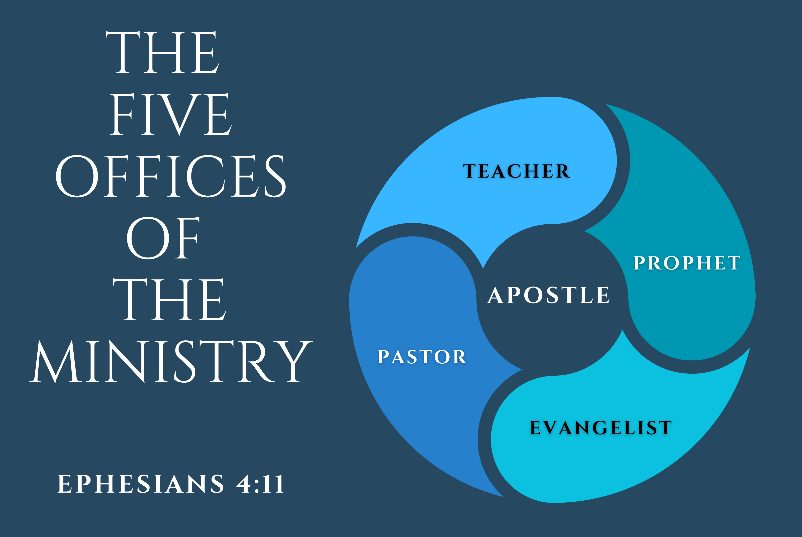
Among the mysteries hidden in the design: the precise details of the foreordained plan of salvation; the door of faith and repentance; the blood covering; water, Spirit and fire baptisms; the number and nature of the spiritual heavens; the first and second earth (the old earth and the new); the number of biographical Gospels written about Jesus; the length of time Israel would be under the Mosaic Law; the length of the Church Age, or Age of Grace, and of the Millennial Reign; the five offices of the ministry; the sevenfold light of God; the progressive path of access to the throne of God; and many more.
Seven titles are used for the Tabernacle in the Scripture:
Table 2. The seven titles used for the Tabernacle.
The instructions for the building of the Tabernacle are in Exodus 25–31, and the account of the building in Exodus 35–40.
The precise pattern of design
Since the earthly Tabernacle was a shadow of the true Tabernacle in heaven, and a foreshadowing of God’s plan and order, it had to be built according to the precision measurements that God revealed to Moses. The command is repeated at every stage [Exodus 25:40; 26:30; 27:8; Acts 7:44], and Paul rests his teaching on it:
Exodus 25:8–9 And let them make me a sanctuary; that I may dwell among them. According to all that I shew thee, after the pattern of the tabernacle, and the pattern of all the instruments thereof, even so shall ye make it.
Hebrews 8:5 Who serve unto the example and shadow of heavenly things, as Moses was admonished of God when he was about to make the tabernacle: for, See, saith he, that thou make all things according to the pattern shewed to thee in the mount.
Its spiritual anti-type, the New Covenant order of God in our day, has to be precision-built to His exact standards as well. We cannot build God’s work in our lives or in the corporate church according to our own preferences: the benchmark has already been set, and we have to discover the precise biblical blueprint of the Early Church, not the maladjusted miscalculations, misinterpretations and tainted traditions that underlie many nominal churches today. Jesus is the ultimate, preeminent measure that has to be modeled after and met, “the measure of the stature of the fulness of Christ” [Ephesians 4:13], and he set the standard of complete purity, a lamb without spot [1 Peter 1:19], and the church, his Body, has to rise to that same measure: a glorious church “not having spot, or wrinkle, or any such thing” [Ephesians 5:27], the Bride in whom there is no spot [Song of Solomon 4:7].
Dimensions of the Tabernacle as related to the plan of salvation
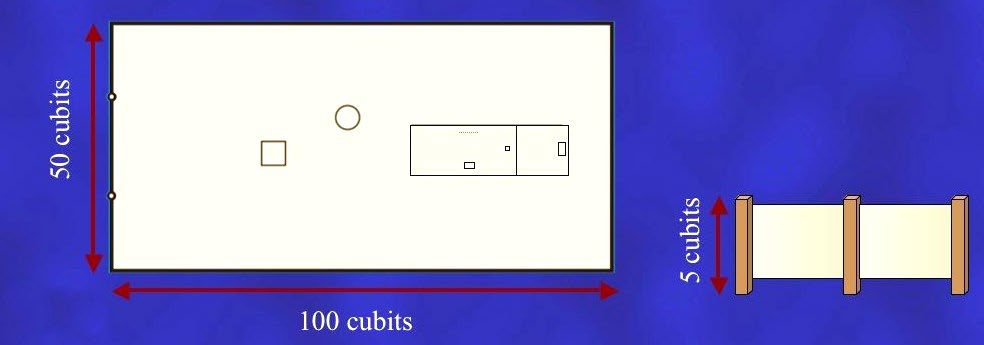
The measurements lay out, in cubits, the timeline of the plan of salvation. The perimeter of the Outer Court is 300 cubits (two sides of 100 cubits, two of 50), and 300 multiplied by the 5-cubit height of the linen wall equals 1500: the 1500 years from the giving of the Law of Moses (the Old Covenant) in the 1400s B.C. to Christ and the New Covenant in the first century A.D.
Figure 1. The Outer Court, 100 cubits by 50, and its linen wall of 5 cubits: 300 multiplied by 5 gives 1500 (book, page 34).
In a spiritual sense, before the New Covenant the people of God could only operate in what we describe as a “first heaven” state. As we will see, the Bible describes three “heavens”, each a progressively higher plane of spiritual existence, so we sometimes refer to the Outer Court as “first heaven”: the first heavenly state of relationship with God attainable by man, entered through faith. The sacrifices of the Old Covenant could cleanse certain external sins, but they had neither the purpose nor the power to take Israel on to full perfection, for “the law made nothing perfect” [Hebrews 7:19; 10:1–10]. With the death and resurrection of Christ and the giving of the Holy Spirit, man could progress beyond first heaven into a second heaven (the Holy Place) and a third heaven (the Holy of Holies) relationship with God. The blood of bulls and goats kept Israel in first heaven under the Law; under grace we enter it through faith in Christ and his precious blood.
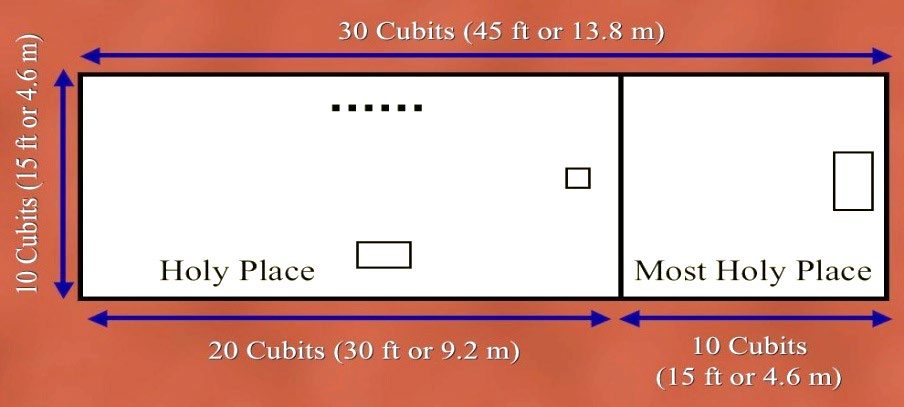
The Holy Place was 20 cubits long by 10 wide by 10 high, a cubed total of 2000: the 2000 years of the Day (or Age) of Grace, from the New Covenant at the death and resurrection of Christ to the Millennial Reign. The Most Holy Place, 10 by 10 by 10, gives 1000, the Millennial Reign of Christ [Revelation 20:1–7; Isaiah 65; Zechariah 14]; the entire building, 30 by 10 by 10, gives 3000, from Christ’s redemptive sacrifice until the end of the Millennial Reign and the New Heavens and the New Earth.
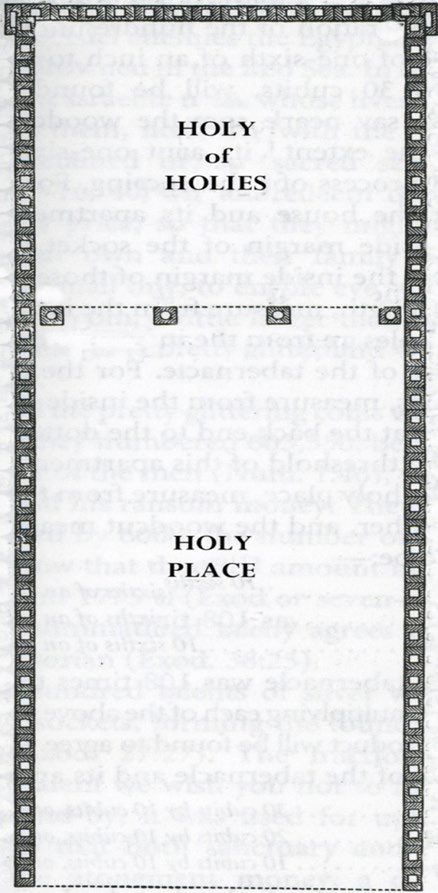
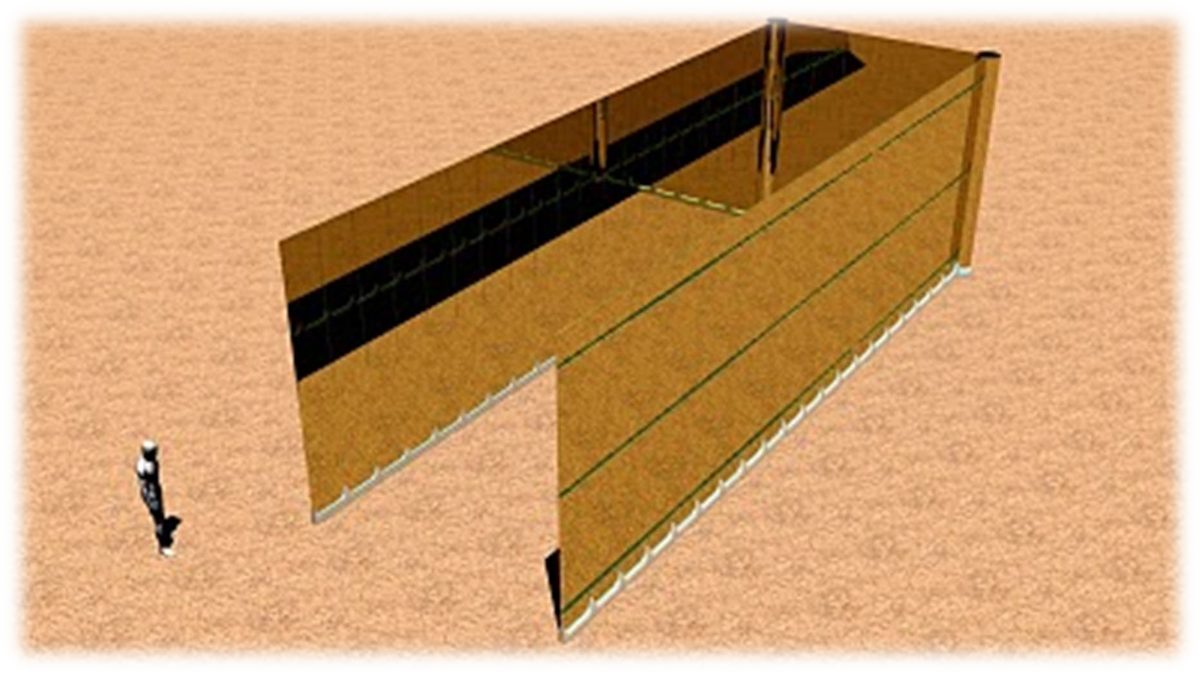
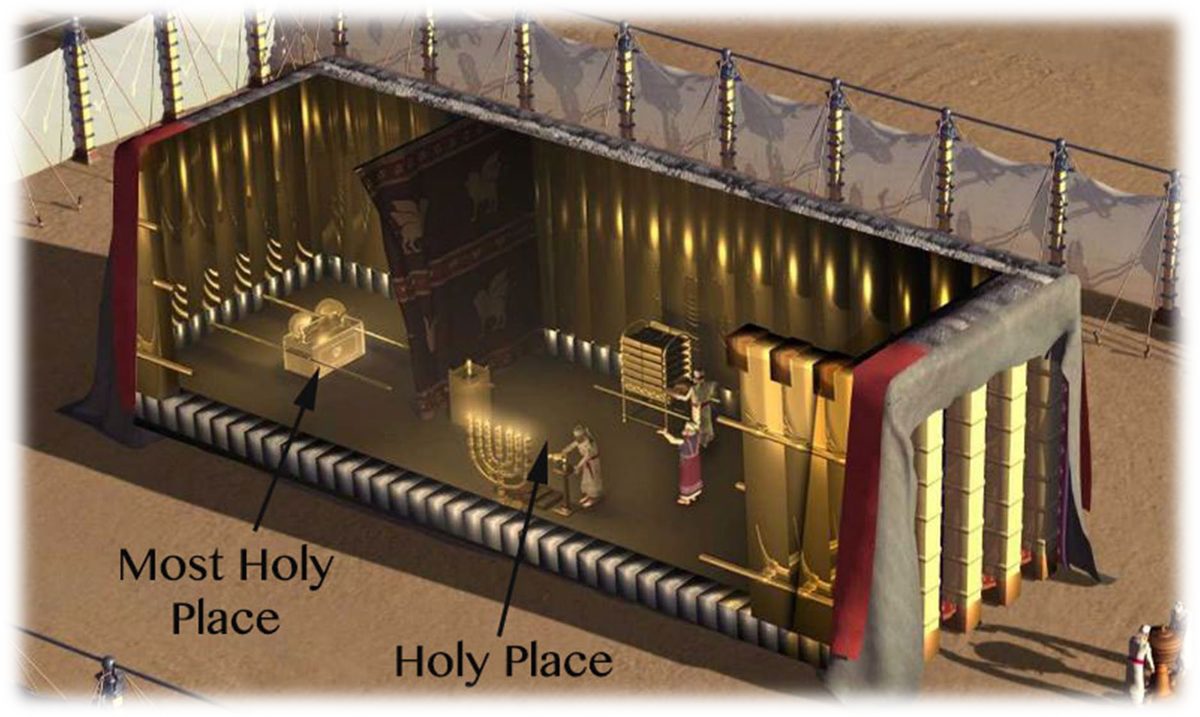
Figure 2. The Tabernacle building, 30 cubits (45 feet) by 10 (15 feet): 20 cubits of Holy Place, 10 of Most Holy Place (book, page 37).
Table 1. The dimensions of the Tabernacle and the periods they symbolize.
Area
Measurement
Sum
Period
Outer Court
perimeter 300 × wall 5 cubits
1500
the Law to Christ
Holy Place
20 × 10 × 10 cubits
2000
the Day of Grace
Most Holy Place
10 × 10 × 10 cubits
1000
the Millennial Reign
The whole building
30 × 10 × 10 cubits
3000
Christ’s sacrifice to the New Earth
The designer and the builders of the Tabernacle
God was the Architect who designed and delivered the blueprint; Moses was the contractor who was given the plan; Bezaleel and Aholiab were the subcontractors who carried out the principal labor. God gave Moses the plan on Mount Sinai, it appears in a vision, with the precise measurements and materials [Numbers 8:4; Acts 7:44]. God called Bezaleel and Aholiab by name as the principal workmen:
Exodus 31:1–6 And the LORD spake unto Moses, saying, See, I have called by name Bezaleel the son of Uri, the son of Hur, of the tribe of Judah: And I have filled him with the spirit of God, in wisdom, and in understanding, and in knowledge, and in all manner of workmanship, … And I, behold, I have given with him Aholiab, the son of Ahisamach, of the tribe of Dan: and in the hearts of all that are wise hearted I have put wisdom, that they may make all that I have commanded thee;
Other men worked under them, “every wise hearted man, in whom the LORD put wisdom” [Exodus 36:1–2]: all who were involved were Spirit-anointed, the common laborers included. In the anti-type, the building of the New Covenant church, God not only needs the five offices of the ministry [Ephesians 4:11]; He needs wise-hearted people to assist them in the labor. He fills us with His Spirit for the same reason He filled these men: so that we might complete the building of the church according to the perfect pattern laid down by Christ, its Head.
Bezaleel was the senior overseer, with Aholiab as his assistant. Bezaleel means “in the shadow of God”, and Aholiab “the father’s tent”. Bezaleel was filled, to some measure, with at least four of the seven Spirits of God of Isaiah 11:1–2[Exodus 35:31], and his hands made the Ark, the Table, the Lampstand, the Golden Altar and the Brazen Altar [Exodus 37:1–38:1]. He was the grandson of Hur, according to Josephus the Hur who stayed up Moses’ hands against Amalek [Exodus 17:10–13] and the husband of Miriam; if so, Bezaleel had the blood of both Judah and Levi in his veins.
Theoretical typological symbolism of the builders
Moses was the general contractor directing the work, and the principal intermediary between God and the children of Israel. Jesus is the anti-typical fulfillment of Moses in the building of the church: he is not only the builder of the house [Matthew 16:18]; he is the master of the house, The BRANCH who “shall build the temple of the LORD” and “shall be a priest upon his throne” [Zechariah 6:12–13], the “counsel of peace” between them both being most likely the combining of the kingly and priestly offices in the one person of Christ. Moses was faithful as a servant, “But Christ as a son over his own house; whose house are we” [Hebrews 3:5–6], and behind both stands God, the grand Architect of the design, whose work is carried out by His agents.
Bezaleel may be a type of the Early Church apostolic ministry, under whose direct order the Body of Christ was built, and Aholiab the other offices of the ministry under that apostolic government. Some believe Bezaleel is a type of Christ, but Moses fits Christ’s role more precisely. Some have taught that Bezaleel is the Early Church ministry and Aholiab the ministry of the latter-day church we are seeking to restore; that is less likely, because Bezaleel and Aholiab worked hand in hand at the same time, whereas the Early Church and Latter Church ministries did not.
The building method
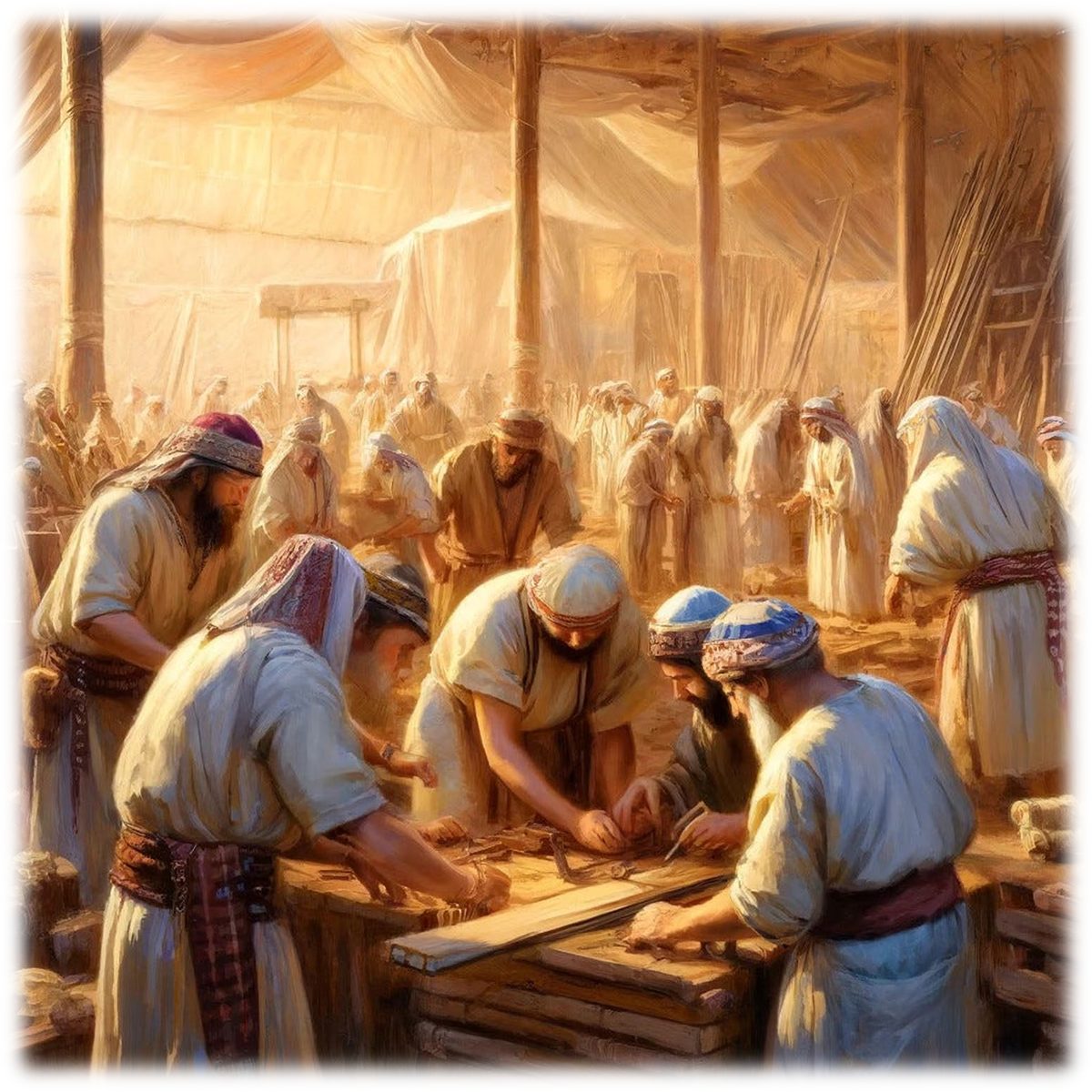
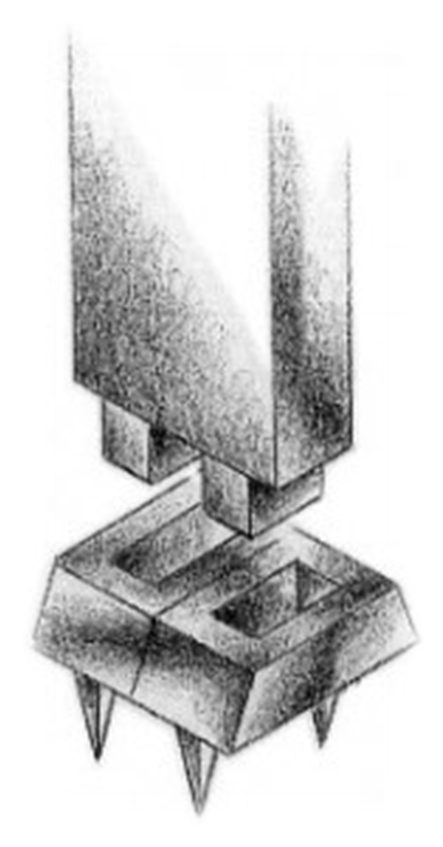
The Tabernacle was built without nails, screws, glue or any other fasteners: its parts snapped together or locked into one another like puzzle pieces. Spiritually, that is exactly how the Body of Christ has to be built: not held together by man’s fasteners, a social spirit, a carnal spirit, a spirit of entertainment or even a spirit of false love; but by the purity and power of the love of its members for God and for one another, love without dissimulation [Romans 12:9]. Love is the spiritual glue that fastens the Body of Christ together, “the bond of perfectness” [Colossians 3:14; 1 John 4:7–12]:
Ephesians 4:16 From whom the whole body fitly joined together and compacted by that which every joint supplieth, according to the effectual working in the measure of every part, maketh increase of the body unto the edifying of itself in love.
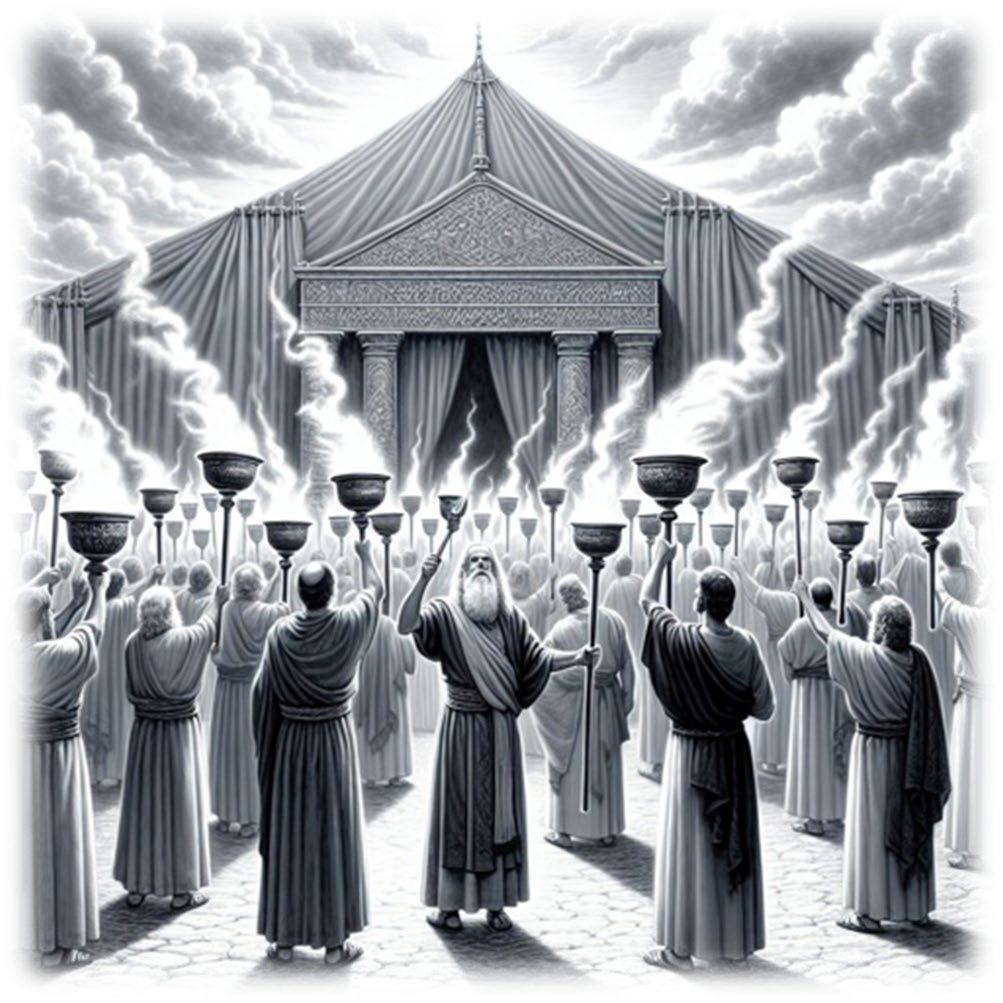
Figure 3. The workmen fitting the parts of the Tabernacle, a construction held together without nails, screws or glue (book, page 44).
The building materials
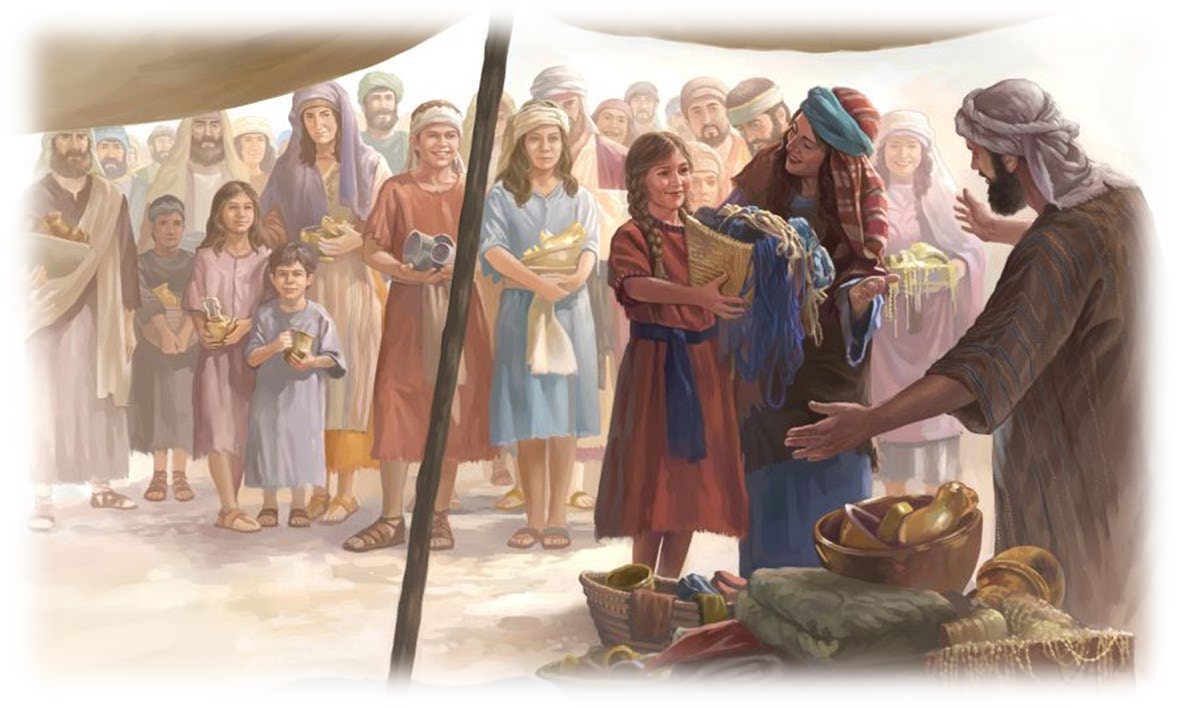
The materials were supplied by the people of Israel, and in our day God’s people themselves are the primary materials of the church: given wholly to Him, we become a living sanctuary for Him to dwell in and lively stones He can build with [1 Peter 2:4–5]. The materials came out of the treasures of Egypt, for Israel spoiled the Egyptians when they fled, as God had commanded [Exodus 3:21–22; 12:35–36], and gave them as a willing offering [Exodus 25:1–8; 35:4–29]. God is seeking a people who give willingly of their time, talent and increase, by choice rather than by dictate.
Figure 4. The willing offering of Exodus 35: the people bringing their jewels of gold and their cloth to the work (book, page 47).
The Hebrew word translated “offering” here is terumah, something offered up, in the sense of raising it up in your hands to God, from the root rum, “to be high or raised up”. A true offering is a sacrifice lifted up to God, out of an inward awareness that what you offer Him was given to you by Him in the first place: Israel was destitute in Egypt and left laden with the treasures of their former masters. The people were so generous that Moses had to order them to stop, for “the stuff they had was sufficient for all the work to make it, and too much” [Exodus 36:5–7].
Timeline of the construction
The Bible is not specific about when the construction began or how long it took. Some ancient scholars believed it took nine months, paralleling human gestation: nine months did pass from Israel’s arrival at Sinai to the completion [Exodus 19:1; 40:2], but that included Moses’ sojourns on the mount, and if those nine months symbolize a spiritual gestation, they run from the first Pentecost at Sinai, the national birth of Israel, to the completed Tabernacle. About six to seven months is most likely:
Table 2. From the Exodus to the raising of the Tabernacle.
Stage
Passage
Almost 50 days from the Exodus to Sinai
Exodus 19:1
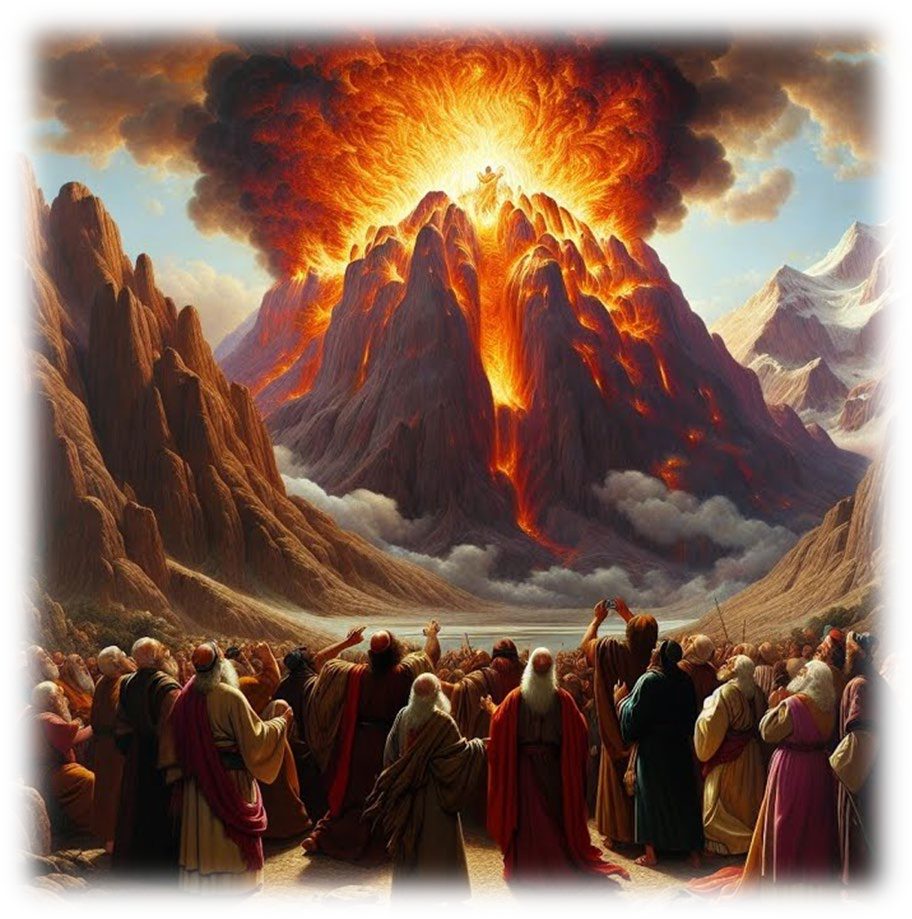
The LORD descends on the third day
Exodus 19:10–11
Moses on the mount forty days; the pattern given
Exodus 24:18; 25–31
The golden calf
Exodus 32
A temporary tabernacle outside the camp (not the Tabernacle)
Exodus 33:7
A second forty days; Moses descends with shining face and dons the veil
Exodus 34:4, 28
The Law and the pattern given to Israel
Exodus 35
The Tabernacle reared up, first day of the first month, second year
Exodus 40:17
Thus there was one year, minus about 15 days, between the Exodus and the raising of the Tabernacle; subtracting the 15 days to Passover, the 50 days to Pentecost and the 80 to 90 days until the pattern was given to Israel, the Tabernacle could not have taken more than seven months to complete.
Moses’ approval and blessing of the Tabernacle
When the work was finished, Moses put his final seal of approval on it and blessed the people: “they had done it as the LORD had commanded, even so had they done it: and Moses blessed them” [Exodus 39:32–33, 43].
Final purification and sanctification
When completed, the Tabernacle was sprinkled with blood, anointed with oil and sanctified, and the altar was dedicated with offerings made by the princes of the twelve tribes [Hebrews 9:19–21; Numbers 7:1–2]: each prince brought a silver charger and a silver bowl full of fine flour mingled with oil, a golden spoon full of incense, a burnt offering, a sin offering and peace offerings [Numbers 7:13–17].
God’s final approval and blessing
When all was completed, the Lord descended on it in glory:
Exodus 40:34–35 Then a cloud covered the tent of the congregation, and the glory of the LORD filled the tabernacle. And Moses was not able to enter into the tent of the congregation, because the cloud abode thereon, and the glory of the LORD filled the tabernacle. The cloud was on the Tabernacle by day and fire by night, throughout all their journeys [Exodus 40:36–38].
The three divisions of the Tabernacle
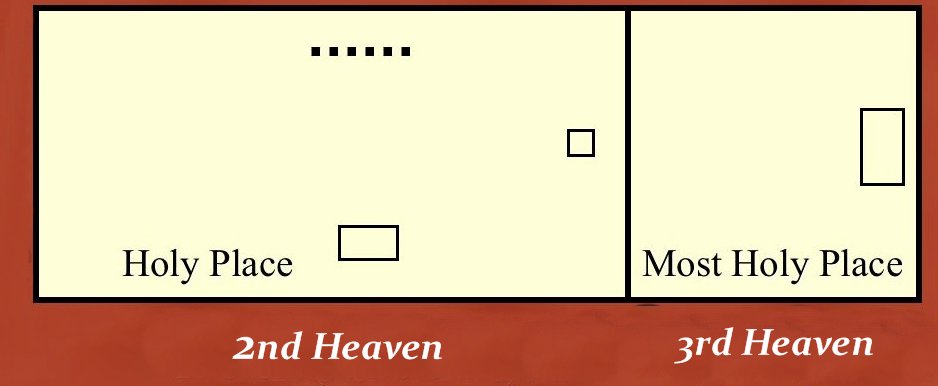
The Outer Court symbolizes a first heaven state, a relationship with God by faith without further spiritual development: the place of physical sacrifice, blood covering and salvational faith, entered by faith and repentance at the Brazen Altar, the washing of the word at the Laver then preparing a believer for the Holy Place. The Holy Place symbolizes a second heaven state, being “in the Spirit”: the place of the Spirit’s covering, operation and spiritual sacrifice, entered by Holy Spirit baptism, which opens the light of the Lampstand, the greater truths of the shewbread and the spiritual sacrifice of the Golden Altar; priests and Levites only under the Old Covenant, all the people of God under the New. The Holy of Holies symbolizes a third heaven state, complete spiritual maturity with a morally perfect nature: the “throne room” of God, closed under the Old Covenant, open under the New to all who go on to perfection and overcome the old nature.
Figure 5. The three divisions and the heavens they picture: the Courtyard first heaven, the Holy Place second, the Holy of Holies third, and the camp of Israel outside as first earth (book, page 54).
Class Four · The Encampment of Israel about the Tabernacle
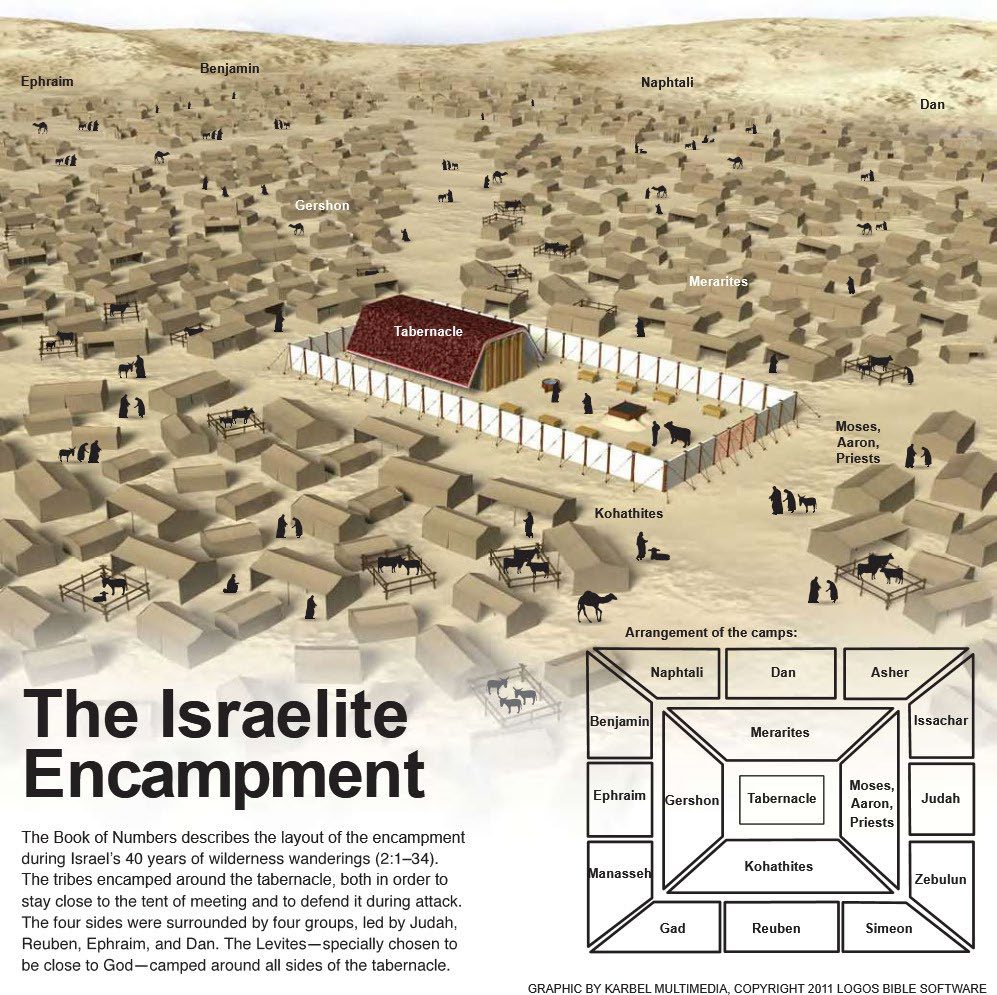
Figure 1. The Israelite encampment: the Tabernacle in its linen court at the center, the families of Levi nearest it, and the twelve tribes camped on all four sides, with an inset plan of the camps (book, page 55).
The Tabernacle’s location in the camp of Israel
Numbers 2:17 Then the tabernacle of the congregation shall set forward with the camp of the Levites in the midst of the camp: as they encamp, so shall they set forward, every man in his place by their standards.
The Tabernacle stood in the midst of the camp of Israel, and the camp of Israel is a symbolic type of First Earth, a term we use to refer to the entire Earth in a cultural and sociological sense, as well as to the world of mankind in general. The Tabernacle was to be in the camp, but separate from the camp, and the church, the people of God, are to be in the world but not of the world [Romans 12:2; Colossians 3:1–3; 1 John 2:15–17]:
2 Corinthians 6:17–18 Wherefore come out from among them, and be ye separate, saith the Lord, and touch not the unclean thing; and I will receive you, And will be a Father unto you, and ye shall be my sons and daughters, saith the Lord Almighty.
The Israelites in the camp were to come up to the Tabernacle to worship, and the spiritual lesson of this is that the children of God have to come up to a higher place to approach God, to ascend out of the dark valley of this present world to the mountain of the Lord’s House. Mankind will come up to the House of God during the Millennial Reign [Micah 4:1–3; Jeremiah 31:6]:
Isaiah 2:2–3 And it shall come to pass in the last days, that the mountain of the LORD’s house shall be established in the top of the mountains, and shall be exalted above the hills; and all nations shall flow unto it. And many people shall go and say, Come ye, and let us go up to the mountain of the LORD, to the house of the God of Jacob…
The camp of Israel as a type of First Earth: the present world of mankind
First Earth is the place of man’s carnal society and culture, and before we come into the Kingdom of God by faith, all of us begin out in the world. If the inner parts of the Tabernacle complex may be seen as symbolic of First, Second and Third Heaven, picturing the different spiritual stages of a relationship with God, then the camp of Israel, outside the Tabernacle precincts, could be seen as the spiritual place that the world, outside a relationship with Him, is in.
Symbolically, First Earth and First Heaven will one day pass away: the societies, cultures, civil systems and governments that constitute this present carnal world will be removed so that they can be replaced by a New Heaven and a New Earth, a new civil and religious system established by and ruled over by Christ and his Bride, under the auspices of the Almighty [Matthew 24:35; Psalm 102:25–28; Isaiah 51:6; Isaiah 65:17; Hebrews 1:10–12; 2 Peter 3:7–13; Revelation 20:11].
Revelation 21:1 And I saw a new heaven and a new earth: for the first heaven and the first earth were passed away; and there was no more sea.
That is not the destruction or replacement of the physical earth; it is a removal and replacement of the present earthly civil and religious systems tainted by carnal mankind. The physical earth was created to last forever, unlike the carnal civil powers of man: “the earth abideth for ever” [Psalm 78:69; Psalm 104:5; Ecclesiastes 1:4]. The New Earth will replace First Earth, beginning with the establishment of the government of Christ during the Millennial Reign and culminating after the Second Resurrection and the final White Throne Judgment of Revelation 20. Other scriptures describe this judgment and removal [Isaiah 34:4; Isaiah 54:10; Isaiah 66:22; Revelation 6:12–17], and some of them, like the sixth seal, refer to the beginning of the process that will fully remove and replace the kingdoms and religions of this earth with the Kingdom of our God and the power of His Christ [Revelation 12:10].
The dream of Nebuchadnezzar in Daniel 2 prophesies that a little stone, which pictures the latter-day church or Bride of Christ, will strike the feet of an image that represents the historical kingdoms that affected Israel, and will not only destroy them, with the present-day iterations produced by their influence, but replace them entirely by spreading out over all the Earth: the stone “became a great mountain, and filled the whole earth” [Daniel 2:34–35, 44–45]. There has been some debate over whether the little stone is the true church, called out of the mountain of religion, or the smaller group that is the Bride of Christ, the overcomers taken out of the mountain of God.
One more line completes the type. The sacrifices made at the Tabernacle atoned for the tribes of Israel, the camp around the Tabernacle, and they were fulfilled in a much greater measure under the New Covenant by Jesus, the Lamb of God, the propitiation for our sins, “and not for ours only, but also for the sins of the whole world” [John 1:29; Galatians 1:3–5; 1 John 2:2]: the whole world is a picture of the camp in its fullest sense.
The arrangement of Israel’s encampment
Numbers 2:2 Every man of the children of Israel shall pitch by his own standard, with the ensign of their father’s house: far off about the tabernacle of the congregation shall they pitch.
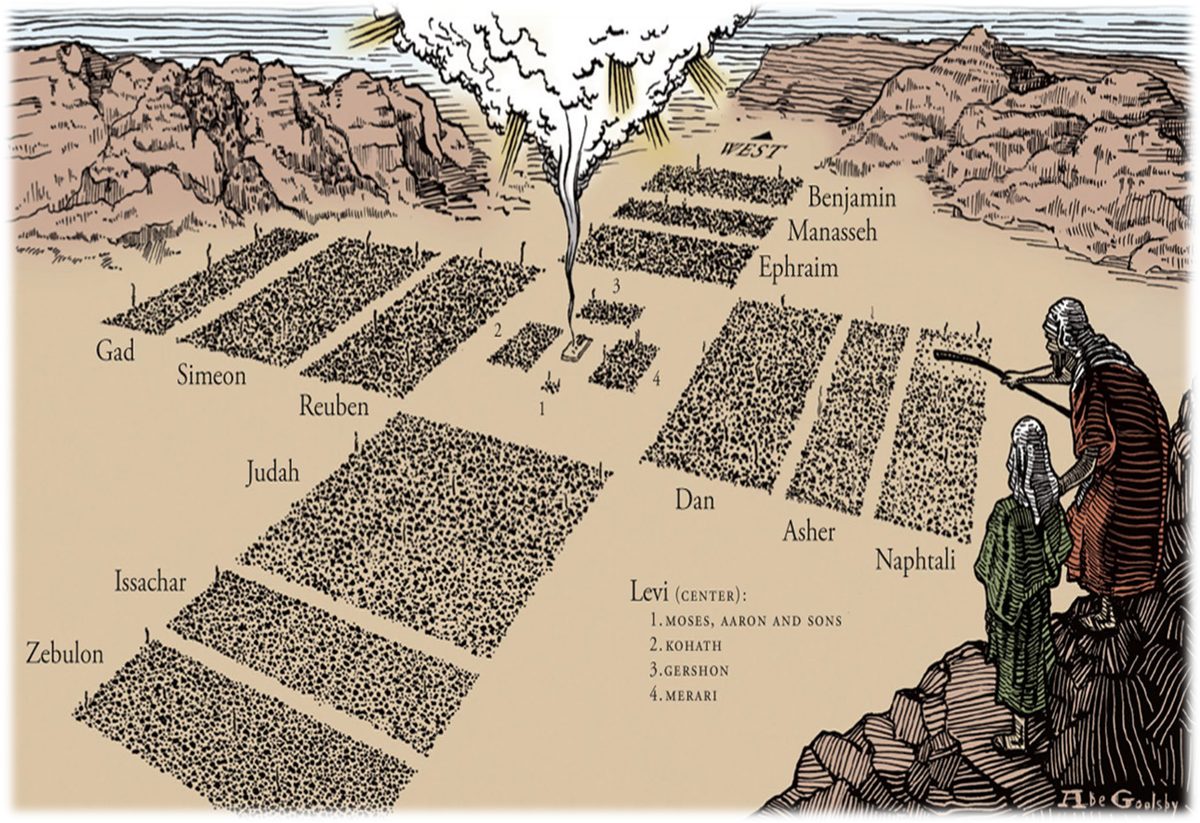
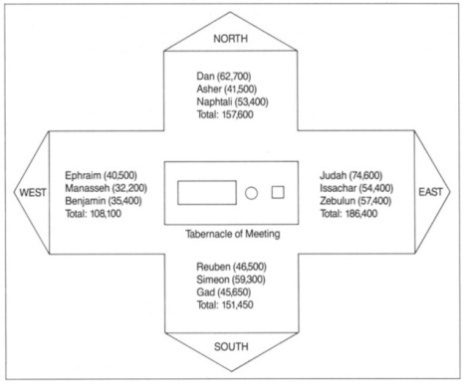
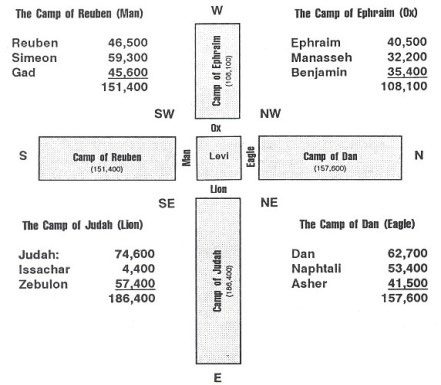
The camp of Israel was arranged in four divisions corresponding to the four points of the compass and aligned according to their tribal standards; the pictures show the order of encampment, and the table gathers it up with the totals of Numbers 2.
Figure 2. The order of encampment: the twelve tribes in their four divisions, the families of Levi in the center about the Tabernacle, and the pillar of cloud rising over it (book, page 63).
Figure 3. The four camps about the Tabernacle of Meeting, with the numbered men of each tribe and the total of each camp (book, page 64).Figure 4. The same arrangement with Levi in the middle and east at the bottom, each camp labeled with its ensign: the lion for Judah, the man for Reuben, the ox for Ephraim and the eagle for Dan (book, page 64).
Table 1. The four divisions of the camp, with the totals of Numbers 2.
Camp
Side
Tribes
Total
Camp of Judah
East, toward the rising of the sun
Judah, Issachar, Zebulun
186,400
Camp of Reuben
South
Reuben, Simeon, Gad
151,450
Camp of Ephraim
West
Ephraim, Manasseh, Benjamin
108,100
Camp of Dan
North
Dan, Asher, Naphtali
157,600
Levites
Round about the Tabernacle
Moses, Aaron and the priests; Kohath, Gershon, Merari
Each family had its own standard, and each tribe had its standard by which it camped. In a spiritual sense this pictures the world of mankind, encamped under its own nationalistic and tribalistic standards and ensigns: all its religious and philosophical sects, political systems and governments are camped under their own cultural and religious standards.
A secondary, practical picture of this kind of tribalistic division can be seen in Christendom itself, for much of Christianity is camped under its own denominational standards today. Though God’s overall Kingdom may cover, to some degree, the whole camp of Christianity, there is a smaller, inner territory where the Tabernacle sits, spiritually speaking, and there are a ministry and a people who have gone up, out of the camp of denominational Christendom, to live and work within its sacred boundaries: called out of the camp and into the Court, not to go back and forth between the Court and the camp, nor to live in the Court, but with the higher calling of going into the Holy Place and, eventually, the Most Holy Place, and going out no more: “Him that overcometh will I make a pillar in the temple of my God, and he shall go no more out” [Revelation 3:12]. This is the completion of what David longed for, to dwell in the house of the LORD for ever [Psalm 23:6; Psalm 27:4].
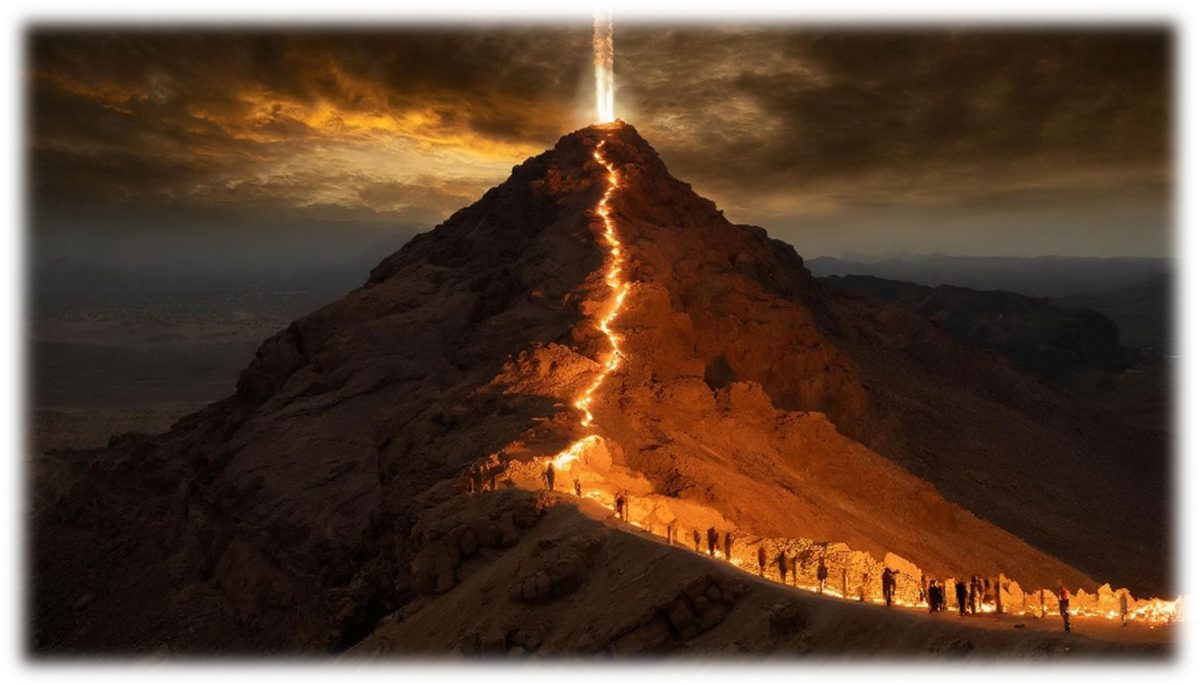
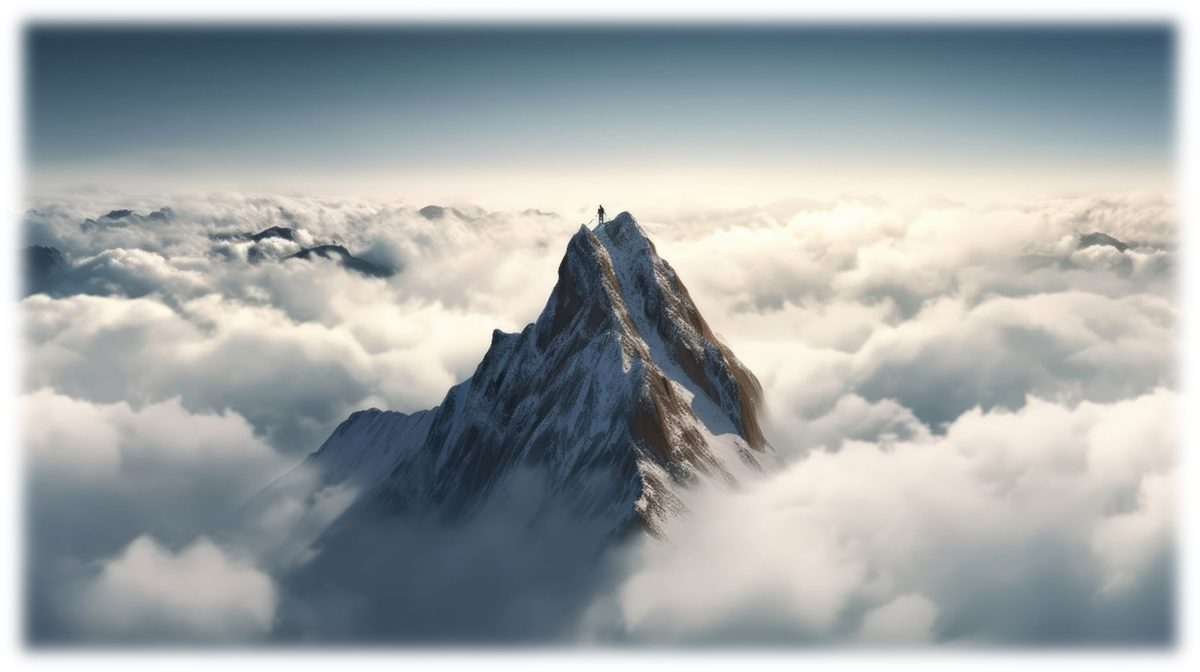
Kevin Conner combines some of these pictures another way: “camp” is a military term, natural Israel was to be the Armies of the Lord, and the Church, spiritual Israel, is the present-day camp of the saints of Revelation 20:9 under its captain, Jesus Christ. Though we agree with the heart of his points, and with the practical application he is making, the progressive nature of salvation pictured in the Tabernacle, with the camp outside and around it, necessitates our leaving the camp behind to go up higher. As we will see, the sections of the Tabernacle represent stages of spiritual progress and maturing, a path to the perfection, moral and maturational, that God is seeking in His people. Seen in a topographically spiritual way, the Tabernacle precincts and the surrounding camp might look more like a mountain to be climbed, with the camp at its base and the Holiest of All at its peak.
Figure 5. The Tabernacle and its camp seen as a mountain to be climbed: the camp at the base, the lit path of ascent, and the light of the Holiest of All at the peak (book, page 66).
One standard over the Tabernacle: the pillar of cloud and fire
There was only one standard, only one ensign, that covered the Tabernacle sitting in the midst of the camp with all its myriad standards: by day a pillar of cloud, and by night a pillar of fire over the Holy of Holies. When a temporal king is in an encampment or aboard a ship, his flag is flown above it to declare his presence, and the pillar was a statement that the King was in the camp, clear to all Israel like a flag flying high atop the mast of a ship: whether it was dark or light, God’s battle standard and the symbol of His presence was always visible, a bold declaration that He was among His people.
The pillars of the cloud and of the fire symbolized the presence of the Angel of the Lord who went before Israel, and it was through this Angel that God directed and protected His people: “the angel of his presence saved them” [Exodus 14:19–20; Numbers 20:16; Isaiah 63:9]. This Angel, who went before Israel in the pillar, was expected to be obeyed:
Exodus 23:20–21 Behold, I send an Angel before thee, to keep thee in the way, and to bring thee into the place which I have prepared. Beware of him, and obey his voice, provoke him not; for he will not pardon your transgressions: for my name is in him.
This command is particularly interesting, given the little evidence that the Angel spoke to the Israelites directly, which leads us to believe it may be a subtle hint of his identity and future activity. It is almost certain that this Angel was a Christophany: an Old Testament appearance of Christ Jesus. God sets this Angel in his place as His specially authorized and empowered agent, to be heeded and respected as if God Himself were speaking. That is what it means when God says, “My name is in him”: God’s name represents His authority, so this Angel was commissioned with the authority of God Himself over Israel. This perfectly fits Jesus, the highest agent of the Almighty, and it is the reason he is to be treated as if he were God: God’s name is in him. If this passage foreshadows the role of Christ, it is noteworthy that in the Old Covenant era this Legate of God was not authorized to pardon the transgressions of God’s people, but when Jesus came to establish the New Covenant he was empowered to do so. Paul alludes to Christ being the one who went with Israel in the wilderness:
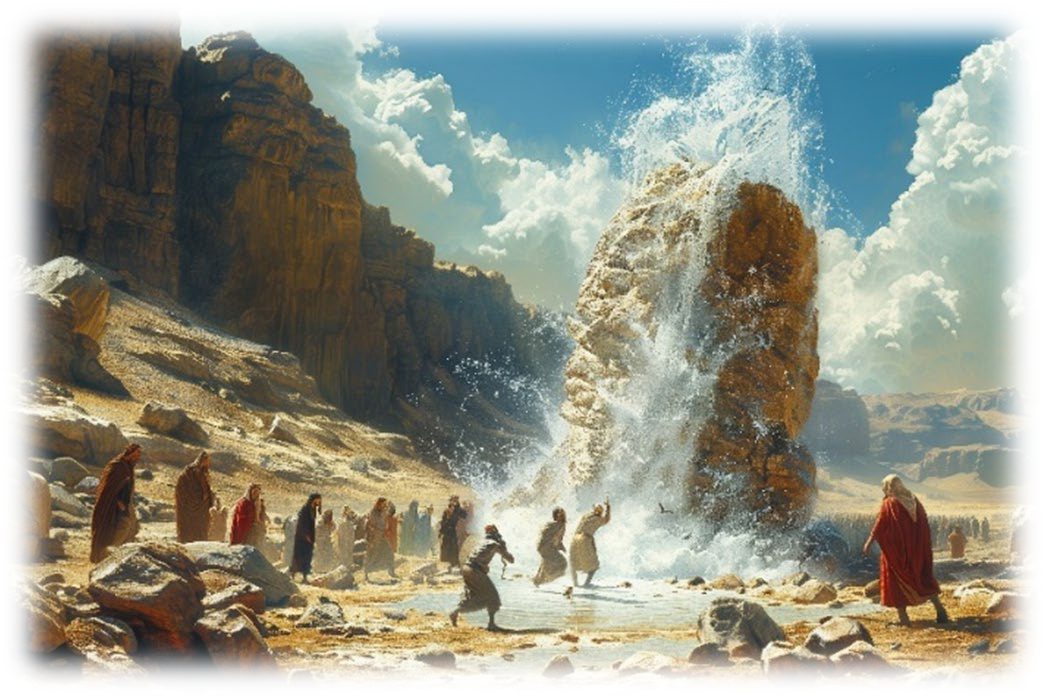
1 Corinthians 10:4 And did all drink the same spiritual drink: for they drank of that spiritual Rock that followed them: and that Rock was Christ.
Figure 6. The one standard over the Tabernacle: the pillar over the tent in the midst of the court, declaring that the King was in the camp (book, page 70).
Through the pillar God descended, and made Himself known, to His people: the LORD came down in the pillar of the cloud and stood in the door of the Tabernacle [Numbers 12:5]. The pillar is a parallel to Jacob’s ladder in Genesis 28, the ladder the angels ascended and descended on: it was the connection between heaven and earth, and it is symbolic of Jesus [John 1:51].
Entering through the camp of Judah
To approach the gate of the Tabernacle Court, you would have to pass first through the camp of Judah, for Judah’s camp was on the east, and the Tabernacle was entered from the east:
Numbers 2:3 And on the east side toward the rising of the sun shall they of the standard of the camp of Judah pitch throughout their armies: and Nahshon the son of Amminadab shall be captain of the children of Judah.
In order to enter the spiritual operation that the Tabernacle signifies, it is necessary to go through the greatest prince of Judah’s line, the Lion of the Tribe of Judah himself: Jesus Christ. There is another layer of possible meaning behind this as well: the name Judah refers to “praise”, and we have to come to and before the LORD with praise and thanksgiving, for He inhabits the praises of Israel [Psalm 22:3]:
Psalm 100:4 Enter into his gates with thanksgiving, and into his courts with praise: be thankful unto him, and bless his name.
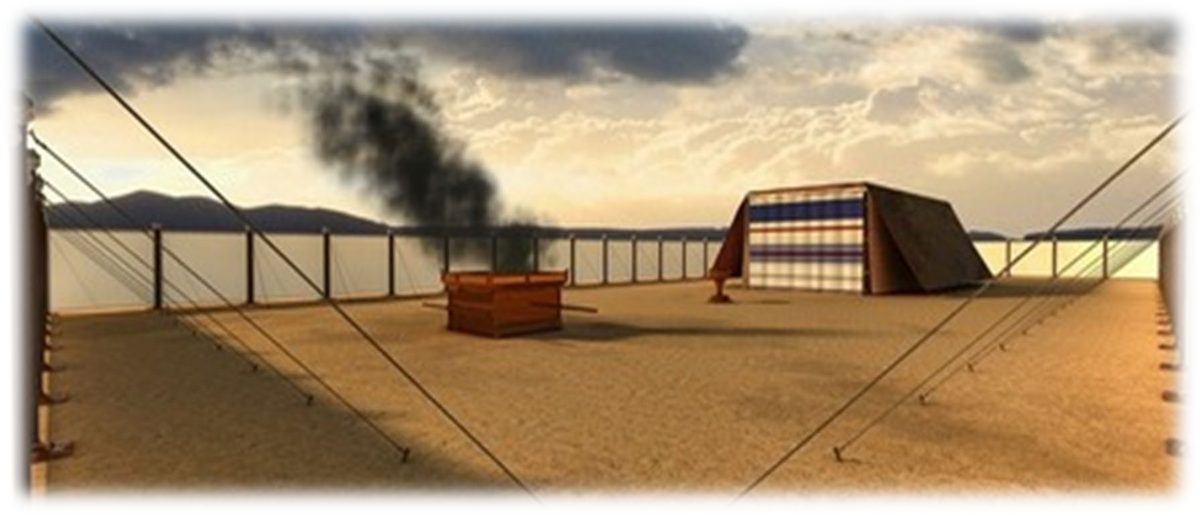
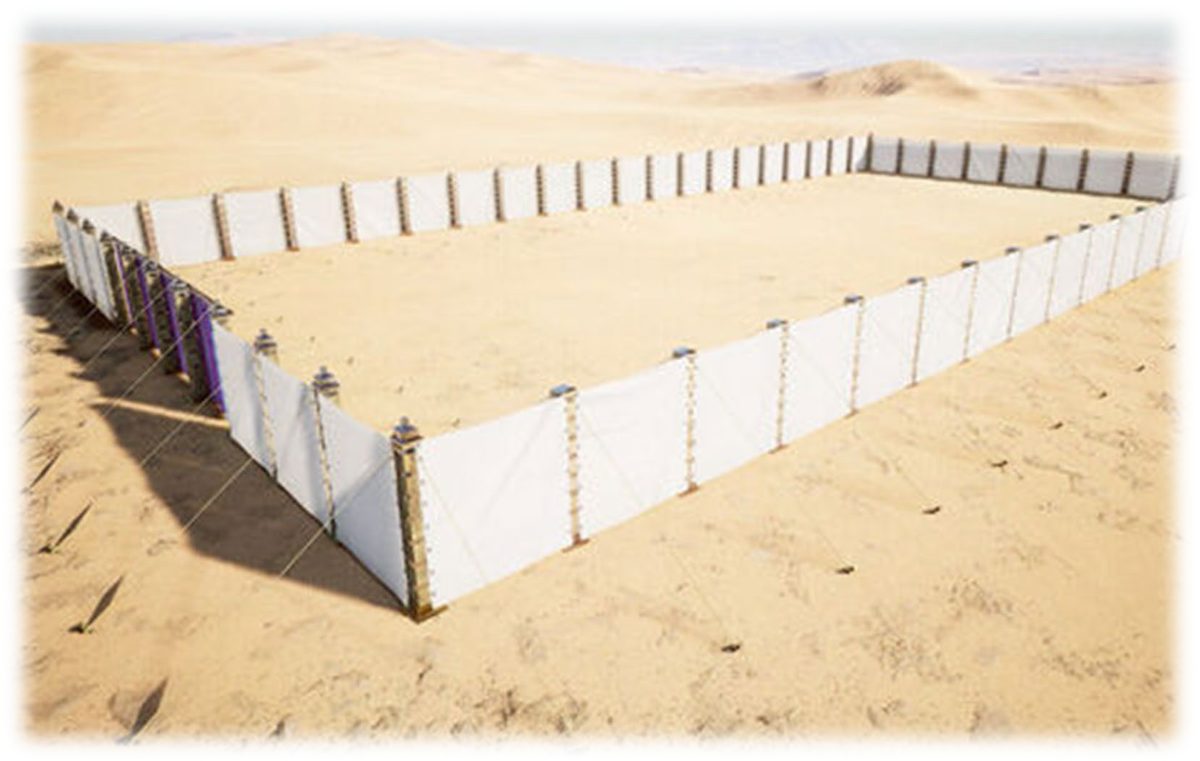
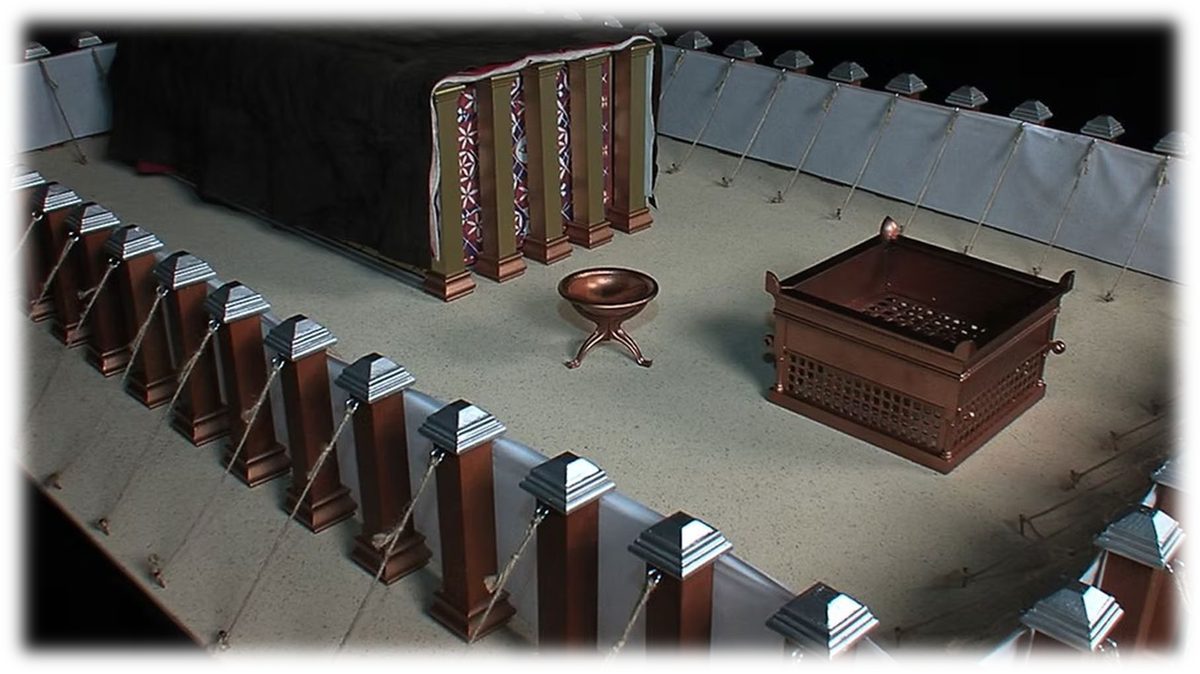
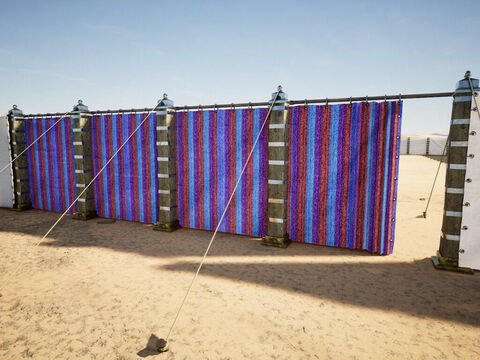
Figure 1. The Outer Court from inside the gate: the linen fence on its pillars, stayed by cords to the ground, and the Brazen Altar smoking before the building (book, page 71).
The Court as God described it
God gave Moses the whole of the Court in one passage, and every measurement, material and number in this class is in it; the cubit we use throughout is about eighteen inches, a man’s elbow to his fingertips.
Exodus 27:9–19 And thou shalt make the court of the tabernacle… All the pillars round about the court shall be filleted with silver; their hooks shall be of silver, and their sockets of brass. The length of the court shall be an hundred cubits, and the breadth fifty every where, and the height five cubits of fine twined linen, and their sockets of brass.
Table 1. The Court of Exodus 27:9–19, side by side, at a cubit of about eighteen inches.
Side
Hangings
Pillars
Sockets
South
fine twined linen, 100 cubits
20
20, brass
North
fine twined linen, 100 cubits
20
20, brass
West
fine twined linen, 50 cubits
10
10, brass
East, each side of the gate
fine twined linen, 15 cubits
3 and 3
3 and 3, brass
East, the gate
blue, purple, scarlet and fine twined linen, needlework, 20 cubits
4
4, brass
The linen fence: a wall of separation
The fence stood five cubits high, about seven and a half feet, half the height of the ten-cubit building within it and too tall for any man of that day to look over: carnal man cannot see into the plan and purpose, the order and operation of God by his own ability or understanding. The wall is the wall of separation between carnal men outside the order of God and those in a relationship with Him: to those inside, who entered by faith and repentance, a barrier of protection from the ungodly world and its judgment; to those outside, a barrier that cuts them off, though one that can be crossed by turning to God.
The Court was both exclusive and inclusive: it excluded anyone who did not enter through the door, which is Christ, and it admitted anyone who chose to enter, so that if you are excluded, you have excluded yourself. As Kevin Conner put it, to those outside the linen spoke an emphatic “Keep out!”; to the person drawn in through the Gate it became a shield, and its message changed to “Stay in!” Under the Law the barrier was literal, for “the stranger that cometh nigh shall be put to death” [Numbers 1:51; Numbers 3:38]; symbolically, you have to be in a covenant relationship with God, through faith in His Son, to approach Him.
Fine-twined linen is righteousness
Revelation 19:7–8 Let us be glad and rejoice, and give honour to him: for the marriage of the Lamb is come, and his wife hath made herself ready. And to her was granted that she should be arrayed in fine linen, clean and white: for the fine linen is the righteousness of saints. This is the white raiment of Revelation 3:4–5 and Revelation 3:18.
Fine-twined linen represents righteousness: the righteousness of Jesus and of those striving to be like him, and in a secondary sense the standards of righteousness and holiness held by the church, lines of demarcation drawn on purpose to show that the church is different from the world. If the tents of Israel were of black goats’ hair, like the tents of Kedar [Song of Solomon 1:5], the high white barrier stood in sharp contrast with the whole camp: this world has to see a standard of purity presented by the Church, not a flawed and imperfect image of Christ.
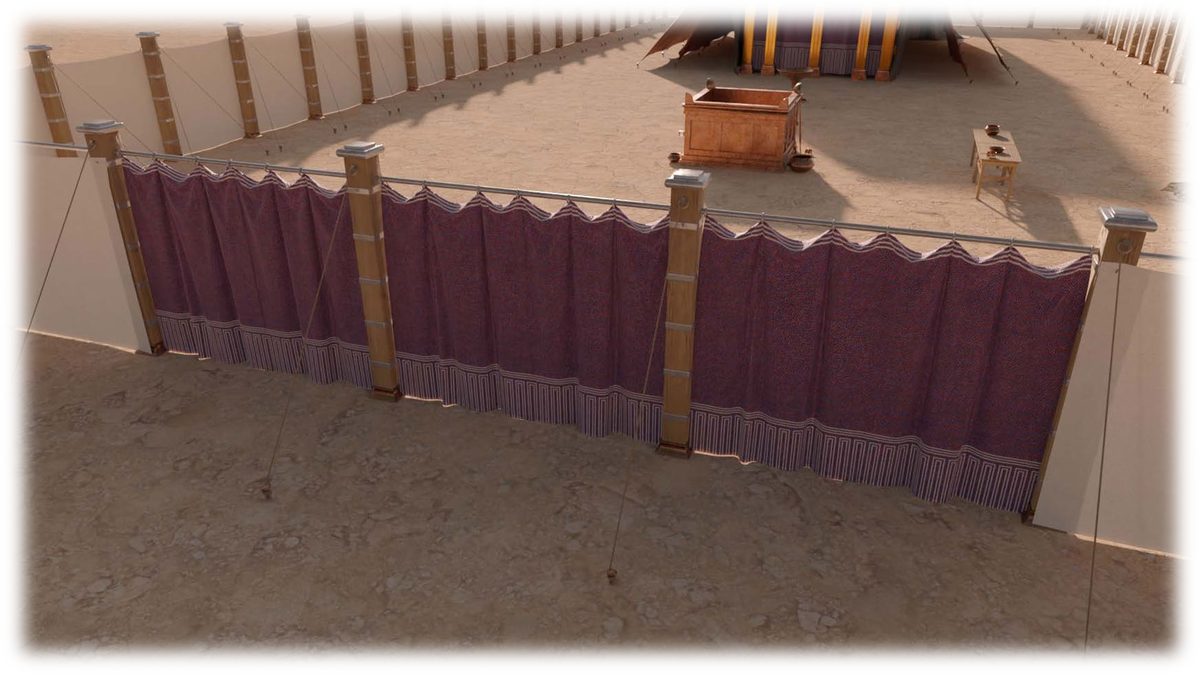
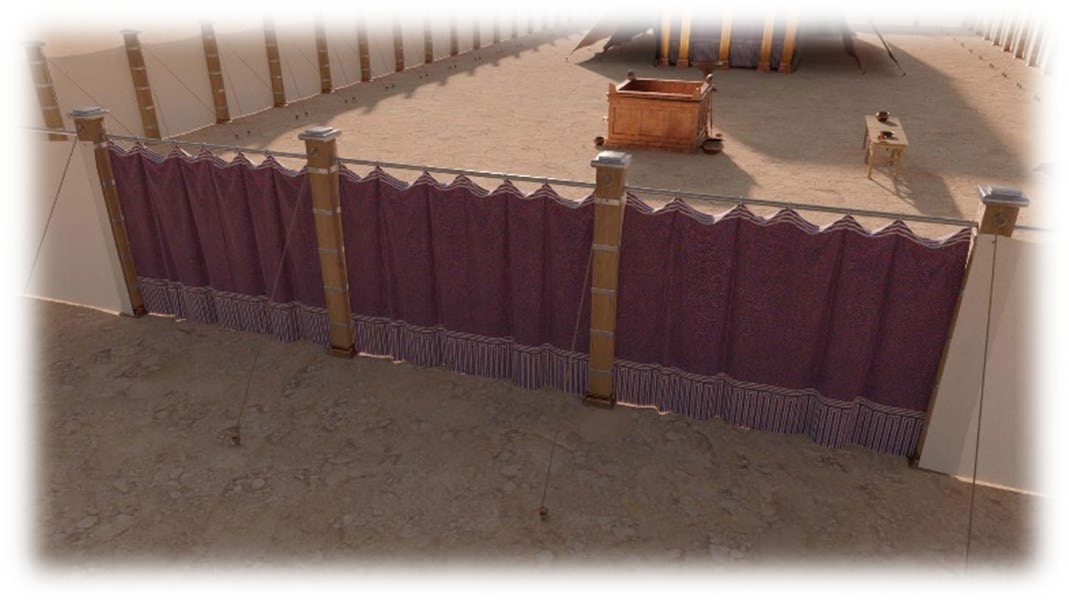
Figure 2. The whole Court from above, a hundred cubits by fifty, with the colored gate hanging in the near end (book, page 74).
The sixty brass pillars
The King James Version calls the pillars “brass”, but that is probably an anachronism: the Hebrew word translated “brass” is nekhosheth, which refers typically to bronze (copper and tin) or to copper; the copper-and-zinc brass we know was not understood until the 1200s A.D. We keep the word “brass” for uniformity with the King James Version. There were ten pillars on each short side and twenty on each long side, sixty in all, of solid brass or of wood covered with brass, set in brass sockets.
Brass is symbolic of judgment, and in particular of judgment against sin, a judgment that can be negative, punishment deserved, or positive, a person judged worthy by the merit of another. The brass pillars hold up the linen fence, and that is the picture: a righteous standard of judgment that separates us from God while we are outside a relationship with Him, and keeps us in right standing once we enter into one. Pillars are stress-bearing stabilizers, so they symbolize spiritual stability and uprightness, and being fastened to one another and to the ground they picture a unified order: anchored to the foundations of our faith and bound together in the love of God, we stay steady in the “wilderness winds” of this world.
Table 2. The symbolic pillars of the Bible.
Who is the pillar
Passage
What the pillar pictures
Jesus, with legs as pillars of marble
Song of Solomon 5:15
the load-bearing support of the plan of salvation
Jeremiah, an iron pillar and brazen walls
Jeremiah 1:18
immovable in upholding God’s standard of judgment
James, Cephas and John
Galatians 2:9
the principal powers of the Early Church, holding up the order of God
The church, the pillar and ground of the truth
1 Timothy 3:15
holding the truth up before this world, in word and in deed
The overcomers, pillars in the temple of God
Revelation 3:12
the Bride company, the support structure of the church
The last of these, Revelation 3:12, proves a doctrinal point. The overcomers, the members of the Bride of Christ, are the support structure of the church, the temple of God, and are to rule alongside Christ in a way the rest of the church will not. That they are called pillars in the temple, when the temple pictures the church, proves that the whole church is not part of the special company that constitutes the Bride: the church is the overall temple, and the Bride company are the pillars within it. Not all the members of the church are pillars now, but the perfected portion will be, taken out of his Body as Eve was taken out of Adam [Genesis 2:21–23].
The number sixty
Sixty is the number of man (6) times the number of judgment (10). It may also be the number of the ministry (5) times the number of government (12): the government of God and the five offices of the ministry are the foundational pillars on which the linen wall is hung, called to build and keep the wall of purity between the church and the carnal works of this world. The sixty pillars may also parallel the threescore valiant men about the bed of Solomon [Song of Solomon 3:7], the Hebrew mittah, a “bed”, “couch” or “litter”, which may picture the church. And 144,000, the number of the overcomers in Revelation 7 and Revelation 14, is 60 × 2,400, as the forty-eight boards give 48 × 3,000.
Silver chapiters and fillets: the price of a soul
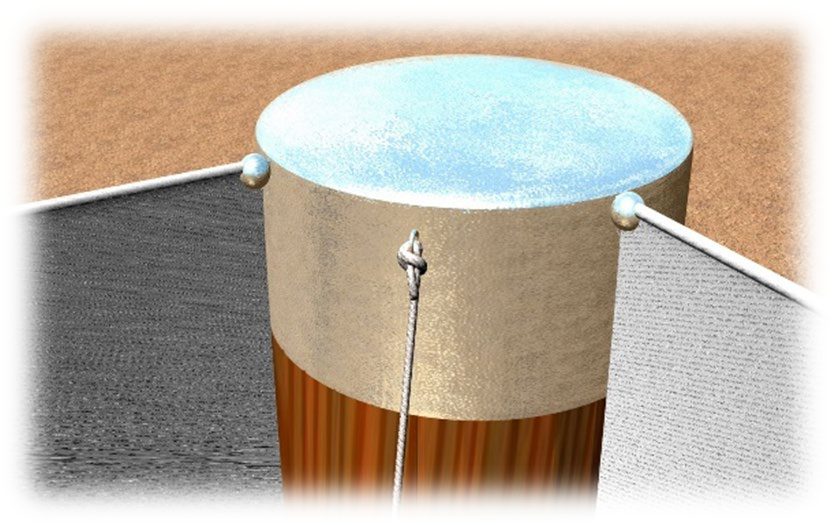
The pillars were capped with silver chapiters; the Hebrew word translated “chapiters” is rosh, the “head” or “topmost part”, a capital or crown at the top of each pillar. If we are like these brass pillars, lives under judgment covered by the redemptive work of Christ, then the crown on each pillar is the silver of his redemptive sacrifice. The pillars were connected by silver rods hooked from one to the next, the “fillets” the linen hung on; the Hebrew word translated “fillet” is khashuq, from the root khashaq, “connect”, “join” or even “cling” together.
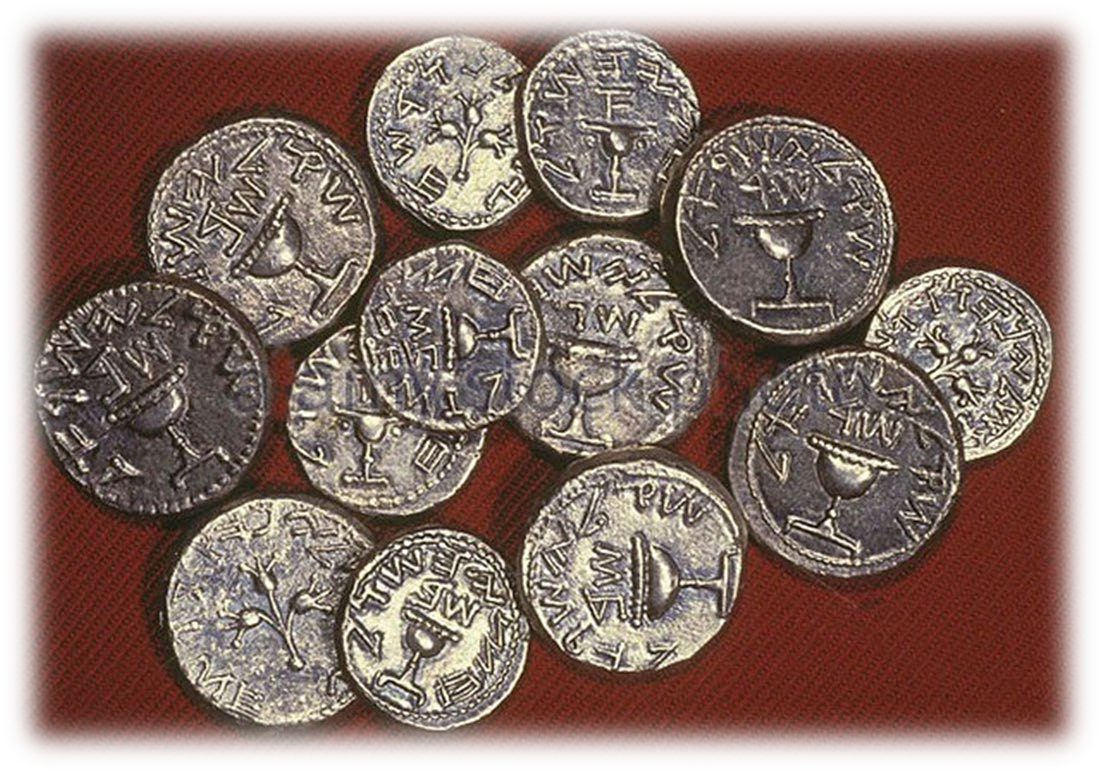
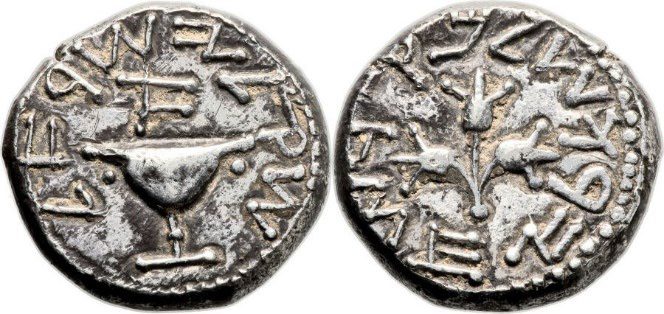
Silver primarily represents redemption: Joseph was sold for twenty pieces of silver [Genesis 37:28], Jesus was sold for thirty pieces of silver [Zechariah 11:12–13; Matthew 26:14–15], and every man of Israel paid half a shekel of silver as a ransom for his soul.
Exodus 30:12–16 When thou takest the sum of the children of Israel after their number, then shall they give every man a ransom for his soul unto the LORD, when thou numberest them… The rich shall not give more, and the poor shall not give less than half a shekel, when they give an offering unto the LORD, to make an atonement for your souls.
The price was the same whether a person was rich or poor, moral or deep in sin: there is one price for redemption. And those half shekels made the chapiters, fillets and hooks of the pillars, as well as the silver sockets of the Tabernacle itself [Exodus 38:25–28]: a hundred talents cast the hundred sockets, a talent for a socket, and the remaining 1,775 shekels made the hooks, overlaid the chapiters and filleted the pillars. Redemption money held up the wall of righteousness.
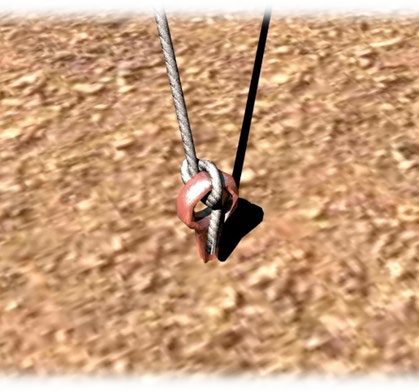
Figure 3. The head of a pillar: the silver chapiter, the silver hooks carrying the fillets and the linen, and the cord knotted beneath (book, page 80).Figure 4. Silver shekels: the half-shekel atonement money made the chapiters, fillets and hooks (book, page 81).
Cords and pins: what held the pillars up
The pillars were stabilized on both sides of the fence by fine-twined linen cords, fastened to the ground by brass pins. What holds us to our spiritual foundation is the truth of the word of God, which the Bible pictures as fasteners: the words of the wise are “as nails fastened by the masters of assemblies” [Ecclesiastes 12:11]. The pins are the truths that hold us fast, brass because it is God’s truth that judges mankind.
Isaiah 54:2 Enlarge the place of thy tent, and let them stretch forth the curtains of thine habitations: spare not, lengthen thy cords, and strengthen thy stakes;
Isaiah’s statement is in reverse order of requirement. We have to strengthen our stakes first: the stronger our commitment to God and our belief in His word, the further out we can lengthen our cords, and only then can we enlarge our tent. The cords on each side of each pillar may have represented the Law and the Prophets under the Old Covenant, and the Old and New Testaments under the New, holding together the standards of righteousness as the cords held up the linen; and the cords of God’s love [Hosea 11:4] and truth bind us as sacrifices to the altar [Psalm 118:27], the living, spiritual sacrifices of Romans 12:1 and 1 Peter 2:5.
Figure 5. A model of the Court: cords from each pillar to the ground on both sides, the Brazen Altar and Laver within (book, page 82).Figure 6. A cord fastened to its pin in the ground: “strengthen thy stakes” comes first (book, page 83).
In contrast, false doctrines and the carnal desires of man are cords and snares that capture [Proverbs 5:22; Isaiah 5:18], and false doctrine and a lack of the love of the truth [2 Thessalonians 2:10] were the principal causes of the falling away of the church, when “all my cords are broken” [Jeremiah 10:20]. One day, most fully during the Millennial Reign, they will be purged out from among God’s people, and the cords of God’s word will be untainted and unbroken.
Isaiah 33:20 Look upon Zion, the city of our solemnities… a tabernacle that shall not be taken down; not one of the stakes thereof shall ever be removed, neither shall any of the cords thereof be broken.
The Outer Court as the place of blood sacrifice
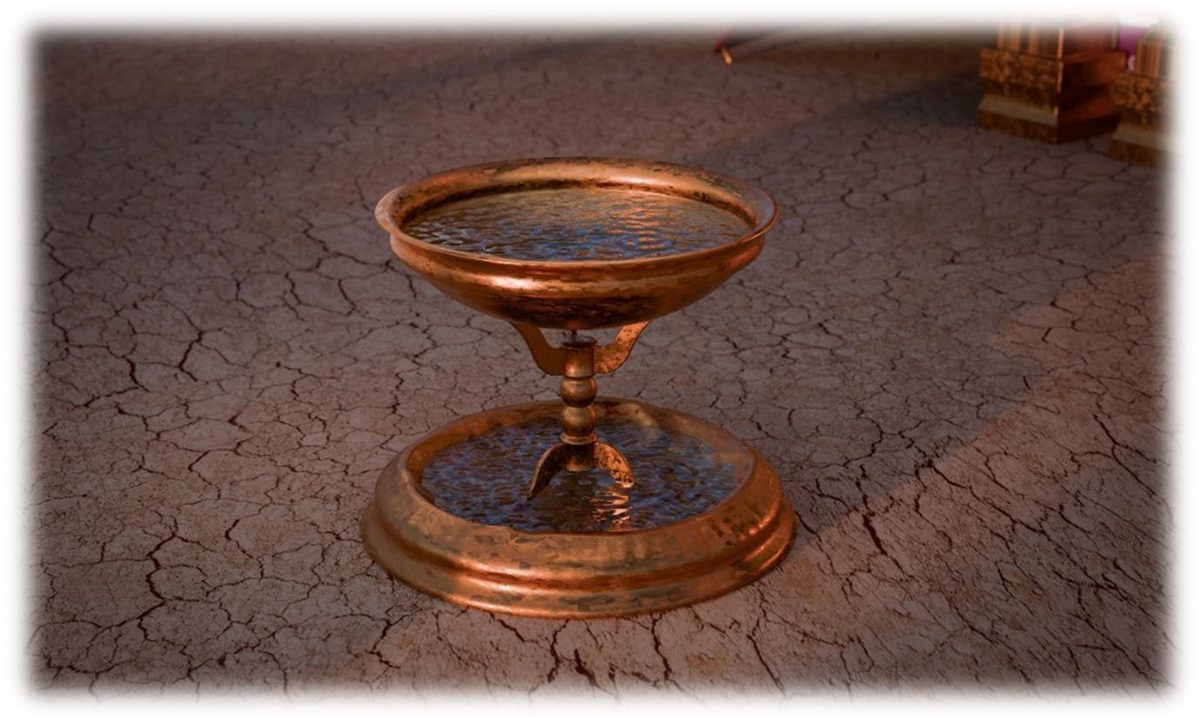
Under the Old Covenant blood sacrifices were shed only in the Outer Court, never in the Holy Place or the Holy of Holies, and under the New Covenant it is by the blood sacrifice of Christ that we initially come into covenant relationship with the Lord. So the Outer Court symbolizes the place where we first enter a covenant condition through faith and repentance, and the spiritual state we are in at that point. We pass through the Gate by faith and repentance, the blood shed at the Brazen Altar, picturing the death of Christ on the cross, is applied to us, and we then have to wash at the Brazen Laver to go on through the door, which pictures the baptism of the Holy Spirit. The Psalms are full of the invitation to enter the courts of God and stay there [Psalm 84:10; Psalm 100:4].
Who could work in the Court, and who in the building
Two classes of people could operate in the Court, but only one could officiate in the building. The sons of Levi were the general laborers of the Court, the picture of those who have come to Christ by faith and blood atonement and work for the Lord; but the Levites not descended from Aaron had no right to enter the Holy Place or to handle the holy things [Numbers 18:1–3]. Only the sons of Aaron officiated there: those who have come to Christ by spiritual birth and are commissioned to work on the spiritual things pictured within the Holy Place.
Numbers 4:15 And when Aaron and his sons have made an end of covering the sanctuary, and all the vessels of the sanctuary, as the camp is to set forward; after that, the sons of Kohath shall come to bear it: but they shall not touch any holy thing, lest they die. These things are the burden of the sons of Kohath in the tabernacle of the congregation.
In a symbolic sense, only the Spirit-born Body of Christ can touch the holy things; those not born of the Spirit handle them only through their coverings, for the mysteries of God’s word are hidden from carnal eyes [1 Corinthians 2]. Here, then, are three stages: those who operate only in the Court as blood-bought believers; those who have entered the Holy Place and become Spirit-born sons; and those who pass through the veil into the Holiest, a people purged unto perfection by the Spirit, the word and the baptism of fire that purges out the old man [Romans 6:6], who will be Kings and Priests with Christ, ruling and reigning with him as the Bride company during the Millennial Reign.
Class Six · The Gate of the Court
The Gate of the Court
Exodus 27:16 · Exodus 38:18 · Numbers 3:26 · John 10:1–16 · John 14:6 · Romans 5:1–2 · Genesis 28:16–17 · Matthew 7:13–14
Exodus 27:16 And for the gate of the court shall be an hanging of twenty cubits, of blue, and purple, and scarlet, and fine twined linen, wrought with needlework: and their pillars shall be four, and their sockets four.
Three names for one entrance
The Scripture gives three titles to the entrance of the Court of the Tabernacle. Exodus 27:16 calls it the Gate, and Numbers 3:26 calls it both the Curtain for the Door of the Court and the Door of the Court. Three names, then, for one opening in the white linen wall, and that one opening is the subject of this class: what it was made of, how it was measured, what held it up, and what it pictures.
Figure 1. The Gate of the Court from outside: the colored hanging on its four pillars, set into the white linen wall of the Outer Court, with the Brazen Altar and the Tabernacle beyond it (book, page 91).
The one Gate of entry
There is only one Gate, one way of entrance into the Court, and one way to enter through that Gate: by faith in Christ. The Gate itself is a type of Jesus, the one through whom all have to come to gain access to the things of God. Jesus is the way, the truth and the life, and no man comes to the Father but by him. There is salvation in no other, for there is none other name under heaven given among men whereby we must be saved [Acts 4:11–12]. Being justified by faith, we have access by faith into the grace wherein we stand, and through him we both have access by one Spirit unto the Father [Ephesians 2:18]. Four passages, and each of them lands on the same point: access, and access through him alone.
John 14:6 Jesus saith unto him, I am the way, the truth, and the life: no man cometh unto the Father, but by me.
Romans 5:1–2 Therefore being justified by faith, we have peace with God through our Lord Jesus Christ: By whom also we have access by faith into this grace wherein we stand, and rejoice in hope of the glory of God.
Jesus referred to himself as the Door to the sheepfold, as well as the Shepherd of the sheep, and the whole parable of John 10:1–16 turns on that one door. The one who climbs up some other way is a thief and a robber; the one who enters through the door is the shepherd, whom the sheep follow because they know his voice. When those who heard the parable did not understand it, Jesus told them in so many words that he is the door of the sheep and the good shepherd who gives his life for them, unlike the hireling who flees when the wolf comes, and that he has other sheep, not of this fold, whom he must also bring, so that there will be one fold and one shepherd. The door and the shepherd are the same person: there is no way into the fold except through him, and no one leading the flock but him.
John 10:7–9 Then said Jesus unto them again, Verily, verily, I say unto you, I am the door of the sheep. All that ever came before me are thieves and robbers: but the sheep did not hear them. I am the door: by me if any man enter in, he shall be saved, and shall go in and out, and find pasture.
The limited nature of the Gate
The Gate is both strait, that is, narrow, and wide. It is strait in the sense that there is a precise and particular requirement that has to be met to enter it. It is wide in the sense that, under the New Covenant fulfillment of its typology, it is open to whomsoever will. It is wide enough for all to enter, but so narrow that many will choose not to enter through it.
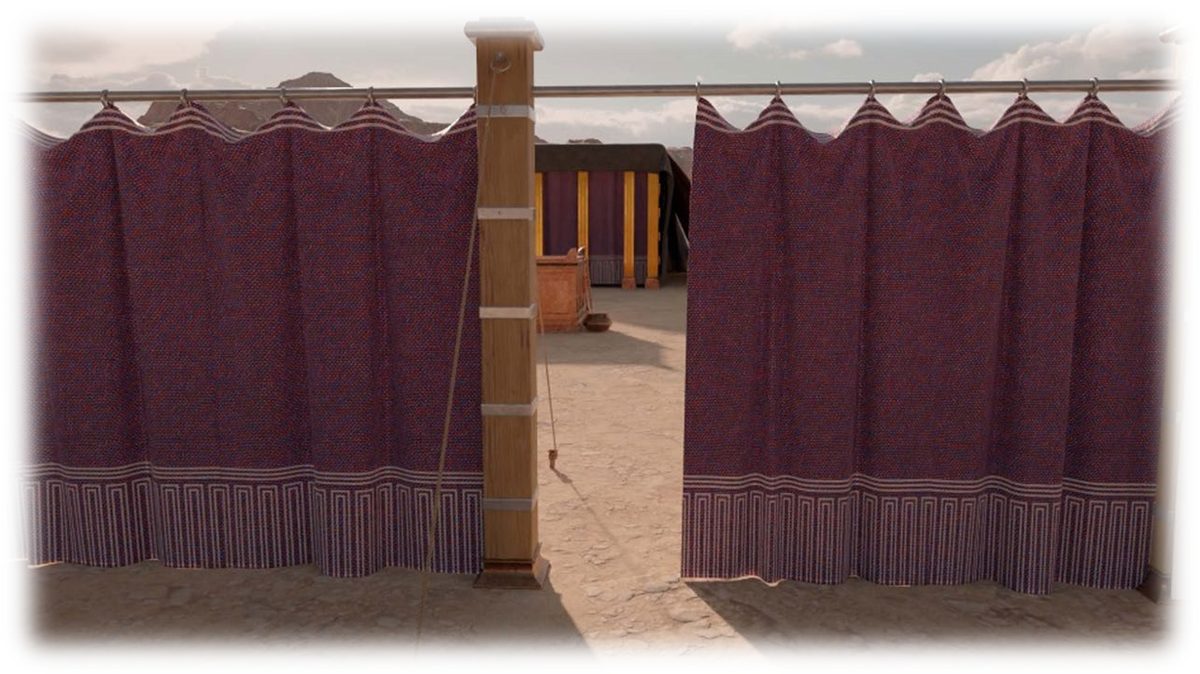
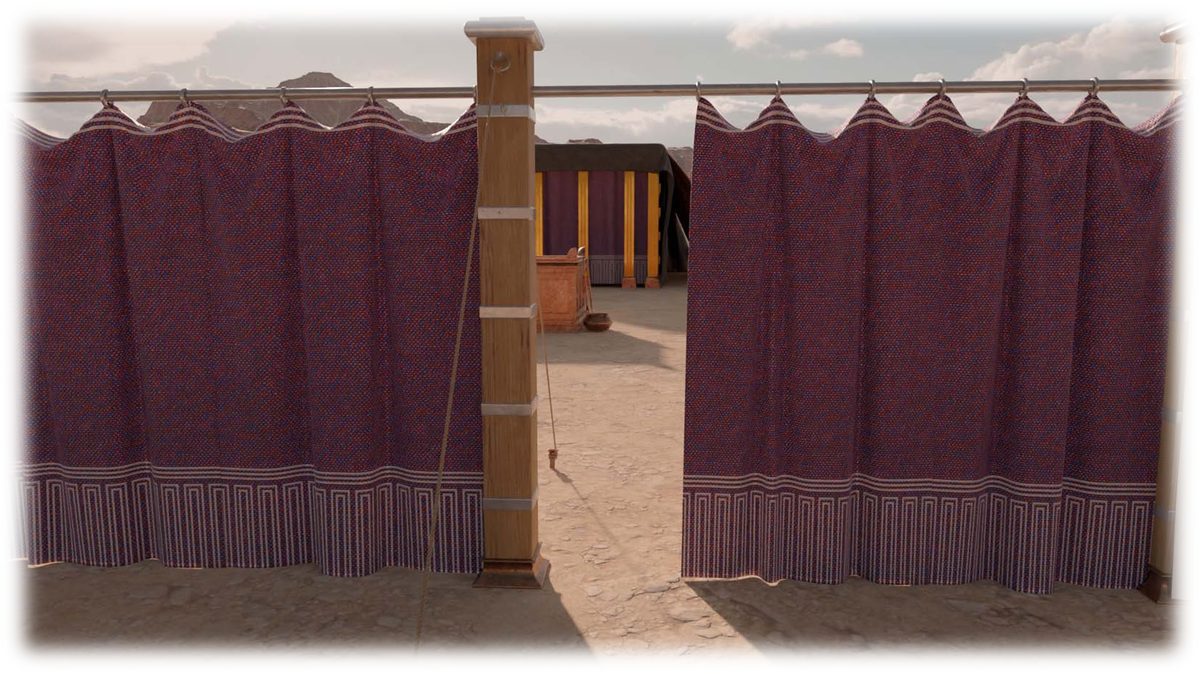
Figure 2. The Gate hanging parted at one of its pillars: through the one opening the Court, the Brazen Altar and the door of the Tabernacle come into view (book, page 91).
Notice four things about this Gate. First, it was the only entrance to the Court: just as there is one entrance, there is but one Savior, the one Mediator between God and man. Second, it was a wide Gate, wide enough to accommodate everyone who wanted to come, for God would have all men to be saved and come to the knowledge of the truth [1 Timothy 2:4]. Third, it was a beautiful Gate, inwrought with several colors that made it something to attract those searching for something beautiful in the wilderness. Fourth, it was a distinctive Gate. No one seeing it could mistake it for the rest of the wall: its colors marked it out clearly for all to see, distinguishing it from the white linen curtain wall of the Outer Court, and Jesus Christ is likewise distinguished among men by who he was, what he did and all that he said. One entrance, open to all, beautiful to the seeker and unmistakable to the eye: that is the Gate, and that is Christ.
The measurements of the Gate
Exodus 38:18 And the hanging for the gate of the court was needlework, of blue, and purple, and scarlet, and fine twined linen: and twenty cubits was the length, and the height in the breadth was five cubits, answerable to the hangings of the court.
The Gate was 20 cubits wide by 5 cubits high, for a total of 100 square cubits. Now every entry into the Tabernacle was 100 square cubits: the vail of the Holy Place was 10 cubits by 10 cubits, and the vail of the Holy of Holies was 10 cubits by 10 cubits. The measurement 10 by 10 is ten squared, symbolic of perfect judgment. God wants a hundredfold return on His investment, men and women who have been perfectly judged and judged to be perfect, and every doorway on the way into His presence carries that same hundred.
Table 1. The three entries of the Tabernacle, each of them 100 square cubits.
Entry
Width
Height
Area
The Gate of the Court
20 cubits
5 cubits
100 square cubits
The vail of the Holy Place
10 cubits
10 cubits
100 square cubits
The vail of the Holy of Holies
10 cubits
10 cubits
100 square cubits
The frame of the Gate
Four of the sixty brazen pillars of the Court made up the frame of the Gate, with their four sockets, as Exodus 27:16 directs. These four pillars symbolize the four Gospels: just as the four pillars held up the curtain of the Gate, so the four Gospels hold up the life and ministry of Jesus as a testimony to the world. They may also represent the fourfold sonship of Christ: the Son of David, the promised King; the Son of Abraham, the promised Seed; the Son of man, the promised human Mediator to God for man; and the Son of God, the promised divine Ambassador of God to man. Four pillars, four Gospels, four sonships, and one hanging held up among them.
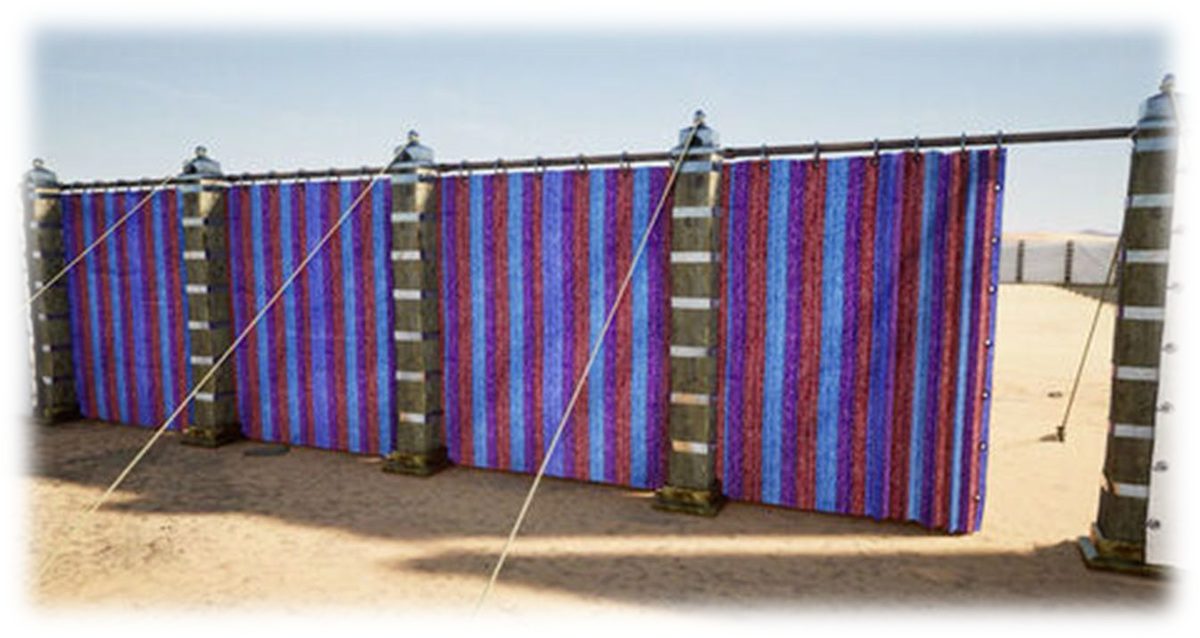
Figure 3. The Gate hanging in blue, purple and scarlet, hung on its pillars and steadied by cords, with the white hangings of the Court visible beyond it (book, page 94).
The materials of the Gate
The Gate was made of fine twined linen on which blue, purple and scarlet colors were embroidered, the needlework of Exodus 38:18. The fine twined linen was white, and it made up the base color on which the others were worked. The four colors of the Gate may signify the four Gospel testimonies, as well as the four dimensions of the work of Christ. White linen represents the sinless and perfect purity of Jesus, and parallels the Gospel of Luke, written primarily to the Greeks and Hellenistic Jews, which presents Jesus as the Son of Man. Blue represents the divine nature of Christ and his relationship to God, and parallels the Gospel of John, written to the overall Jewish and Gentile world, which presents Jesus as the Son of God. Purple, a color of royalty, represents Christ as King of Kings and Lord of Lords, and parallels the Gospel of Matthew, written primarily to the Jews, which presents Jesus as the Messiah and the King of Israel. Scarlet represents the sacrificial offering of his blood, shed for mankind, and parallels the Gospel of Mark, written primarily to the Romans, which presents Jesus as the suffering servant. Purity, deity, royalty and sacrifice: the one hanging carried all four, worked into one piece of cloth, as the one Christ carries all four in one person.
Table 2. The four colors of the Gate, the dimension of the work of Christ each represents, and the Gospel each parallels.
Color
Represents
Gospel
Written to
Presents Jesus as
White linen
the sinless and perfect purity of Jesus
Luke
the Greeks and Hellenistic Jews
the Son of Man
Blue
the divine nature of Christ and his relationship to God
John
the overall Jewish and Gentile world
the Son of God
Purple
royalty: Christ as King of Kings and Lord of Lords
Matthew
the Jews
the Messiah and the King of Israel
Scarlet
the sacrificial offering of his blood, shed for mankind
Mark
the Romans
the suffering servant
A gate as a symbolic picture of a church
It is through the physical gate of God’s house, that is, the church, that we enter into the spiritual gate that is God’s Son. There are many allusions to this concept in the Scripture, where gates in a vision, or in a parabolic or poetic passage, refer to the entries into the heavenly realm of being in a relationship with God. Jacob, waking at Bethel, called the place the house of God and the gate of heaven: the house and the gate are named in one breath, because the one is the way into the other.
Genesis 28:16–17 And Jacob awaked out of his sleep, and he said, Surely the LORD is in this place; and I knew it not. And he was afraid, and said, How dreadful is this place! this is none other but the house of God, and this is the gate of heaven.
The Psalms carry the picture forward. The gates are told to lift up their heads that the King of glory may come in [Psalm 24:7–10]; the LORD loves the gates of Zion more than all the dwellings of Jacob [Psalm 87:2–3]; we are to enter into His gates with thanksgiving and into His courts with praise [Psalm 100:4]; and the psalmist was glad when they said to him, let us go into the house of the LORD, for our feet shall stand within thy gates, O Jerusalem [Psalm 122:1–9]. Isaiah adds that the gates are to be opened for the righteous nation which keeps the truth [Isaiah 26:1–2], and that “thou shalt call thy walls Salvation, and thy gates Praise” [Isaiah 60:18]. Gate after gate, the Scripture uses the entrance of the house to speak of the entrance into relationship with God.
Psalm 118:19–20 Open to me the gates of righteousness: I will go into them, and I will praise the LORD: This gate of the LORD, into which the righteous shall enter.
So we end where the strait and wide Gate began, with the words of Jesus on the two gates and the two ways. Wide is the gate that leads to destruction, and many go in at it; strait is the gate that leads to life, and few find it. The Gate of the Court was wide enough for all and narrow enough that many would pass it by, and the Gate it pictures is the same.
Matthew 7:13–14 Enter ye in at the strait gate: for wide is the gate, and broad is the way, that leadeth to destruction, and many there be which go in thereat: Because strait is the gate, and narrow is the way, which leadeth unto life, and few there be that find it.
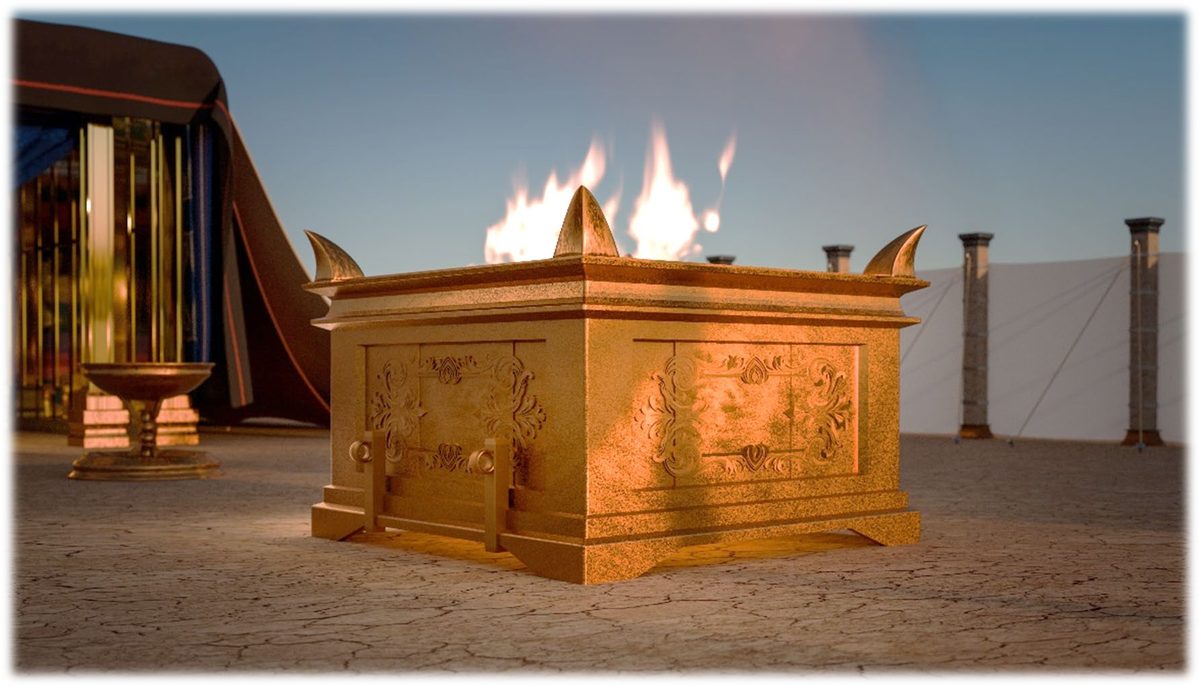
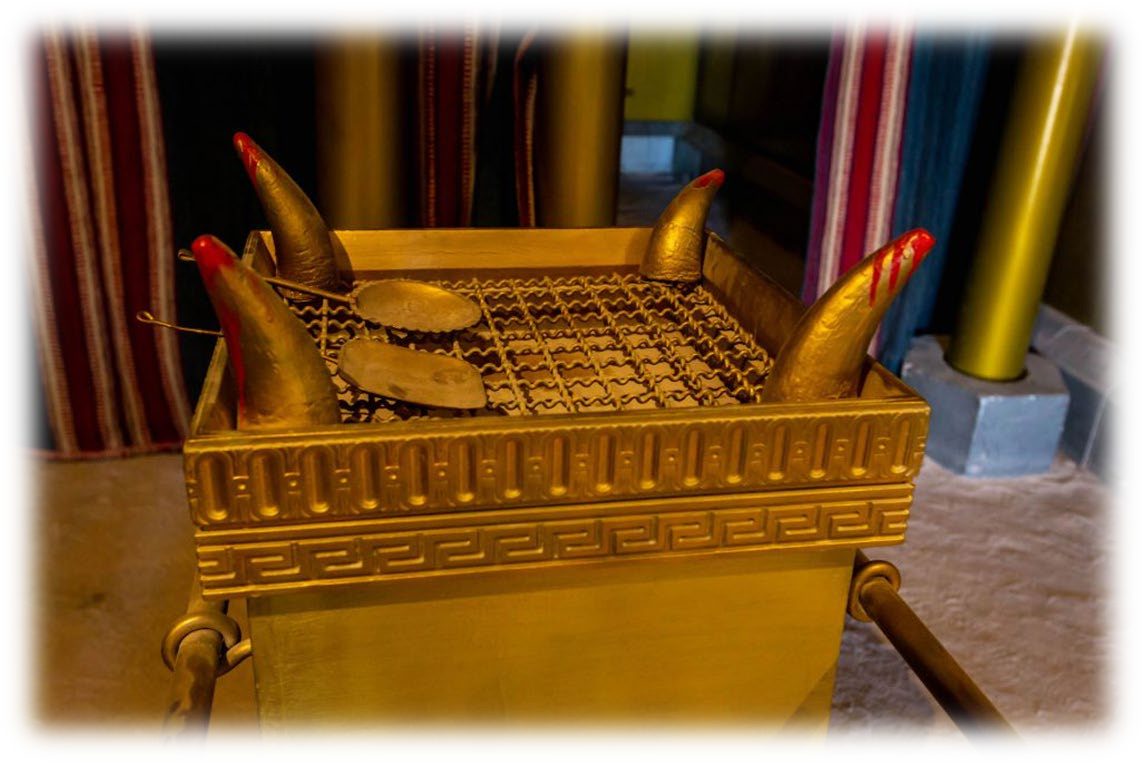
Figure 1. The Brazen Altar, the first furnishing inside the Gate, with its fire burning (book, page 97).
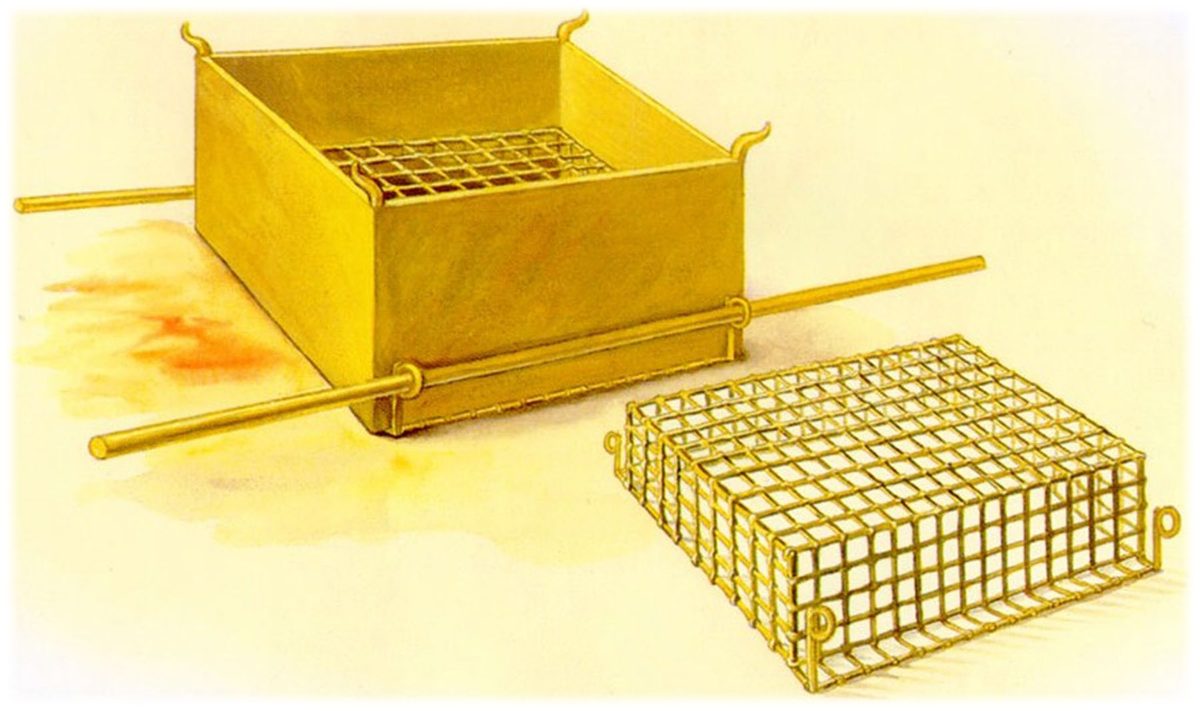
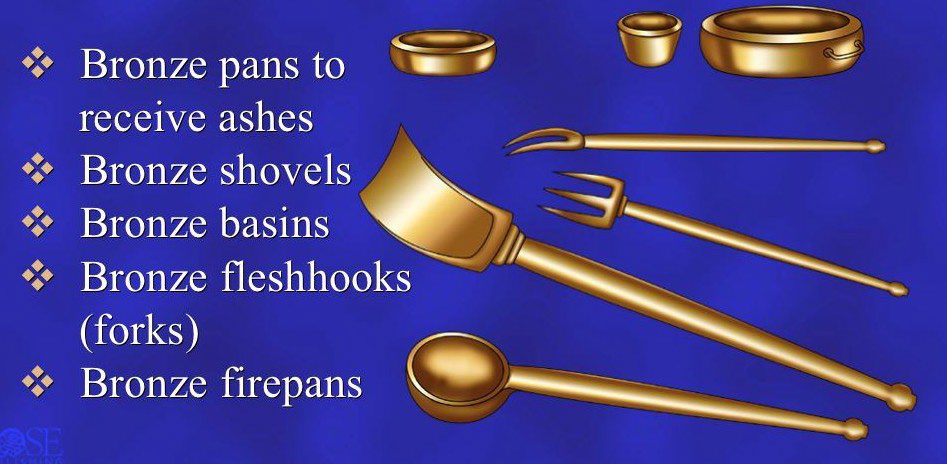
Exodus 27:1–8 And thou shalt make an altar of shittim wood, five cubits long, and five cubits broad; the altar shall be foursquare: and the height thereof shall be three cubits. And thou shalt make the horns of it upon the four corners thereof: his horns shall be of the same: and thou shalt overlay it with brass. And thou shalt make his pans to receive his ashes, and his shovels, and his basons, and his fleshhooks, and his firepans: all the vessels thereof thou shalt make of brass. And thou shalt make for it a grate of network of brass; and upon the net shalt thou make four brasen rings in the four corners thereof. … And thou shalt make staves for the altar, staves of shittim wood, and overlay them with brass. … Hollow with boards shalt thou make it: as it was shewed thee in the mount, so shall they make it.
Seven titles for one altar
The Scripture calls this altar by seven titles, and each one tells us something of what it was.
Table 1. The titles used for the Brazen Altar.
Title
Where it is used
The Altar of Shittim Wood
Exodus 27:1
The Altar
Exodus 29:36–44
The Altar of Burnt Offering
Exodus 30:28
The Brazen Altar
Exodus 38:30
The Altar of God
Psalm 43:4
The Altar at the Door of the Tabernacle
Leviticus 1:5
The Table of the Lord
Malachi 1:7
Two altars in the Tabernacle
The Brazen Altar was the first of two altars in the Tabernacle; the other was the Golden Altar within the Holy Place. The Brazen Altar represented physical sacrifice and the Golden Altar spiritual sacrifice: dying, natural sacrifices for sin were offered at the one, as Jesus was physically offered up on the cross, and at the other we offer up ourselves as living sacrifices [1 Peter 2:5]:
Romans 12:1 I beseech you therefore, brethren, by the mercies of God, that ye present your bodies a living sacrifice, holy, acceptable unto God, which is your reasonable service.
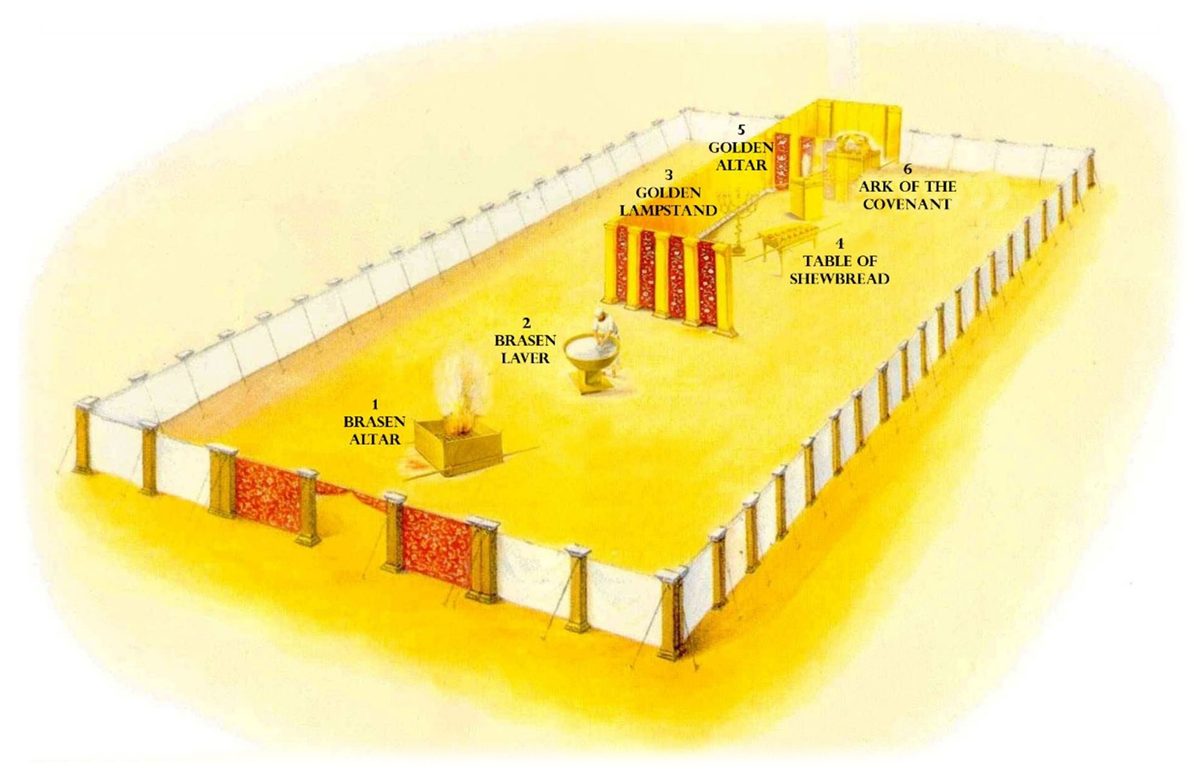
The first of six stations
Each entry point of the Tabernacle and each of its six furnishings is a spiritual station on a progressive path from initial salvation to full perfection. We enter the Gate by faith, receive remission of past sins at the Brazen Altar, are washed with the water of the word at the Laver, pass through the Door by Holy Spirit baptism, gain light at the Lampstand, eat of the full Gospel at the Table of Shewbread, offer up our lives at the Golden Altar, and pass through the veil to the Ark, where God is enthroned.
Figure 2. The six stations in order, from the Brazen Altar to the Ark of the Covenant (book, page 99).
Shittim wood: the material underneath
Shittim wood was the underlying material of the Brazen Altar and of most of the Tabernacle and its furnishings. The Hebrew word occurs twenty-eight times in the Old Testament, all in the plural form shittim except once, in the singular shittah[Isaiah 41:19]. The tree is the acacia of the desert, and one of its species is named seyal, “torrent”, because it grows massed in desert valleys that become torrents in the rainy season.
Its wood is very hard and close-grained, and its durability stems from its growth pattern: slow growth in desert conditions produces hard, dense wood, and the children of God go through a progressive growth to produce the spiritual density necessary to withstand the pressure of the process of salvation and of the world. Several commentators state that shittim wood was white, but there is no sound basis for this beyond an attempt to present a picture of purity: shittim was a dark red-brown wood resembling dried blood, and some have called it an “incorruptible wood”; the children of God need to be an incorruptible people, born of an incorruptible seed [1 Peter 1:23]. Though the tree was not tall, its roots grew deep: it is not how big we are above ground that determines our quality of use to God, but how deep our roots go.
Trees are people, and wood is human nature
In the Bible, trees sometimes represent people: the blessed man is “like a tree planted by the rivers of water” [Psalm 1:1–3; Jeremiah 17:5–8; Isaiah 44:1–4], and the mourners in Zion are “trees of righteousness” [Isaiah 61:3]. Wood may then symbolize humanity, and the shittim wood substructure of the building and its furnishings pictures the human nature and condition.
The shittim wood of the posts of the Outer Court, of the Brazen Altar, and possibly of the Laver was overlaid with brass, and it symbolizes humankind under judgment. The Tabernacle building was shittim wood overlaid with gold, humankind under a covering of complete purity and perfection. We come to the Lord under judgment, and through His progressive judgments we are made pure: from sinful creatures without a covering, to those under a brazen covering, to perfected overcomers under pure gold.
Isaiah 60:17 For brass I will bring gold, and for iron I will bring silver, and for wood brass, and for stones iron: I will also make thy officers peace, and thine exactors righteousness.
The spiritual shittim wood that is a redeemed person has to have the water of the Holy Spirit feeding its roots: a fountain from the house of the LORD “shall water the valley of Shittim” [Joel 3:18].
The brass overlay: a covering of judgment
Brass symbolizes judgment against the sinful deeds and fleshly nature of man. All the instruments of the Outer Court were brazen, because the Outer Court, where blood sacrifices were offered for sin and trespass, pictured the place where judgment for sin, and judgment to ameliorate sin, was carried out. So God warned a disobedient Israel that “thy heaven that is over thy head shall be brass” [Deuteronomy 28:23]: under judgment, their prayers for His blessing would be limited.
One brazen instrument that carried out and ameliorated judgment is the serpent of brass that Moses lifted up on the pole in Numbers 21, which the bitten people had to look to in order to live. That serpent prefigures Christ, lifted up in his human frame as a standard to judge sin and to deliver mankind from its bondage.
John 3:14–15 And as Moses lifted up the serpent in the wilderness, even so must the Son of man be lifted up: That whosoever believeth in him should not perish, but have eternal life.
The purpose of an altar
An altar was usually built to offer sacrifices to God for propitiation, petition or praise, and a blood sacrifice most often represented a propitiatory covering made by the blood. The Brazen Altar signifies and foreshadows the blood sacrifice of Christ for all mankind, which would eclipse and fulfill the Old Covenant sacrificial system.
Foursquare: fullness in area and covering
The Altar was built foursquare, its length and width equal and its height slightly shorter. The number four symbolically represents fullness or entirety in terms of area or covering: the four corners of the earth are the whole earth [Isaiah 11:12; Revelation 7:1], the four corners of the land the whole land [Ezekiel 7:2], and the four dimensions of the love of Christ the fullness of God [Ephesians 3:17–19; Job 11:7–9]; the four Gospels give the full testimony to Jesus Christ.
The measurements
The Altar was three cubits high, five cubits wide and five cubits deep. The three cubits may symbolize the three days and nights Jesus lay in the grave, and the five cubits his five wounds on the cross: two in his hands, two in his feet, and one in his side. Five is often symbolic of grace and of the ministry, and the dimensions of the Tabernacle are all multiples of five: the Outer Court 100 by 50 cubits, the Holy Place 10 by 10 by 20, the Holy of Holies 10 by 10 by 10.
The grate and the staves
A grate was built into the Altar to hold up the body of the animal while it burned, and to let the ashes fall through to be removed. Its four brass rings took the two shittim wood poles that carried it, and the two poles may point to the carrying of the message of the Altar, fulfilled in Christ: the death and resurrection of Jesus, its twofold testimony; the Old and New Testaments; the Early and Latter Rain Churches before the Millennial Reign; and the Jewish and Gentile ministries during it.
Figure 3. The grate of network with its four rings, drawn beside the Altar and its staves (book, page 110).
The five instruments
Five vessels of brass were made for the Altar: pans to receive its ashes, shovels, basins, fleshhooks and firepans [Exodus 27:3]. They may typify the five offices of the ministry, through which God works with those who are His living sacrifices; the five-man priesthood of Aaron and his four sons is a parallel. Each use pictures a work of the ministry.
Figure 4. The five brass instruments of the Altar: pans, shovels, basins, fleshhooks and firepans (book, page 111).
Table 2. The five instruments, their use at the Altar, and the work of the ministry each pictures.
Instrument
Its use
The work of the ministry
Pans
carried the ashes out of the camp
our sins are removed from us at the altar: separating the people from sin, keeping the old carnal ways out of the camp of God’s people
Shovels
picked up the ashes and tended the fire
putting the past behind us and keeping present sins dealt with: using the word to separate the spirit from the flesh, out of our hearts and out of the church
Basins
held the blood for pouring out or sprinkling
the application of the blood of Jesus: making sure people are under its sanctifying covering
Fleshhooks
raised the sacrifice onto the altar and moved it on the grate until it was fully consumed
the “perfecting of the saints” [Ephesians 4:12]: keeping the sacrifice on the altar and helping people make the necessary spiritual adjustments
Firepans
carried the fire from the Brazen Altar into the Holy Place to the Golden Altar
keeping the fire burning in our hearts, never forgetting what Christ has done; the ministry holding up the saints in prayer and intercession before the throne
The horns on the corners
There was a horn on each of the four corners of the Altar. Horns typify power and dominion, especially a ruler’s, because they rise from the head as a crown does, and power that protects and delivers: the LORD is “the horn of my salvation” [2 Samuel 22:2–3; Psalm 89:24; Psalm 92:10; Psalm 132:13–18], and Christ is the Lamb with seven horns [Revelation 5:6]. Christ’s sacrifice purchased dominion over all the earth, and the four horns can represent that dominion, and the saving power of his death, which encompasses the four corners of the earth.
The horns also represent a place of refuge and safety. Adonijah, fearing Solomon, fled to the altar and clung to its horns, and Solomon sent him home [1 Kings 1:50–53]; Joab caught hold of the horns too, and Solomon, knowing his reprobate heart, had Benaiah take his life [1 Kings 2:28–34]. Neither man truly repented, and both were executed. If we lay hold of the horns of the Brazen Altar with true repentance and a genuine desire for reconciliation, we will be delivered; but if we continue in wickedness, expecting to lay hold of its horns perpetually, the efficacy of the cross will not save us. By taking hold of Christ with a heart that longs to be delivered, we lay hold on the horns and are delivered from judgment:
Hebrews 6:18 That by two immutable things, in which it was impossible for God to lie, we might have a strong consolation, who have fled for refuge to lay hold upon the hope set before us:
The horns of the Altar were also where the sacrificial animal was tied while it awaited its death:
Psalm 118:27 God is the LORD, which hath shewed us light: bind the sacrifice with cords, even unto the horns of the altar.
Under the New Covenant, after the blood of Christ has been applied to our past sins, we have to live as living sacrifices from that point forward, bound by the cords of our commitment to the process of full salvation, the dying out of our carnal nature. The cords of our obedience to the word and of our relationship to Christ keep us bound to the altar: a place of terrible distress, and of incredible deliverance.
Blood on the horns
Blood was put on the horns of the Brazen Altar at the consecration of the priesthood [Exodus 29:11–12; Leviticus 8:14–15], on the Day of Atonement [Leviticus 16:18–19], and for the sin offering of a ruler or a common individual [Leviticus 4:25, 30, 34]. For the sin offerings of a priest or of the whole nation it went on the horns of the Golden Altar instead, which may picture the contrast between a secular and a spiritual operation: the ruler and the individual Israelite are covered at the Brazen Altar, the priest and the nation as a spiritual kingdom at the Golden Altar. Aaron’s first sin offering for himself [Leviticus 9:8–9] is a unique exception.
Figure 5. The four horns with blood on them, the grate within, and two instruments on it (book, page 118).
The original fire
Leviticus 9:23–24 And Moses and Aaron went into the tabernacle of the congregation, and came out, and blessed the people: and the glory of the LORD appeared unto all the people. And there came a fire out from before the LORD, and consumed upon the altar the burnt offering and the fat: which when all the people saw, they shouted, and fell on their faces.
God Himself ignited the original fire on the Altar. Some have theorized that this flame was the only source from which fire could be taken for the later work of the Tabernacle; if so, the firepans carried its coals through the wilderness, any other fire was “strange fire”, fire not originally ignited by God, and the Brazen Altar lit the Golden Lampstand and the Golden Altar of Incense.
Figure 6. The fire that came out from before the LORD: God Himself ignited the original fire (book, page 119).
Figure 1. The Brazen Laver in its two pieces, the Laver and its foot of brass: here the bowl stands on a pedestal and the broad foot beneath it holds water too, as in the cup-and-saucer theory, where the water was released into the base for washing (book, page 121).
Materials and measurements of the Laver
The Scripture gives this vessel two titles, the Laver of Brass [Exodus 30:18] and simply the Laver [Exodus 30:28], and no measurements at all: it was two pieces, the Laver itself and the foot on which it sat. Two theories of its form are the most traditional and plausible: a goblet or modern birdbath, a bowl-like basin on a pedestal base, or a cup and saucer, the upper part holding the water, which could be released into the base for washing. Like everything else in the Outer Court it was of brass (bronze), and apparently solid brass, not shittim wood overlaid with brass as the court pillars and the Brazen Altar were. One ancient tradition holds that its water came first from the rock Moses smote in Exodus 17, a type of Christ, struck for our sin, from whose pierced side flowed the water and the blood: “that Rock was Christ” [1 Corinthians 10:4].
Figure 2. The rock Moses smote, from which, by one ancient tradition, the Laver was first filled: a type of Christ, from whose pierced side flowed the water and the blood (book, page 122).
Position and purpose of the Laver
The Brazen Laver stood directly between the Brazen Altar and the Tabernacle proper, the place of ritual purification where the priests washed their hands and their feet before entering into the work of the Tabernacle.
Exodus 30:18–21 Thou shalt also make a laver of brass, and his foot also of brass, to wash withal: and thou shalt put it between the tabernacle of the congregation and the altar, and thou shalt put water therein. For Aaron and his sons shall wash their hands and their feet thereat: When they go into the tabernacle of the congregation, they shall wash with water, that they die not; or when they come near to the altar to minister, to burn offering made by fire unto the LORD: So they shall wash their hands and their feet, that they die not: and it shall be a statute for ever to them, even to him and to his seed throughout their generations.
There was a death penalty for any priest who did not wash, the literal and symbolic point being that it is impossible to do the work of God without proper purification: sin in a general sense could be cleansed by blood at the Brazen Altar, but the priesthood had to be washed with water at the Brazen Laver as well.
Does the Laver picture baptism?
Many have argued that the Brazen Laver depicts water baptism, since it is the next location after the Brazen Altar, which pictures the sacrifice of Christ, and some forms of mikvah, the ritual immersion practiced in Israel before John the Baptist, are very similar to his baptism. But water baptism is typically a one-time event, whereas the Laver was used daily. When a priest was first ordained he was washed from head to toe, and that one complete washing may point to water baptism; but afterward he washed his hands and feet there daily, and those ongoing washings, the regular purpose of the Laver, cannot, since we do not keep getting baptized over and over again. Thus its primary symbolic meaning has to describe something that occurs not once but regularly, even daily, and this is one of many reasons we do not believe it symbolizes Holy Spirit baptism either, a connection many have made by conflating the receiving of the Holy Spirit with conversion or water baptism.
The Laver pictures the washing of water by the word of God
Water, in its various forms, is symbolic of, or figuratively paralleled with, the word of God: “My doctrine shall drop as the rain, my speech shall distil as the dew” [Deuteronomy 32:1–2; Job 29:21–23].
Isaiah 55:10–11 For as the rain cometh down, and the snow from heaven, and returneth not thither, but watereth the earth, and maketh it bring forth and bud, that it may give seed to the sower, and bread to the eater: So shall my word be that goeth forth out of my mouth: it shall not return unto me void, but it shall accomplish that which I please, and it shall prosper in the thing whereto I sent it.
Ephesians 5:25–27 Husbands, love your wives, even as Christ also loved the church, and gave himself for it; That he might sanctify and cleanse it with the washing of water by the word, That he might present it to himself a glorious church, not having spot, or wrinkle, or any such thing; but that it should be holy and without blemish.
We have to be cleansed by the preaching and teaching of the word of God, not only by ministers of God but also by our own personal study, consideration and meditation on it [John 15:3; John 17:17; Psalm 119:9]. There are three elements by which we have to be washed to undergo full salvation: the blood of Christ [1 John 1:7], the word of God [Ephesians 5:26], and the Spirit of God [Titus 3:5]; Peter refers to a combined cleansing of the word and the Spirit [1 Peter 1:22]. In a symbolic sense, after believers have been saved from their past sins by the blood at the Brazen Altar, they have to maintain the purity of their garments by washing at the Brazen Laver, and that is the believer’s own responsibility [Hebrews 10:22–24; 2 Corinthians 7:1]. Ancient tradition states that the water of the Laver was changed daily, the pattern of the manna, which also foreshadowed the word of God: we have to have fresh manna daily, the word of God fresh from the source, alive and dynamic with transformative power.
Figure 3. Washing the hands: the priests washed their hands and their feet at the Laver before every day’s work in the Tabernacle, and the water, by tradition, was changed daily (book, page 127).
The lookingglasses of the women of Israel
Exodus 38:8 And he made the laver of brass, and the foot of it of brass, of the lookingglasses of the women assembling, which assembled at the door of the tabernacle of the congregation.
The material of the Laver was taken from the lookingglasses of the women of Israel, mirrors of highly polished brass (bronze), and the reflective nature of those mirrors and of the water in the Laver are both symbolic of the reflective, mirroring work of the word of God.
Hebrews 4:12–13 For the word of God is quick, and powerful, and sharper than any twoedged sword, piercing even to the dividing asunder of soul and spirit, and of the joints and marrow, and is a discerner of the thoughts and intents of the heart. Neither is there any creature that is not manifest in his sight: but all things are naked and opened unto the eyes of him with whom we have to do.
The word of God not only reveals Christ to us but shows us ourselves, a mirror that contrasts what we see of him with how much of him we can see in us: it uncovers our innermost identity and holds it up against the image-bearer we are intended to replicate. The women’s mirrors judged their outer appearance; the mirror of the word judges the condition of the inner man, objectively, seeing yourself for what you truly are, and we use it to make sure our disposition, words and deeds are in line with His will.
Figure 4. A hand mirror of polished bronze, such as the women of Israel gave up at the door of the Tabernacle to make the Laver and its foot (book, page 128).
When we look into the Brazen Laver of the word of God, we are seeing ourselves as God sees us, and the image may look like a fun-house mirror image, distorted and out of proportion: our spiritual life inflated with carnal things or emaciated in the things of God, or the mirror only just cleaned by the truth after false doctrine had fogged it. False doctrine most often makes us feel better about ourselves than we should, and though that does not change the requirement that our reflection match Christ’s, it can prevent that image from ever developing. If we strive to obey God’s word, its mirror will one day reveal Christ in us: we will look into the bowl of the Laver, spiritually speaking, and see the image of Christ reflecting back.
2 Corinthians 3:18 But we all, with open face beholding as in a glass the glory of the Lord, are changed into the same image from glory to glory, even as by the Spirit of the Lord.
James 1:22–25 But be ye doers of the word, and not hearers only, deceiving your own selves. For if any be a hearer of the word, and not a doer, he is like unto a man beholding his natural face in a glass: For he beholdeth himself, and goeth his way, and straightway forgetteth what manner of man he was. But whoso looketh into the perfect law of liberty, and continueth therein, he being not a forgetful hearer, but a doer of the work, this man shall be blessed in his deed.
The Greek word translated “glass” in 1 Corinthians 13:12 and James 1:23 is esoptron, which means a “mirror”, and “beholding as in a glass” in 2 Corinthians 3:18 translates katoptrizomai, “to mirror” or “to see in a reflection”. Self-examination, and the corrections that follow it, are some of the first steps on the path of righteousness that leads into the Holy Place and eventually into the Holy of Holies: we are called to finish our course and reach the same end that Jesus did, and that course, race, path and way is pictured in the progressive path through the Gate all the way into the Holiest of All.
Washing at the Laver begins an increase in our personal responsibility
Each area of the Tabernacle precincts, from the Outer Court to the Holy Place to the Most Holy Place, represents an increasing level of spiritual development and maturity, and each step forward requires an increasing level of personal responsibility. It might be said that it is God or Christ who washes you in the blood at the Brazen Altar, but you are the one who has to wash yourself at the Brazen Laver: God provides His word, but you have to use it to cleanse yourself, directly, through your own study, or indirectly, through a minister of God. He will not allow forward progress without exhaustive effort on our part; but if we give our hundred percent, which alone is far from enough, He will make up the difference, and our investment, married to His might, will meet “the measure of the stature of the fulness of Christ” [Ephesians 4:13].
The call to be part of the royal priesthood that is the Bride of Christ requires a higher standard than initial salvation: the standard of the Bride company is complete perfection, keeping the garments clean by washing them in the blood of Christ and by the word of God. Though all believers are corporately a kingdom of priests, as all Israel was [Exodus 19:6], only those who go on to complete perfection before the Marriage Supper of the Lamb [Revelation 19:5–10] will be part of the Bride, a select group taken out from the Body of Christ, the Church. A few of the many proofs: Eve was taken out of Adam’s body, and Christ is “the last Adam” [1 Corinthians 15:45], so his Bride is taken out of his Body; God has always used a selective hierarchy, all Israel a “kingdom of priests” but only Aaron’s line priests and only David’s line kings; the rewards of the “overcomers” match the role of the Bride, and not all believers attain to them; and the Bride is married at one event at the beginning of the Millennial Reign and reigns a thousand years [Revelation 19–20], so the millions who join the Church during or after that reign cannot belong to a company married before they came in. Those called to the Bride are not only given new garments, as all are who enter the New Covenant, but have to keep their garments white [Revelation 3:4–5].
Revelation 19:7–8 Let us be glad and rejoice, and give honour to him: for the marriage of the Lamb is come, and his wife hath made herself ready. And to her was granted that she should be arrayed in fine linen, clean and white: for the fine linen is the righteousness of saints.
Figure 5. Arrayed in fine linen, clean and white: those called to the Bride company are given new garments, and have to keep them white (book, page 134).
There is a process, a preparation, which God honors among those who desire to enter their full inheritance. As Steven Fuson puts it, the hands represent our ministry (we would say our God-ordained works) and the feet our understanding, and if there were no journey, God would have had Moses build the Ark of the Covenant and nothing more. We say, amen.
Washed once, and then washed daily
The priests were washed once at the beginning of their priesthood and from then on had to wash daily. When Aaron and his sons were first consecrated, Moses washed them with water at the door of the Tabernacle [Exodus 29:1–4; 40:11–12; Leviticus 8:1–6], apparently at the Laver, and by tradition and biblical inference that washing was of the entire body, from head to foot. It belongs to the process of entering through the Gate by faith and repentance, receiving atonement for past sin at the Brazen Altar, and being cleansed by the word at the Brazen Laver, where the foundational truths of the plan of salvation are accepted and the washing of the mind occurs: that initial setting apart pictures initial salvation. The daily washing that followed was not that full-body washing but a washing of the hands and the feet before each day’s work [Exodus 30:18–21].
In the spiritual fulfillment of this, after we have been washed in the blood of Christ and the water of the word at our initial salvation, we are still required to continue washing, or we may end up back under the penalty of death: believers once washed can, like dogs, return to their vomit [2 Peter 2:22] and become castaways [1 Corinthians 9:27]. The first, full-body washing was a washing away of the past, not a preemptive purging of future sins. The washing of the feet and the hands symbolizes a cleansing of a person’s ways and deeds. Jesus washed his disciples’ feet in John 13, whereas the priests washed themselves, and that principal difference may allude to the far greater purification now possible through the work of Christ.
Figure 6. Jesus washing his disciples’ feet in John 13: the priests washed themselves at the Laver, whereas Jesus washed his disciples (book, page 138).
The plan of God is not about leaving us in the state He finds us in; it is about full transformation, from the broken image of God shattered by Adam’s sin to the perfect reflection of His character. We are predestinated “to be conformed to the image of his Son” [Romans 8:29; Colossians 3:10], a mirror image of Jesus Christ, “the express image of his person” [Hebrews 1:1–3]. The Bible shows us ourselves, and then it shows us our Savior. As Adrian Rogers put it, some people use the mirror but not the water: they look into the Bible, see what shape they are in, and go right on their way, like a little boy who says “I have a dirty face” and does not wash. The brass lookingglasses speak of the judgment of self; the water speaks of the pure word of God, God’s answer.
The Brazen Altar and the Brazen Laver compared
Table 1. The Brazen Altar and the Brazen Laver compared (book, page 140).
The Brazen Altar
The Brazen Laver
Blood sacrifice
Washing of water
Cleansing by blood
Cleansing by water
The blood of Christ
The word of God
Forgiveness of past sin
Maintenance of purity
Makes the garment white
Keeps the garment white
For the purification (cleansing) of all sinners
For the purification (cleansing) of priests
Class Nine · Foundation of the Tabernacle Building
A Foundation of Silver
Exodus 30:12–16 · Exodus 38:25–28 · 1 Peter 1:18–21 · 1 Corinthians 6:19–20 · 1 Corinthians 3:10–11 · Isaiah 28:16 · Ephesians 2:19–22 · Matthew 16:13–19 · Luke 6:47–49
One hundred sockets of silver
Before we raise the walls of the Tabernacle building, we need to look at what they stood on. The foundations of the Tabernacle consisted of 96 silver sockets beneath its framework and four silver sockets for the pillars between the Holy Place and the Holy of Holies, 100 silver sockets in all. That total corresponds to 10 x 10, or ten squared, and since the number ten is symbolic of judgment, 10 x 10 represents complete judgment.
Figure 1. The plan of the building: the boards of the three walls standing in their row of sockets, with the four sockets of the pillars that separated the Holy Place from the Holy of Holies (book, page 141).Figure 2. The three walls of the Tabernacle building raised on their silver foundation, with a man standing beside them for scale (book, page 148).
We settled the meaning of silver in the Outer Court. In the same way that the silver capping, trimming and connecting the brazen pillars of the court was symbolic of redemption, the Tabernacle itself was laid on a solid foundation of silver, indicating that the process of salvation depicted within its structure is set on a foundation of redemption. Symbolically, all the elements and operations of the Tabernacle, every board and bar, every curtain and covering, every piece of furniture and every act of the priesthood, rested on the foundation of the redemptive work of Christ.
The ransom of half a shekel
Where did so much silver come from? A redemption tax was given by the men of Israel who were twenty years of age or older to pay for the silver materials of the Tabernacle. Every man paid half a shekel of silver as a ransom price for his soul, and the rich were not to give more, nor the poor less.
Exodus 30:12–16 When thou takest the sum of the children of Israel after their number, then shall they give every man a ransom for his soul unto the LORD, when thou numberest them; that there be no plague among them, when thou numberest them. This they shall give, every one that passeth among them that are numbered, half a shekel after the shekel of the sanctuary: (a shekel is twenty gerahs:) an half shekel shall be the offering of the LORD. Every one that passeth among them that are numbered, from twenty years old and above, shall give an offering unto the LORD. The rich shall not give more, and the poor shall not give less than half a shekel, when they give an offering unto the LORD, to make an atonement for your souls. And thou shalt take the atonement money of the children of Israel, and shalt appoint it for the service of the tabernacle of the congregation; that it may be a memorial unto the children of Israel before the LORD, to make an atonement for your souls.
Exodus 38:25–28 And the silver of them that were numbered of the congregation was an hundred talents, and a thousand seven hundred and threescore and fifteen shekels, after the shekel of the sanctuary: A bekah for every man, that is, half a shekel, after the shekel of the sanctuary, for every one that went to be numbered, from twenty years old and upward, for six hundred thousand and three thousand and five hundred and fifty men. And of the hundred talents of silver were cast the sockets of the sanctuary, and the sockets of the vail; an hundred sockets of the hundred talents, a talent for a socket. And of the thousand seven hundred seventy and five shekels he made hooks for the pillars, and overlaid their chapiters, and filleted them.
Figure 3. Both faces of an ancient silver coin of Israel, a cup on the one and a branch with three buds on the other: the ransom every numbered man brought was half a shekel of silver, the price of his soul (book, page 143).
The ransom price in silver paid by the men of Israel was melted down and used to construct the foundations of the Tabernacle. Notice one detail of the census before we go any further: each man had to bring his own half shekel. The ransom was personal, and so is the thing it pictured. Your salvation in Christ is individual and personal. You cannot inherit a relationship with the Lord from someone else; every man has to choose him for himself.
Under the Old Covenant, corruptible gold and silver symbolized the physical reality of redemption. Under the New Covenant, that picture was fulfilled in the redemption price paid in blood by Jesus, a price that is incorruptible because the Lamb who paid it was without blemish and without spot.
1 Peter 1:18–21 Forasmuch as ye know that ye were not redeemed with corruptible things, as silver and gold, from your vain conversation received by tradition from your fathers; But with the precious blood of Christ, as of a lamb without blemish and without spot: Who verily was foreordained before the foundation of the world, but was manifest in these last times for you, Who by him do believe in God, that raised him up from the dead, and gave him glory; that your faith and hope might be in God.
Just as the men of Israel were redeemed by the price of a half shekel of silver, so we are bought with a price and redeemed by the blood of Christ. That is why Paul can ask the Corinthians whether they know that their body is the temple of the Holy Ghost, “and ye are not your own? For ye are bought with a price” [1 Corinthians 6:19–20]. A people who have been purchased are not their own: their body and their spirit are God’s, and are to glorify Him.
A talent for a socket
Each of the silver sockets was formed out of a talent of silver, and we need to know what a talent was to feel the weight of that statement. The talent probably originated in the “load” that a man could carry: the Akkadian biltu, the Greek talanton and probably the Sumerian gun all carry that sense in their roots. It was the largest measure of weight in Old Testament times, amounting to about 3,000 shekels or about 75 pounds, and Exodus 38:25–26 makes it clear that the talent was equal to 3,000 shekels, though whether that was 60 minas of 50 shekels each or 50 minas of 60 shekels each is unknown. Whichever the case, excavated talents weigh from about 65 to 80 pounds. In the Old Testament the talent is used only for precious metals, usually silver or gold (the bronze of Exodus 38:29 is the exception); Solomon’s annual tribute of 666 talents was apparently considered quite extravagant [1 Kings 10:14], and David bequeathed 100,000 talents of gold and 1,000,000 talents of silver to Solomon for the building of the Temple [1 Chronicles 22:14]. In New Testament times the talent was the largest named quantity of money, worth about twenty years’ wages for the average day laborer, so that the debtor in the parable of the unforgiving servant [Matthew 18:24] owed the king several thousand years’ worth of labor.
Figure 4. The foot of a board descending by its two tenons into a pair of silver sockets: each socket was one talent of silver, the ransom of 6,000 men (book, page 144).
Now put the figures together. If the talent of silver in the materials of the Tabernacle sockets was about 75 pounds, then the foundation of the Tabernacle would have weighed about 7,500 pounds. And since a talent was equal to 3,000 shekels, and each of the men of Israel brought half a shekel for his ransom money, each of the sockets set beneath the Tabernacle represented the redemption price of 6,000 men, and the entire 100-socket foundation would have been equal to the redemption price of 600,000 men. The building did not stand on money; it stood on ransomed souls.
Table 1. The arithmetic of the silver foundation, worked out from Exodus 30 and Exodus 38.
Item
Figure
Where it comes from
Sockets under the framework
96
the boards of the walls
Sockets under the pillars of the vail
4
the four pillars between the Holy Place and the Holy of Holies
Sockets in all
100
10 x 10, complete judgment
Ransom for each man
half a shekel
a bekah, from every man twenty years old and upward; the rich no more, the poor no less
Men numbered
603,550
Exodus 38:26
Silver in one socket
1 talent
about 3,000 shekels, about 75 pounds
Men’s ransom in one socket
6,000
3,000 shekels at half a shekel each
Men’s ransom in the whole foundation
600,000
100 sockets
Weight of the whole foundation
about 7,500 pounds
100 talents at about 75 pounds
Silver left over
1,775 shekels
the hooks of the pillars, their chapiters and fillets, Exodus 38:28
Jesus is the only foundation
Jesus is the foundation on which all else is to be built. There is only one foundation that we are to build on, only one foundation that can provide redemption from sin and restoration to God, and the Scripture says so from the Law and the Prophets to the apostles, with one voice.
1 Corinthians 3:10–11 According to the grace of God which is given unto me, as a wise masterbuilder, I have laid the foundation, and another buildeth thereon. But let every man take heed how he buildeth thereupon. For other foundation can no man lay than that is laid, which is Jesus Christ.
Isaiah 28:16 Therefore thus saith the Lord GOD, Behold, I lay in Zion for a foundation a stone, a tried stone, a precious corner stone, a sure foundation: he that believeth shall not make haste.
Ephesians 2:19–22 Now therefore ye are no more strangers and foreigners, but fellowcitizens with the saints, and of the household of God; And are built upon the foundation of the apostles and prophets, Jesus Christ himself being the chief corner stone; In whom all the building fitly framed together groweth unto an holy temple in the Lord: In whom ye also are builded together for an habitation of God through the Spirit.
Peter said the same before the council: the stone set at nought by the builders is become the head of the corner, and “neither is there salvation in any other: for there is none other name under heaven given among men, whereby we must be saved” [Acts 4:11–12]. In his epistle he takes up Isaiah’s stone again: the chief corner stone laid in Sion, elect, precious, on whom the believer shall not be confounded, but to the disobedient a stone of stumbling and a rock of offence [1 Peter 2:6–8]. Isaiah foretold the stone, Peter preached it, and Paul built on it: the foundation of the Church has never been anything but Christ.
The construction of the foundation
The Tabernacle’s foundation was laid in such a way as to give the Tabernacle building the strength and stability to withstand all the desert winds and conditions. Our foundation is to be laid in the person of, and the price paid by, Jesus Christ. If we build our lives on the right foundation, we will not be moved, no matter the sandstorm or tempest that comes against the walls of our house.
The foundation of the Church, then, has to rest on the bedrock knowledge of who Jesus is (his person) and the understanding of what Jesus did (the price he paid). That is the rock on which he built his church, the confession the Father revealed to Peter, that Jesus is the Christ, the Son of the living God.
Matthew 16:13–18 When Jesus came into the coasts of Caesarea Philippi, he asked his disciples, saying, Whom do men say that I the Son of man am? … And Simon Peter answered and said, Thou art the Christ, the Son of the living God. And Jesus answered and said unto him, Blessed art thou, Simon Barjona: for flesh and blood hath not revealed it unto thee, but my Father which is in heaven. And I say also unto thee, That thou art Peter, and upon this rock I will build my church; and the gates of hell shall not prevail against it.
This is the rock Jesus referred to in his parable of the houses built on the rock and on the sand. The difference between the two builders was not in the storm, for the same stream beat vehemently on both houses; the difference was in what lay beneath them.
Luke 6:47–49 Whosoever cometh to me, and heareth my sayings, and doeth them, I will shew you to whom he is like: He is like a man which built an house, and digged deep, and laid the foundation on a rock: and when the flood arose, the stream beat vehemently upon that house, and could not shake it: for it was founded upon a rock. But he that heareth, and doeth not, is like a man that without a foundation built an house upon the earth; against which the stream did beat vehemently, and immediately it fell; and the ruin of that house was great.
Figure 5. The two houses of the parable in the storm: the one built on the earth breaking up as the flood carries away its ground, the other standing unshaken on the rock (book, page 147).
The house of God, and the temple that each of us is as part of the greater house, is not to be built on the earth; it is to be founded on the Rock.
Figure 1. The walls of the Tabernacle building: the gold-sheathed boards standing on their silver sockets, with a man beside them for scale, and two boards drawn apart to show the sockets under their feet (book, page 153).
Forty-eight boards of shittim wood, sheathed in gold
The walls of the Tabernacle building consisted of 48 boards of shittim wood, each 10 cubits long by a cubit and a half wide, approximately 15 feet by 2 feet in our modern measurements, and each standing up on two tenons cut at its foot.
Exodus 26:15–17 And thou shalt make boards for the tabernacle of shittim wood standing up. Ten cubits shall be the length of a board, and a cubit and a half shall be the breadth of one board. Two tenons shall there be in one board, set in order one against another: thus shalt thou make for all the boards of the tabernacle.
Now the shittim wood of the Outer Court was covered in brass; the boards of the building were overlaid with gold, as were the bars that braced them and the rings that carried the bars.
Exodus 26:29 And thou shalt overlay the boards with gold, and make their rings of gold for places for the bars: and thou shalt overlay the bars with gold.
Gold: purity and perfection
When gold is used symbolically in the Bible, it most commonly represents purity and perfection: gold abides when the fire tries every man’s work [1 Corinthians 3:11–15], the Lord purges the sons of Levi “as gold and silver” [Malachi 3:2–3], Job could say, “when he hath tried me, I shall come forth as gold” [Job 23:10], and the counsel to Laodicea was to “buy of me gold tried in the fire” [Revelation 3:18]. Given this association, gold can also represent a first-resurrection Bride member, whereas silver may represent a second-resurrection inhabitant of the New Earth, and the New Jerusalem, which is paralleled with the Bride [Revelation 21:2], will be a city of gold:
Revelation 21:18 And the building of the wall of it was of jasper: and the city was pure gold, like unto clear glass.
If the New Jerusalem is symbolic of the government and order of God that will come down on the New Earth, and if that government consists of Christ and his Bride, it is significant that the city contains no silver; even its street is pure gold [Revelation 21:21]. That may allude to the fact that only the fully perfected will be a part of the government of God: every believer who began as silver, redeemed from past sins, has eventually to be made perfect, and be as gold, to live throughout eternity.
Humanity clothed in perfection
The shittim wood boards were symbolic of humanity, whether that of Christ or of the believer, just as the brass-covered shittim wood of the Outer Court represented humanity covered by judgment. In the building the boards were sheathed in pure gold, not bare and not brass-covered: humanity clothed in a state of complete purity and perfection. Christ was the first man to reach full perfection, and in him the shittim wood of humanity was united with the gold of the divine and perfect nature that mankind was originally intended to have and to hold, to develop and to retain. Just as with the 60 pillars of the Outer Court fence, the 48 boards divide evenly into 144,000, the number of the overcomers in Revelation 7 and Revelation 14: 48 × 3,000 = 144,000.
Figure 2. The parts of one board: a finished board seated in its two silver sockets, a pair of sockets on their own, the bare shittim wood board with its two tenons at the foot, and the gold sheathing with its rings for the bars (book, page 160).
Two tenons: the hands that lay hold on the foundation
Each board had two tenons at its base, the two cutouts on a puzzle piece, so to speak, that allowed the board to drop down into the sockets. The Hebrew word translated “tenon” is yad, which means “hand”: these two tenons were the hands that reached down into and grasped the sockets of silver. Every believer who intends to remain in a relationship with the Lord, and to go on to perfection (the gold standard), has to reach out and lay hold on the Rock, Christ Jesus, with all of their strength.
The two tenons may symbolize the death and the resurrection of Jesus, the two principal elements that allow us to lay hold on the silver foundation of redemption, for without both of them redemption would not have been possible. They may symbolize the Spirit of God and the word of God, which anchor us into the foundation of Christ and seat us firmly on it, and as an extension of this some may see them as the truths of the Old and New Testaments.
Figure 3. The two tenons at the foot of a board above their two silver sockets, and the board dropped into place (book, page 151).Figure 4. A labeled section at the foot of the wall: the gold over the board, the tenons passing down into the silver sockets, and the ground under the sockets, which the tenons never touched (book, page 152).
Set in the sockets, not in the earth
No board had its tenons planted in the earth; each was fastened securely into the silver sockets. Our foundations have to be laid on the solid base of biblical truth and the revelation of Christ: not in the earth, not on earthly, human men, not on earthly ideologies. As trees, the wood of these boards was first rooted deep in the desert ground, the carnal earth; it had to be removed from that foundation, cut and shaped into the form God desired, sheathed in pure gold, and grounded on the silver sockets, so that the boards could stand stable and strong through the fiercest desert winds. The redemptive work of Jesus, pictured by the silver sockets, is what we have to set our lives on, and what will set us apart from the world of mankind: just as the wise builder of Matthew 7 built his house on the rock and not on the sand, so the foundations of our lives have to be built on the Rock, Christ Jesus.
Each board was set down into two sockets and locked into them by its tenons, one tenon to each socket: 96 silver sockets under 48 boards.
Exodus 26:18–23 And thou shalt make the boards for the tabernacle, twenty boards on the south side southward. And thou shalt make forty sockets of silver under the twenty boards; two sockets under one board for his two tenons, and two sockets under another board for his two tenons. And for the second side of the tabernacle on the north side there shall be twenty boards: And their forty sockets of silver; two sockets under one board, and two sockets under another board. And for the sides of the tabernacle westward thou shalt make six boards. And two boards shalt thou make for the corners of the tabernacle in the two sides.
Thus each board sat on an overlapping foundation footer of 150 pounds, or more, of pure silver: a foundation equal to the redemption price of 12,000 men, exactly the number that will be sealed out of each of the twelve tribes of Israel.
Revelation 7:4–8 And I heard the number of them which were sealed: and there were sealed an hundred and forty and four thousand of all the tribes of the children of Israel. Of the tribe of Juda were sealed twelve thousand. … Of the tribe of Benjamin were sealed twelve thousand.
Standing up: the uprightness of righteousness
The boards were set upright in the foundation, “standing up” [Exodus 26:15], and their uprightness represents the upright condition of righteousness we have to maintain to remain a part of the Tabernacle: “unto the upright there ariseth light in the darkness” [Psalm 112:4], and “the upright shall dwell in thy presence” [Psalm 140:13].
Proverbs 2:21–22 For the upright shall dwell in the land, and the perfect shall remain in it. But the wicked shall be cut off from the earth, and the transgressors shall be rooted out of it.
Twenty, twenty, six and two
There were 20 boards on each of the north and south sides, the long sides, and six on the west, or back, side, which probably had two overlapping boards on the corners, making eight on the back and 48 in the building.
Table 1. The framework of the Tabernacle building by the numbers.
Item
Number
Detail
Boards
48
shittim wood overlaid with gold; 10 cubits by 1½ cubits (about 15 feet by 2 feet)
South side
20
the long side
North side
20
the long side
West (back) side
6 + 2
six boards, with two overlapping boards at the corners
Tenons
2 per board
yad, “hand”; one tenon to each socket
Sockets of silver
96
two under every board; 150 pounds or more of silver under each, the redemption price of 12,000 men
Bars
5 per side
shittim wood overlaid with gold, in rings of gold; the middle bar reached from end to end
The 48 boards are a symbolic parallel with the 48 cities given to the Levites in Joshua 21:
Joshua 21:41 All the cities of the Levites within the possession of the children of Israel were forty and eight cities with their suburbs.
And 48 is 4 × 12, which may represent the fullness of the earth (4) multiplied by government (12): the divine government of God that will one day rule over all the world.
The five bars and their rings
The boards were not only anchored in the sockets of silver; gold bars also ran along, or through the middle of, the boards to brace them to one another.
Exodus 26:26–29 And thou shalt make bars of shittim wood; five for the boards of the one side of the tabernacle, And five bars for the boards of the other side of the tabernacle, and five bars for the boards of the side of the tabernacle, for the two sides westward. And the middle bar in the midst of the boards shall reach from end to end. And thou shalt overlay the boards with gold, and make their rings of gold for places for the bars: and thou shalt overlay the bars with gold.
Five shittim wood bars overlaid with gold ran along each side through rings of gold set in the boards. The rings may symbolize the eternal work of Christ and his endless love for his church. The five bars may symbolize grace, as well as the fivefold ministry that Christ has given as a buttress and defense for the church: the five offices of the ministry hold the boards in place. Some have taken the middle bar as a picture of Christ in the midst of his church, since it appears to have been longer than the rest and was central; if so, it is harder to see the five bars picturing the ministry, unless the central bar is at once symbolic of Christ and of the office of the apostle.
How were the bars arranged?
It is not completely clear how the five bars were arranged. In the first theory, two bars ran on the upper half of the wall, two on the lower half, and one long bar ran the entire length, all of them on the outside of the boards. In the second, the long middle bar ran through the midst of the wall of boards rather than along the outside, and this layout seems to be supported by Exodus 26:28: “And the middle bar in the midst of the boards shall reach from end to end.”
Figure 5. The first layout: the bars running through rings on the outside of the boards along all three walls (book, page 157).Figure 6. The second layout: two bars above and two below in rings, with the middle bar passing through the midst of the boards; boards, bars, tenons and silver sockets are labeled (book, page 158).
The Jewish writers seem to agree with this latter view, that the boards were bored through for the long bar. That would require very thick boards, and Josephus, the Jewish historian of the first century, does describe them so: a cubit and a half broad and four fingers thick, plated with gold on both sides, the joints invisible so that the whole seemed one united wall. Though a single bar passing through a four-finger-thick series of boards is compelling in its potential symbolism, such a bar would have had to be at least 30 cubits (about 45 feet) long, and a bar of that length could hardly have been sturdy enough not to bend or break without a diameter the wall does not seem to allow for. The Babylonian Talmud went further still, claiming that the middle bar stood there by a miracle, one long straight bar bending by itself around all three sides of the walls: God could have accomplished such a thing if He desired, but it seems very unlikely when nothing of that miraculous caliber is noted in the Bible.
The rabbis made the boards thicker still, a full cubit, or tapering from a cubit at the bottom to a fingerbreadth at the top. (The building as a whole measured 30 cubits long and 10 cubits in both width and height, exactly half the size of Solomon’s Temple in length and width and one third of its height [1 Kings 6:2].) To justify walls of that thickness, some of the ancient Jewish sources speculate that the walls were not single, solid boards but a framework of boards, a belief that rests on some complex (and, we believe, questionable) linguistic interpretations. We believe it is far more likely that the walls were solid boards, not as thick as the rabbis speculated. As John Gill objected, boards thick enough to admit such a bore are not consistent with a portable house, and a bar hidden inside the boards would have no need of the overlay of gold that the next verse requires: the middle bar more probably went not through the thickness of the wood but along the middle of the length of the planks, which is what set it apart from the bars at the top and bottom of the wall.
Class Eleven · The Coverings of the Tabernacle Building
Figure 1. The four coverings turned back in layers: the dark outer “badgers’ skins”, the rams’ skins dyed red, the goats’ hair, and the embroidered linen lying over the gold boards (book, page 161).
The Tabernacle building lay under four coverings, and we take them from the outside in: from the rough exterior the world saw to the glory only the priest saw above his head. Each layer was more costly and more secure than the one above it, and each pictures an aspect of the covering Christ provides for his people.
Table 1. The four coverings of the Tabernacle building, from the outside in.
Covering
Passage
Curtains and size
Fastening
Symbolism
“Badgers’ skins” (takhash)
Exodus 26:14
no measurements given; draped over the sides and the back
–
Christ’s protective covering; Christ as he is seen from without
Rams’ skins dyed red
Exodus 26:14
no measurements given
–
Christ’s blood, the substitutionary sacrifice
Goats’ hair
Exodus 26:7–13
11 curtains, 30 by 4 cubits, in sets of 6 and 5
50 loops, 50 taches of brass
Christ’s death as our sin offering
Fine linen with cherubim
Exodus 26:1–6
10 curtains, 28 by 4 cubits, in two sets of 5
50 blue loops, 50 taches of gold
Christ’s righteousness under the overshadowing presence of God
The outermost covering of “badgers’ skin”
Exodus 26:14 And thou shalt make a covering for the tent of rams’ skins dyed red, and a covering above of badgers’ skins.
We put “badger skin” in quotation marks because it is unclear which animal the hide came from, though for uniformity we keep the King James title. The Hebrew word is takhash, and its meaning is uncertain: the versions give “badger”, “porpoise skins”, “tanned ram skins” and colored leather. Most scholars take it for a marine mammal such as a dolphin, porpoise or seal (some name the dugong of the Red Sea as the likeliest candidate), whose hide is smooth, waterproof and durable, and the Septuagint’s “skins of a blue color” points the same way: a black, blue or mottled bluish gray covering. The only thing that seems certain is that it was some kind of tanned or treated animal skin, and if it was a marine hide, giving it was a great sacrifice for a people far from its source. It is the same word used for the shoes God gave Israel [Ezekiel 16:10]. No measurements are given for either outer covering; the traditional view is that they draped over the sides and the back, covering the inner curtains and the gold-sheathed boards.
This outer covering is symbolic of Christ’s protective covering over his people, and of Christ as he is seen from without. Beside the embroidered curtain within it was rough and utilitarian, and that is how the majority of the Jews of his day perceived him: they sought external royal beauty in their Messiah and did not recognize him.
Isaiah 53:2–3 For he shall grow up before him as a tender plant, and as a root out of a dry ground: he hath no form nor comeliness; and when we shall see him, there is no beauty that we should desire him. He is despised and rejected of men; a man of sorrows, and acquainted with grief: and we hid as it were our faces from him; he was despised, and we esteemed him not.
Most human beings have hidden their faces from Christ, but those who have entered into a relationship with him have come to know his glorious beauty, “the chiefest among ten thousand” [Song of Solomon 5:10]. The Church in her wilderness journey is the same, “black, but comely” [Song of Solomon 1:5]: black outwardly, where the sun of persecution has marred all outward beauty, but comely within. The true badger-skin exterior is the walk of a risen heavenly person in an unredeemed wilderness earth, not an affected garb of humility worn to gain the esteem of men.
The covering of rams’ skin dyed red
This covering symbolizes Christ’s blood covering his people, especially in its substitutionary sense: the skins were dyed red to represent the blood shed as the ram died as a substitute. The first animal skins in the Bible are the coats God made for Adam and Eve, uncovered by their sin, which required the shedding of blood [Genesis 3:21]; and when Abraham went to offer Isaac, God provided a ram to take his place.
Genesis 22:13–14 And Abraham lifted up his eyes, and looked, and behold behind him a ram caught in a thicket by his horns: and Abraham went and took the ram, and offered him up for a burnt offering in the stead of his son. And Abraham called the name of that place Jehovah-jireh: as it is said to this day, In the mount of the LORD it shall be seen.
There is a dual aspect here: Jesus was the sacrifice who came to take our place, but he was also the Son who, like Isaac, was willing to be sacrificed by his Father. The thicket that caught the ram’s horns is a picture of the Old Covenant laws, requiring the blood sacrifice for sin, that bound Jesus to his death for us, and Jehovah-jireh means “Jehovah will provide”: He provided a substitute. Two rams were sacrificed at the consecration of Aaron and his sons [Leviticus 8:18–30], and one ram was offered with the two goats on the Day of Atonement [Leviticus 16:5], so the covering may represent Christ as the anti-type of the burnt offering on that day.
Figure 2. Aaron and his sons laying their hands on the head of the ram at their consecration (book, page 169).
There are two times in the Bible that we see Christ’s body or garments marred with blood: when he shed his own blood for the sins of mankind, and when his garments are stained with the blood of those who stand against him as he establishes his Millennial Reign [Isaiah 63:1–3; Revelation 19:13]. Like the red heifer of Numbers 19, the reddened skins had been taken from slaughtered victims: people could not fail to see the sorrow and death in which the Lord was steeped, but they did not see the goats’ hair curtains beneath.
The curtains of goats’ hair
Exodus 26:7–9 And thou shalt make curtains of goats’ hair to be a covering upon the tabernacle: eleven curtains shalt thou make. The length of one curtain shall be thirty cubits, and the breadth of one curtain four cubits: and the eleven curtains shall be all of one measure. And thou shalt couple five curtains by themselves, and six curtains by themselves, and shalt double the sixth curtain in the forefront of the tabernacle.
This was likely black goat hair, the most common in that region, and perhaps the material of “the curtains of Solomon” [Song of Solomon 1:5]. The goat was often associated with the sin offering, pictured most powerfully on the Day of Atonement, when two goats were taken, one sacrificed and one sent free as the scapegoat [Leviticus 16:5–10], so these black curtains may symbolize the covering provided by the work of Christ as our sin offering. Some have taken the curtains to be white and the covering to be the righteousness of Christ. That is possible, but we believe it is more likely that they were black and that the idea is his righteous condition as our sin offering: his death as such is the object. White goats’ hair on the white linen directly beneath would have created no contrast or layered effect, but black on white starkly does.
Figure 3. The eleven goats’ hair curtains: six toward the front, with curtain 1 doubled at the door, and five toward the back, joined by fifty blue loops and brass taches (book, page 175).
The eleven curtains, each 30 cubits by 4, laid out a covering 30 cubits wide and 44 long. Thirty can picture consecration for the service of the ministry, the age at which the Old Covenant ministry began full service [Numbers 4:3] and Jesus began his [Luke 3:23]; four may symbolize the complete covering of his death for sin, the four corners of the earth standing for the whole world. Ten curtains lay over the top under the outer coverings, and the eleventh came down the front at the door and was doubled, the only portion that was visible: some take this as the life of Jesus, of which his public ministry, his visible life, was about one eleventh.
A set of five lay toward the back and a set of six toward the front, including the doubled curtain, joined by fifty blue loops fastened with fifty taches, clasps or hooks, of brass, “that it may be one” [Exodus 26:10–13]. Fifty points to the days between Passover and Pentecost, “the counting of the omer” [Leviticus 23:15–16], and to the year of Jubilee, with its release from slavery and restoration of lost property, deeply figurative of our redemption from sin [Leviticus 25:8–10]. The two sets may symbolize that Christ’s death was sufficient for both Jews and Gentiles; some associate them with the Early and Latter Rain Bride members.
The cherubim-embroidered white linen curtains
Exodus 26:1–2 Moreover thou shalt make the tabernacle with ten curtains of fine twined linen, and blue, and purple, and scarlet: with cherubims of cunning work shalt thou make them. The length of one curtain shall be eight and twenty cubits, and the breadth of one curtain four cubits: and every one of the curtains shall have one measure.
This final inner curtain was the Tabernacle’s inner ceiling. It lay across the top of the walls and down their sides on the outside, underneath the other coverings, so that it could be seen above but did not cover the gold walls. What it looked like is unclear, since we are told only its colors, its material and the cherubim embroidered on it: artists have pictured a white linen ground with the cherubim in blue, purple and scarlet, a mixture of the colors, and separate panels, and the first seems closest to the language and the oldest traditions. The ten curtains symbolize judgment, and their two sets of five may symbolize the Early and Latter Rain ministries, with the five offices of the ministry in each, that carry out the judgment of God as the leadership of His Church; some connect the ten with the Ten Commandments, five toward God and five toward our fellow man.
Figure 4. One artist’s speculative representation of the inner ceiling as seen from the Holy Place, with cherubim worked into the curtain above the gold boards (book, page 179).Figure 5. The ten linen curtains in two sets of five, joined by fifty blue loops and gold taches (book, page 181).
Fine linen, the righteousness of saints
The linen was likely Egyptian, plundered from Egypt with the rest. The Hebrew word translated “fine linen” here is shesh, the general term for the thread and the woven cloth; the other word, bad, is used only of the cloth, and only in uses of a religious character, such as the linen ephod. The long process of pulling, retting, drying, beating and combing flax may picture steps in the progressive work of righteousness and full salvation, for the fine or white linen of the Scripture is nearly always symbolic of righteousness, holiness and purity.
Revelation 19:7–8 Let us be glad and rejoice, and give honour to him: for the marriage of the Lamb is come, and his wife hath made herself ready. And to her was granted that she should be arrayed in fine linen, clean and white: for the fine linen is the righteousness of saints.
This is the wedding garment a person has to have on to enter the Marriage Supper of the Lamb [Matthew 22:11–14]. The “robe of righteousness” [Isaiah 61:10], the “white raiment” of the overcomer [Revelation 3:4–5], the “white robes” washed in the blood of the Lamb [Revelation 7:13–14] and the “raiment of needlework” of the king’s daughter [Psalm 45:13–14] likely refer to this same covering, and all the redeemed have eventually to be fully clothed in it by going on to perfection: full salvation and complete righteousness.
A garment that can be counterfeited
Linen garments that appear to be a covering of righteousness are not always bona fide. Like knockoffs of designer garments, there are linen garments of supposed holiness that are manmade forgeries, and Babylon, the worst example of apostate religion, is “clothed in fine linen, and purple, and scarlet” [Revelation 18:16]. Any student of church history can tell you that the church did not fall away by lowering its external standards of holiness, as some have claimed; it lowered the internal standards that produce true holiness while expanding the external ones, requiring rules found nowhere in the Scripture, such as forbidding its priests to marry [1 Timothy 4:3], and it mastered outward forms of “holiness” in order to master the people of God. We have to further the work of the Reformation to full Restoration, not follow Babylon in cutting standards of holiness out of carnal “whole cloth”: the validity of a doctrine rests not on what any men taught in the past, however holy, but on whether its origin can be traced to the Scripture. Invented prohibitions leave us cloaked in a carnal crust of outward actions that are at best empty and at worst the opposite of God’s intent. The linen over the Holy Place and the Holiest of All was not of human design, nor open to human addition; like every element of the Tabernacle, it was held strictly to the pattern God Himself gave on the mount.
Hebrews 8:5 …See, saith he, that thou make all things according to the pattern shewed to thee in the mount.
Putting on Christ
In the Tabernacle you could not come in under the covering of the cherubim-embroidered linen without first entering the Holy Place. Spiritually speaking, we enter through the curtained doorway of the Holy Place, and come in under that covering, when we are baptized in the Holy Spirit, and so begin the process of “putting on” Christ.
Galatians 3:27 For as many of you as have been baptized into Christ have put on Christ.
This is not water baptism. Water baptism baptizes you out of something, not into something; it ritually washes away the old world and your old ways. Holy Spirit baptism places you into something, the family of God, and puts you in Christ: putting him on, like a spiritual covering you are intended to keep on from that point forward. So we put on the armor of light and the new man [Romans 13:11–14; Ephesians 4:22–24]; the Spirit allows Christ to be in us, “the hope of glory” [Colossians 1:27], and it is the earnest, the down payment, on our inheritance [Ephesians 1:13–14].
The colors, the cherubim and the golden taches
The linen covering had the same four colors as the Gate of the Outer Court, and they may be symbolic of the same elements in a greater measure: the white linen, the sinless purity and righteousness of Jesus; the blue, his divine nature and his relationship to God; the scarlet, his blood shed for humanity; the purple, the color of royalty, Christ as King of Kings and Lord of Lords. Blue and scarlet combine to produce purple: the divine Son of God, giving his life’s blood for mankind, is crowned King.
The cherubim embroidered on the curtains symbolize the overshadowing presence and power of God. Cherubim are most often depicted as guardians of God’s presence; some scholars take the root of the word to mean guardianship, and others connect it with the Akkadian karabu, “bless”, which fits their described roles less well. They first appear at the east of Eden, keeping the way of the tree of life [Genesis 3:24], and a pair hovered over the Mercy Seat. The Hebrew cherubim is already the plural of cherub, so the King James “cherubims” adds a plural to a plural.
Figure 6. The winged cherubim over the Mercy Seat; cherubim are always shown with wings, and the priest ministered under the shadow of them (book, page 193).
Cherubim, when the Scripture describes them, are always shown with wings. When the priest entered the Holy Place he came in under the wings of the cherubim, under the overarching covering of God’s power and presence, the wings the Psalms speak of as a protective covering [Psalm 17:8; 36:7; 61:4].
Psalm 91:1–4 He that dwelleth in the secret place of the most High shall abide under the shadow of the Almighty. I will say of the LORD, He is my refuge and my fortress: my God; in him will I trust. Surely he shall deliver thee from the snare of the fowler, and from the noisome pestilence. He shall cover thee with his feathers, and under his wings shalt thou trust: his truth shall be thy shield and buckler.
The curtains were fastened by fifty blue loops clasped with fifty taches of gold, the same method as the goats’ hair but in a much more valuable material, gold symbolizing perfection and righteousness. In both cases the fifty taches may represent the liberty provided by the work of the Spirit, poured out at Pentecost to give the power to live free of sin: the brass taches represent freedom from the judgment (brass picturing judgment) you were under for your past sin, and the gold taches, a more secure fastening, the complete freedom from sin that is the result of going on to full perfection. Each curtain was 28 cubits by 4, and 28 is 4 times 7: the completeness (4) of the perfection (7) of the covering of Christ. The clasped curtains declared that the Tabernacle was one, and the rending of the vail proclaimed it: Christ crucified is like the golden tache in the loop of blue, linking heaven and earth and giving the worshipper entrance to the immediate presence of God.
Class Twelve · The Eastward to Westward Direction of the Work
Before we move from the Outer Court into the Tabernacle building, we need to take a brief but critical detour through the symbolism of the entry points, for each entry opens into a more sacred space and carries significant insight into the progressive nature of the work of full salvation. The Gate of the Outer Court, the Door of the Tabernacle and the Veil of the Holy of Holies all faced east, and all three were entered by moving from east to west, a directional movement with deep symbolic connotations in Scripture.
Figure 1. The Gate of the Outer Court from the east, the first of the three east-facing entries; through its parted hanging the Brazen Altar and the Tabernacle building lie to the west (book, page 197).Figure 2. The same Gate from above, looking west along the line of approach: every entry, from the Gate to the Veil, is passed through from east to west (book, page 197).
Symbolically, eastward travel (from west to east) may represent moving toward the world and away from God, since a great wilderness lay to the east of Israel, and beyond it Babylon; whereas westward movement (from east to west) can picture leaving the old world behind, literally and figuratively, and traveling toward God.
Eastward in Genesis: away from God
The garden was planted eastward in Eden [Genesis 2:8], and two cherubim now guard the way to it, which also faces the east: if man ever returns to the garden, especially in a spiritual sense, he will have to come from the east to the west. After Cain’s judgment, he moved to the east.
Genesis 3:24 So he drove out the man; and he placed at the east of the garden of Eden Cherubims, and a flaming sword which turned every way, to keep the way of the tree of life.
Genesis 4:16 And Cain went out from the presence of the LORD, and dwelt in the land of Nod, on the east of Eden.
Abraham was called out of the east, from Ur of the Chaldees, to travel westward to Canaan [Genesis 11:31; 12:1]. Lot’s heart was drawn to the cities of the plain, east of his camp with Abraham, and his move there began his spiritual and natural downfall.
Genesis 13:11 Then Lot chose him all the plain of Jordan; and Lot journeyed east: and they separated themselves the one from the other.
Abraham kept Isaac with him, but the sons of his concubines, who would not inherit the promised blessing, he sent away “eastward, unto the east country” [Genesis 25:5–6]: among the patriarchs, the east is the direction of the disinherited, and the west the direction of the promise.
The east wind
In Pharaoh’s dreams the east wind was a negative, destructive force [Genesis 41:6–7], and it was the east wind that brought the plague of locusts on Egypt.
Exodus 10:13 And Moses stretched forth his rod over the land of Egypt, and the LORD brought an east wind upon the land all that day, and all that night; and when it was morning, the east wind brought the locusts.
The east wind was often (though not always, as we will see) associated with negative and destructive elements: it carries the wicked away [Job 27:21], breaks the ships of Tarshish [Psalm 48:7], scatters Judah before the enemy [Jeremiah 18:17], withers the vine [Ezekiel 17:10; 19:12], dries up Ephraim’s fountain [Hosea 13:15], and beats on the head of Jonah until he wishes to die [Jonah 4:5–8].
These evils coming by the east wind may not mean that the east wind pictures something morally evil; it is just as likely the tool of God to bring judgment, and, as a number of passages seem to imply, His judgment comes from the east. As a side note, we often associate the north with God’s spiritual location, partly because it is the only direction missing when Psalm 75:6 lists the places from which promotion does not come; but each direction appears to express His different attributes or purposes in different contexts, so we may need to be more careful about tying any single direction to Him. The Tabernacle and the Temple put His presence in the west, but some passages bring His actions, and even Christ himself, from the east.
The ashes, and the crossing of Jordan
The ashes of the sacrifices appear to have been placed on the east side of the altar until they were removed from the camp: the crop and feathers of the bird offering were cast “beside the altar on the east part, by the place of the ashes” [Leviticus 1:14–16]. And when Israel finally crossed the Jordan into Canaan, they crossed from east to west: the river ran north and south there, and they stood on its eastern bank when the crossing was made.
Figure 3. The Jordan ran north and south where Israel crossed it; the arrow marks the crossing from east to west into Canaan, to Jericho and Gilgal (book, page 201).
Evil at the east gate, and the glory going out to the east
The east is sometimes associated with the origins of Israel’s self-sufficiency and paganized practices: the house of Jacob was “replenished from the east” [Isaiah 2:6], twenty-five men between the porch and the altar turned their backs toward the Temple and worshipped the sun toward the east [Ezekiel 8:16], and twenty-five princes at the east gate devised mischief in the city [Ezekiel 11:1–3]. Now, some of these may not be negative references to the east, per se, but rather evil being done at the eastern entry of the Temple, where people should have been able to come to seek the LORD: the evil at the entry point to God’s house is what is negative, not the eastern area itself.
When God withdrew His Spirit and covering from Israel, the withdrawal moved from the Temple progressively away to the east: the cherubim stood at the door of the east gate with the glory over them [Ezekiel 10:19], and then the glory left the city altogether.
Ezekiel 11:23 And the glory of the LORD went up from the midst of the city, and stood upon the mountain which is on the east side of the city.
The glory returns from the east, and the river from the threshold
But when God’s Spirit returns to Jerusalem, it comes from the east, making the east a direction from which something positive comes, with great power and blessing.
Ezekiel 43:2–4 And, behold, the glory of the God of Israel came from the way of the east: and his voice was like a noise of many waters: and the earth shined with his glory. … And the glory of the LORD came into the house by the way of the gate whose prospect is toward the east.
The same is true of the flow of the Spirit out from the Temple in the latter chapters of Ezekiel, which pictures four degrees of the dispensing of the Spirit, in approximately thousand-year increments from Adam until the Spirit was outpoured on the Day of Pentecost in Acts 2.
Ezekiel 47:1 Afterward he brought me again unto the door of the house; and, behold, waters issued out from under the threshold of the house eastward: for the forefront of the house stood toward the east, and the waters came down from under from the right side of the house, at the south side of the altar.
Ezekiel 47:3–5 And when the man that had the line in his hand went forth eastward, he measured a thousand cubits, and he brought me through the waters; the waters were to the ancles. Again he measured a thousand, and brought me through the waters; the waters were to the knees. Again he measured a thousand, and brought me through; the waters were to the loins. Afterward he measured a thousand; and it was a river that I could not pass over: for the waters were risen, waters to swim in, a river that could not be passed over.
Figure 4. The river of Ezekiel 47, issuing from under the threshold of the house and flowing out eastward through the gate: the Spirit dispensed in four rising degrees (book, page 203).
Not black and white
By now it will be obvious that these directions are not always black and white, positive or negative in nature. We have to consider the context; and though we have left this point open for individual study, these directions clearly refer to different aspects of God’s operations and are not always simply, categorically, good versus bad. The east can be a place from which blessing and help are received: the sun rises in the east, and its light (which can picture spiritual illumination) moves west, and in several places the east is where deliverance and divinely originated elements come from.
Good things from the east
Christ is prophesied to come from the east, naturally or spiritually, when he returns: his feet will stand on the mount of Olives, before Jerusalem on the east [Zechariah 14:4], and his coming will be as the lightning out of the east.
Matthew 24:27 For as the lightning cometh out of the east, and shineth even unto the west; so shall also the coming of the Son of man be.This is a description of the illuminating light of the sun, which rises in the east and stretches across the sky until it sets in the west. The Greek word translated “lightning” is astrape, which can refer to lightning as we think of it, or to a great light that goes forth, “lightening” everything it shines on.
It was from the east that the wise men came to worship Jesus [Matthew 2:1–2]. Jacob traveled east from his father’s camp, and in the land of the people of the east he found his future wife, Rachel [Genesis 29:1, 9]. And an east wind is what drove back the Red Sea, opening a path of deliverance for Israel.
Exodus 14:21 And Moses stretched out his hand over the sea; and the LORD caused the sea to go back by a strong east wind all that night, and made the sea dry land, and the waters were divided.
The camp of Moses and the priests, and beyond them Judah, the tribe from which Christ would come, was pitched on the east side of the Tabernacle [Numbers 3:38; 2:3]. In one of the mightiest moves of the Spirit in the Old Testament, at the dedication of Solomon’s Temple, the singers and the hundred and twenty priests with trumpets stood at the east end of the altar, facing the people outside the Court, and the cloud of the glory filled the house [2 Chronicles 5:11–14]. Elisha had Joash open the window eastward and shoot “the arrow of the LORD’S deliverance” [2 Kings 13:14–19]; Hezekiah gathered the priests and Levites into the east street, at the entry of the Temple, to command the cleansing of the house [2 Chronicles 29:1–5]; and in Revelation 7:1–3 a great angel ascends from the east with the seal of the living God to seal the 144,000 Hebrews.
Babel: the right direction, the wrong place
In one final, interesting example, the builders of Babel came from the east, moving westward, but stopped and settled in the plain of Shinar and built their city and tower there.
Genesis 11:2–4 And it came to pass, as they journeyed from the east, that they found a plain in the land of Shinar; and they dwelt there. … And they said, Go to, let us build us a city and a tower, whose top may reach unto heaven; and let us make us a name, lest we be scattered abroad upon the face of the whole earth.
This work was the foundation of later Babylon, a picture of a polluted system of carnal civil and religious rebellion against God. It is significant that though its builders were moving westward (in the right direction, so to speak), they settled in the wrong place and built a work of iniquity there, just as its later false religious fulfillment, “Mystery, Babylon the Great” [Revelation 17:5], did: a religious group moving in what might be called the right direction, but settling short and building a work of apostasy and idolatry. Right direction is not the same as right destination.
Table 1. The chief examples of east and west in this class, with the sense we give each.
Passage
What happens
The sense
Genesis 3:24
cherubim set at the east of the garden
a return to the garden is from east to west
Genesis 4:16
Cain dwells east of Eden
away from the presence of the LORD
Genesis 13:10–12
Lot journeys east
the beginning of his downfall
Exodus 10:13 and the prophets
the east wind blasts, breaks and withers
likely the tool of God’s judgment
Ezekiel 10:19; 11:23
the glory departs eastward
God withdrawing His Spirit and covering
Ezekiel 43:1–5
the glory returns from the east
power and blessing from the east
Ezekiel 47:1–12
waters flow eastward from the threshold
four degrees of the dispensing of the Spirit
Matthew 24:27
Christ returns as lightning from the east
deliverance and light from the east
Exodus 14:21–22
an east wind parts the Red Sea
a path of deliverance
Genesis 11:1–4
Babel’s builders settle in Shinar
the right direction, the wrong place
Facing east: the Hebrew word qedem
Language and geography confirm the pattern. The Semitic cultures of the ancient Near East literally oriented themselves, that is, faced, to the east: the Hebrew word qedem means both “forward” and “east”, ancient maps placed the east at the top, and the Tabernacle and Solomon’s Temple were both expressly erected to face east. As the Dictionary of Biblical Imagery puts it, the direction a person faces points to origin, not destination: the past is “the days in front” (qedem) and the future is “the after-part of days” (’aẖarît), so that a person heads backwards into the unknown future (west) by facing the past (east). Thus movement toward the east in Genesis consistently appears in the context of rebellion and sin, until Abraham reverses the momentum by moving toward the west. Geography adds its part: the arid eastern wastes produced a scorching sirocco (from the Arabic šarqī, “east wind”) that blighted vegetation and dried up water sources, so that the hot east wind became a metaphor for anything totally worthless.
The westward journey through the Tabernacle
Though eastward and westward movement can have different symbolic meanings, both positive and negative, the westward movement of a person traversing the Tabernacle area, from the Outer Court all the way inward to the Most Holy Place, is a positive picture of progressive spiritual movement toward God: the spiritual maturing and growth that has to occur in the life of the believer in order to pass through each area and stage of development, and at last to go through the veil of the Holiest into the presence of the Almighty. Every entry faces east because every entrant comes from the east, and the whole work moves one way, from the world toward God.
Figure 1. The Tabernacle building opened to view: the Door with its pillars at the near end, the Holy Place with its three pieces of furniture, the cherubim-embroidered Veil, and the Most Holy Place where the Ark resided. The three entryways we are treating here are the Gate of the Court outside the building, the Door, and the Veil (book, page 216).
Three entrances along the path of perfection
We see the three entrances into the Tabernacle precincts and building as points along the way of righteousness: the path of full perfection. Each entry that takes a person deeper into the Tabernacle and closer to the presence of God is symbolic of one of the three baptisms we have to undergo in order to pass along the progressive path from being outside of a covenant relationship with Him to being in the most intimate and permanent place possible. John the Baptist named all three in one breath, water, the Holy Ghost and fire, and the three entryways set them in their order.
Matthew 3:11 I indeed baptize you with water unto repentance: but he that cometh after me is mightier than I, whose shoes I am not worthy to bear: he shall baptize you with the Holy Ghost, and with fire:
Figure 2. The first entrance: the Gate of the Court, with its hanging of blue, purple and scarlet (picture library).Figure 3. The third entrance: the Veil before the Most Holy Place, with the Golden Altar standing before it (picture library).
The Gate of the Court has to be entered in order to leave the camp of Israel and enter the Court of the Tabernacle. It is a type of the initial stages of conversion, followed by the baptism of water. In water baptism, coming up out of the water signifies coming up out of the sea of mankind [Revelation 17:1, 15; Psalm 65:7; Isaiah 57:20]: leaving the world behind in order to go on with the Lord.
The Door of the Tabernacle permits entry into the building itself, gives access to the Golden Lampstand, the Table of Shewbread and the Golden Altar, and brings you in under the covering of the cherubim-embroidered curtain. It is a picture of the baptism of the Holy Spirit, which opens the heart and mind to the deeper things of God and empowers the believer to put those greater truths into practice, enabling him to live and walk in the Spirit [Romans 8; Galatians 5:16, 25] as he strives for spiritual perfection. Holy Spirit baptism consists of taking in the breath of life and being adopted into the family of God by being born again by spiritual birth. That is an event that does not occur automatically at conversion, but it is the necessary next step in order to go on to perfection, after the foundation of faith and repentance has been laid at conversion [Hebrews 6:1].
The Veil of the Holy of Holies was the barrier between the Holy Place and the Most Holy, where the Ark of the Covenant resided and God was present in His Shekinah glory. Passing through that Veil into the Holiest of All is a picture of passing through the veil of the flesh, just as Jesus did [Hebrews 10:20]: fully overcoming the old, carnal nature. It is fire baptism, the last of the three baptisms, that is necessary to accomplish the final purging and purification required to produce full perfection.
Three levels of calling
The three entryways also symbolize the three levels of calling in the Kingdom. The Gate of the Court symbolizes the entrance into the Kingdom of God by faith. The Door of the Tabernacle symbolizes entrance by Holy Spirit baptism into the Body of Christ, the family of God. The Veil of the Holy of Holies symbolizes entrance by fire baptism into the royal priesthood that is the Bride company: the Bride of Christ. We set the three side by side so that the correspondence can be seen at a glance.
Table 1. The three entryways: the baptism, the level of calling, and the relationship with Christ that we find pictured in each one.
Entryway
Baptism
Level of calling
Relationship with Christ
Gate of the Court
water baptism, following the initial stages of conversion
entrance into the Kingdom of God by faith
a salvational relationship: Jesus as Savior, his blood covering accepted at the Brazen Altar
Door of the Tabernacle
Holy Spirit baptism: the breath of life, adoption into the family of God by spiritual birth
entrance into the Body of Christ, the family of God
entering into Christ and putting him on: Jesus as Lord
Veil of the Holy of Holies
fire baptism, the last of the three: the final purging and purification
entrance into the royal priesthood, the Bride company
passing through the veil of the flesh as Jesus did, fully overcoming the carnal nature
Savior at the Gate, Lord at the Door
The three entryways are also symbolic of Christ, and they depict the nature of your relationship with him. The Gate of the Court symbolizes entering into a salvational relationship through faith: entering in through the Gate by faith and accepting the sacrifice of Christ for your sin brings you into a state of initial salvation and puts you in a foundational relationship with Christ, but it does not yet adopt you into his household. We need to be clear about what the blood does and what it does not do. The blood of Jesus covers your sin, but it does not change who you are under its covering. The blood makes you righteous only as long as you stay under its covering, and it does not change your carnal nature; it washes away the sin debt and removes the impending judgment that was the result of its actions.
Jesus becomes your Savior when you enter the Court by faith and accept his blood covering at the Brazen Altar, but to truly be in Christ he has to be more than just your Savior; he has to be your Lord. And for him to become your Lord, you have to pass through the Door of the Tabernacle itself through Holy Spirit baptism, for Paul tells us that there is only one way anyone comes to say it:
1 Corinthians 12:3 Wherefore I give you to understand, that no man speaking by the Spirit of God calleth Jesus accursed: and that no man can say that Jesus is the Lord, but by the Holy Ghost.
There are many people in Christendom who are willing to accept Christ’s offer to be their Savior, but they are not willing to submit to him as Lord. Until you have passed out of the Court-level state of initial Christian experience and entered the Holy Place by surrender and submission to his Lordship and obedience to his commandments, you can never experience full salvation.
The Passover door and the way out of Egypt
The door that was marked with blood on the lintel and doorposts during the first Passover was symbolic of this first Gate into the Court. Entering through the Gate was like entering into a house under the covering of the blood: if you were in the house when death passed through Egypt, you were saved from judgment. But the Israelites were not intended to remain in the house perpetually. Immediately after the Passover, God called Israel out of Egypt to pass through the Red Sea, make their journey through the wilderness, and eventually enter the land of Canaan and conquer its inhabitants. Their deliverance under the blood of the lamb, which pictured the sacrifice of Christ, was the beginning of a journey with many tests and trials to be passed, and an inheritance to be won by battle and victory, and the pictures in Israel’s forging and their fight for the Promised Land are fulfilled spiritually in the path of righteousness under the New Covenant. If you had stayed in the house where you had been saved, you would eventually have died in Egypt, for it was a place of initial salvation only. Israel had to leave their old houses, leave Egypt (the old world) behind, and go through their baptism in the cloud and in the sea.
1 Corinthians 10:1–2 …all our fathers were under the cloud, and all passed through the sea; And were all baptized unto Moses in the cloud and in the sea;
And though Israel was promised the land of Canaan, that promise came with a price: they had to have the faith and courage to fight for the place they had been promised. So it is with the spiritual parallel. We have been given great promises under the New Covenant, but we will only inherit them if we do the work of conquering the enemy within us. We have been delivered from our past sin, saved from our slavery in spiritual Egypt, but from that point on we have to follow Jesus fully, and eventually conquer and overcome all that is in us that is not in harmony with him. Jesus has shown us and will show us the way (he lived it as an example for us), and he has given us and will give us strength to stand and the empowerment to overcome all enemies, within and without, so that we can finally enter into our spiritual rest [Hebrews 3–4]: resting fully in our faith in him, and resting fully from the works of sin.
The Door symbolizes Christ
Figure 4. The Door of the Tabernacle on a full-size model: the hanging of white linen embroidered in blue, purple and scarlet between its pillars. The five pillars rested in sockets of brass, and Christ is described with feet like fine brass (book, page 211).
Just as the Gate of the Court symbolizes Christ, so does the Door of the Tabernacle, and the symbolism of the white linen embroidered with blue, purple and scarlet is the same as we saw for the Gate. The five pillars of the Door rested in sockets of brass, and Christ is described with feet like fine brass:
Revelation 1:15 And his feet like unto fine brass, as if they burned in a furnace…
Revelation 2:18 …the Son of God, who hath his eyes like unto a flame of fire, and his feet are like fine brass;
Entering into Christ: putting on Christ
The Door of the Tabernacle symbolizes entering into Christ: putting on Christ. That is not just entering into a relationship with him but coming to live in him. For you to be in Christ, he first has to be in you, and to get Christ in you, you have to be filled with the Spirit of God, which is what puts you in him positionally and what produces the spirit of Christ in you, which puts you in him relationally. You have to be born of the Holy Spirit to be in Christ, under his covering, and in his Body.
1 Corinthians 12:13 For by one Spirit are we all baptized into one body, whether we be Jews or Gentiles, whether we be bond or free; and have been all made to drink into one Spirit.
Galatians 3:26–29 For ye are all the children of God by faith in Christ Jesus. For as many of you as have been baptized into Christ have put on Christ. There is neither Jew nor Greek, there is neither bond nor free, there is neither male nor female: for ye are all one in Christ Jesus. And if ye be Christ’s, then are ye Abraham’s seed, and heirs according to the promise.
Ephesians 2:18 For through him we both have access by one Spirit unto the Father.
Keeping him on: the new man
You have not just to put on Christ; you have to keep him on. This is accomplished by making sure that you wear him as a spiritual garment every day, by remaining under the covering of the Spirit, and, by its power, developing his spirit within.
Romans 13:13–14 Let us walk honestly, as in the day; not in rioting and drunkenness, not in chambering and wantonness, not in strife and envying. But put ye on the Lord Jesus Christ, and make not provision for the flesh, to fulfil the lusts thereof.
Christ being in you through the Spirit will allow you to become a new man, a new creation. When you put on Christ, you are putting on the new man that came to birth when you received the Holy Spirit within.
Ephesians 4:22–24 That ye put off concerning the former conversation the old man, which is corrupt according to the deceitful lusts; And be renewed in the spirit of your mind; And that ye put on the new man, which after God is created in righteousness and true holiness.
Colossians 3:9–10 Lie not one to another, seeing that ye have put off the old man with his deeds; And have put on the new man, which is renewed in knowledge after the image of him that created him:
The Holy Place has two titles, and neither appears to belong to it alone: “Sanctuary” is applied to the whole Tabernacle or Temple as well as to either chamber, and “Tabernacle of the Congregation” may mean the Holy Place or the whole Tabernacle. Its entryway has three names, and the hanging that closed it three more (Table 1).
Table 1. Titles of the Holy Place, of its entryway, and of the hanging that closed it (book, page 217).
Used for
Title
Passage
the Holy Place
the Sanctuary
Ezekiel 44; 45:3
the Tabernacle of the Congregation
Leviticus 4:7
the entryway
the Door of the Tent
Exodus 26:36
the Tabernacle Door
Exodus 36:37
the Door of the Tabernacle
Leviticus 1:3
the hanging itself
the hanging for the Door of the Tent
Exodus 26:36
the hanging
Exodus 26:37
the hanging for the Tabernacle Door
Exodus 36:37
The doorway of the Holy Place
The door into the Holy Place was very similar to the Gate of the Outer Court, if not of the same design:
Exodus 26:36–37 And thou shalt make an hanging for the door of the tent, of blue, and purple, and scarlet, and fine twined linen, wrought with needlework. And thou shalt make for the hanging five pillars of shittim wood, and overlay them with gold, and their hooks shall be of gold: and thou shalt cast five sockets of brass for them.
Five pillars of shittim wood overlaid with gold: all the walls and pillars of the Tabernacle proper were made of this combination, which symbolizes the perfect life of Christ, wood, symbolic of humanity, overlaid with gold, symbolic of perfection. The walls stood in sockets of silver, but the five pillars stood in sockets of brass, and brass represents judgment: where brass is present the judgment is ongoing and not complete, while silver is something redeemed and saved from judgment. Thus the person who enters the Holy Place has had his past sins forgiven, and his work there rests on the silver under the walls, but he crosses brass at the door, to remind him that a work of judgment on his present sins and carnal nature is still going on, and will not be complete until the shittim wood of his humanity, like the boards of the walls, stands fully covered in the gold mantle of complete purity and perfection.
The five pillars
Five, or a multiple of five, is the primary number in the design and dimensions of the Tabernacle. It can represent grace, and it can represent the five offices of the ministry, which assist the believer in entering and remaining within the Holy Place. Now this door was narrower than the Gate, yet it had five pillars where the Gate had four: God makes no mistakes. Some see in the Gate’s four pillars the four Gospels, and in the door’s five the five writers of the epistles, Peter, James, John, Jude and Paul, pillars in the early Church [Galatians 2:8–9]. It has been our view that the five pillars represent the five offices of the ministry, we continue to believe that is most likely, and the five epistle writers are an interesting, at least secondary, possibility.
Figure 1. The five offices of the ministry of Ephesians 4:11, which we believe the five pillars of the door most likely represent (book, page 219).
The hanging, and the humility of the one who enters
The hanging at the door was like the curtain at the Gate, fine twined linen embroidered with blue, purple and scarlet, and neither carried cherubim: those were seen only inside, on the inner curtains and on the veil between the Holy Place and the Holy of Holies.
Figure 2. Looking into the Holy Place from its door: the cherubim appear only inside, on the inner curtains and on the veil (book, page 222).
Some believe this curtain was a single piece that hung nearly to the ground, so that the priest had to bow to enter. We are not convinced of that, but the point stands either way: one does not enter the Holy Place through self-will; the one who offers a humble attitude is invited by the Spirit to enter in, for humility comes before honor [Proverbs 15:33]. Humility is the identifying hallmark of all who seek the higher things of God; a person who seeks the honor of men will often find it in the court, but never in the Holy Place.
Design and dimensions of the Holy Place
The Holy Place was 10 cubits wide by 10 cubits high by 20 cubits long: 10 x 10 x 20, totaling 2000, which symbolizes the 2000-year period between the establishment of the New Covenant and the Church and the beginning of the Millennial Reign, the Age of Grace or Church Age. On entering you would see, on the right, the Table of Shewbread; on the left, the Golden Lampstand; and directly ahead, before the veil of the Holiest, the Golden Altar of Incense.
Figure 3. Inside the Holy Place: the Golden Lampstand on the left, the Table of Shewbread with its loaves, and the Golden Altar of Incense before the veil (book, page 217).
The Holy Place as “second heaven”
The Holy Place represents what might be called a “second heaven” spiritual condition. The three sections of the Tabernacle parallel three levels of spiritual development, and these parallel the three heavens of the Bible, which we take from Paul’s statement:
2 Corinthians 12:2 I knew a man in Christ above fourteen years ago, (whether in the body, I cannot tell; or whether out of the body, I cannot tell: God knoweth;) such an one caught up to the third heaven.
If there is a third heaven, there has to be a first and a second, and two questions follow: are these heavens literal or figurative, and are there only three? We believe they are both: three actual, locational places called “heavens”, and three spiritual conditions depicted by them. Some are vehemently resistant to both being true at once, which is perplexing, for three actual locations do not affect their symbolic interpretation, and their literal existence is biblically attested: the atmosphere where the birds fly is called “heaven”, so is the place where the stars are, and God exists above and beyond our “heavens”. Solomon declared that neither the heaven (the atmosphere) nor the heaven of heavens (space, where the stars and the planets are) can contain God’s fullness:
1 Kings 8:27 But will God indeed dwell on the earth? behold, the heaven and heaven of heavens cannot contain thee; how much less this house that I have builded?
Some may argue that he meant this symbolically, but Solomon undoubtedly meant it literally and spatially: the physical Temple was insufficient in size for God to dwell there fully. So the Bible describes three actual locations called “heaven”: the sky, outer space, and the extra-dimensional realm where God and the celestial beings abide. God consistently uses natural things to picture spiritual realities, and the Tabernacle itself, a physical structure that symbolized something beyond itself, is the prime example.
Figure 4. The two chambers of the building: the Holy Place as the second heaven and the Most Holy Place as the third (picture library).
Only three heavens
Are there only three? The Bible refers to three and to none beyond the third. Some of the biblical-period Hebrews speculated about more, but we stand only on what the Scripture conveys. The best and simplest argument is this: Paul would not have claimed so boldly to have been caught up to the third heaven if that was only a lower rung on the ladder of heavens: such a claim would have been unimpressive to his opponents. Paul meant, and they understood, that he had been in the very presence of God, in the highest heaven, which John Gill calls the seat of the divine Majesty and the residence of the holy angels, where the glorified Christ is until his second coming.
Table 2. The three heavens, literal and symbolic (book, page 229).
First heaven
Second heaven
Third heaven
Literal physical heavens
the atmospheric heaven above the earth: Genesis 1:20
the heaven of outer space: Genesis 1:17; Psalm 8:3; incapable of dimensionally containing God: 2 Chronicles 2:5–6; 6:18
the domain of God outside the dimension of space and time, His habitation and dwelling place: Deuteronomy 26:15; 1 Kings 8:30; 2 Chronicles 30:27; Psalm 11:4; 2 Corinthians 12:2–4
Symbolic spiritual heavens, Old Covenant
the Court, entered by covenantal faith in God, by birthright, and by blood
the Holy Place, entered only by Aaronic birthright and calling
the Holiest Place, opened by the High Priest alone on the Day of Atonement
Symbolic spiritual heavens, New Covenant
the Court, entered by covenantal faith in Christ and under his blood
the Holy Place, entered by spiritual birth: Holy Spirit baptism
the Holiest Place, entered by spiritual perfection produced by fire baptism
Why three heavens picture three spiritual states
Why do we believe these heavens are also pictures of three spiritual states? The simplest reason is that the Bible is full of sets of three pointing to three levels of spiritual development, what might be called “salvational stages”. There are three baptisms, of water, of the Spirit and of fire [Matthew 3:11], three progressively more comprehensive salvational states: water baptism, the leaving behind of the world that has to follow conversion; Holy Spirit baptism, the new birth, which allows the believer to go on to perfection; and the baptism of fire, which purges out the last vestiges of the old nature, destroying the “old man” so that the “new man” can enter his inheritance of eternal life and immortality. This sets the precedent for the three portions of the Tabernacle.
Israel’s exodus and inheritance came in three stages, the Passover [Exodus 12], the Red Sea [Exodus 14] and the Jordan [Joshua 3–4]: we have to be delivered from death by the blood, delivered from the old world by baptism, and, eventually, fully conquer our carnal nature to enter our inheritance. At Sinai Israel purified themselves for three days before God came down on the mountain; spiritually, we have to wash our garments for the coming of the Lord, and the three days may picture that process.
Exodus 19:10–11 And the LORD said unto Moses, Go unto the people, and sanctify them to day and to morrow, and let them wash their clothes, And be ready against the third day: for the third day the LORD will come down in the sight of all the people upon mount Sinai.
Figure 5. The LORD coming down on Mount Sinai in fire, on the third day, after Israel’s three days of sanctifying (book, page 227).Figure 6. Elijah over the widow of Zarephath’s son, on whom he stretched himself three times (book, page 227).
When the widow of Zarephath’s son died, Elijah stretched himself three times over him [1 Kings 17:21–22], which may picture the three stages that take a person from spiritually dead to fully spiritually alive. And Jesus gives three levels of return on the seed of the word, thirtyfold, sixtyfold and a hundredfold [Matthew 13:23], and the same threefold measure in Mark 4:
Mark 4:26–29 And he said, So is the kingdom of God, as if a man should cast seed into the ground; And should sleep, and rise night and day, and the seed should spring and grow up, he knoweth not how. For the earth bringeth forth fruit of herself; first the blade, then the ear, after that the full corn in the ear. But when the fruit is brought forth, immediately he putteth in the sickle, because the harvest is come.
These three levels of growth are clearly spiritual measures of maturity, paralleling the three heavens and the three increasingly inward areas of the Tabernacle: entering each brings you closer to God, and only those who are beyond sin can endure the shekinah glory of His direct presence in the Holiest of All. Entering the Holy Place is a step forward on that path, bringing you, by baptism in the Spirit and by walking in the Spirit, ever closer to the veil, and, eventually, by full dying out to sin, through the veil of your flesh, as Jesus did [Hebrews 10:20], into the presence of the Almighty.
Being in the Holy Place is being in the Spirit
Being in the Holy Place symbolizes being in the Spirit. Thus the symbolic Holy Place can be entered initially only through Holy Spirit baptism, being born again by the Spirit, and operating in it parallels walking in the Spirit: to stay in Christ a believer has to continue to walk in the Spirit rather than the flesh:
Romans 8:1, 13–14 There is therefore now no condemnation to them which are in Christ Jesus, who walk not after the flesh, but after the Spirit. … For if ye live after the flesh, ye shall die: but if ye through the Spirit do mortify the deeds of the body, ye shall live. For as many as are led by the Spirit of God, they are the sons of God.
Galatians 5:16–18 This I say then, Walk in the Spirit, and ye shall not fulfil the lust of the flesh. For the flesh lusteth against the Spirit, and the Spirit against the flesh: and these are contrary the one to the other: so that ye cannot do the things that ye would. But if ye be led of the Spirit, ye are not under the law.
Galatians 6:7–8 Be not deceived; God is not mocked: for whatsoever a man soweth, that shall he also reap. For he that soweth to his flesh shall of the flesh reap corruption; but he that soweth to the Spirit shall of the Spirit reap life everlasting.
Believers are converted at the Gate of the Court, but they are not born again until they pass through the Door: there is a significant difference between conversion and new birth. The Greek word translated “converted” is epistrepho, “to turn, return, or revert”: a change of direction that reorients you toward God. That does not mean it is a new birth: it is the implantation of the seed of the word in the heart, which precedes the fuller heart change that begins with the new birth.
The three items of the Holy Place are the elements that have to be working in you before you can pass through the final veil into the Holy of Holies: the Table of Shewbread, the word of God; the Golden Lampstand, the sevenfold light of God revealed through the seven Spirits of God; and the Golden Altar of Incense, a wholly surrendered life offered up to God. Thus you have to have the word, the Spirit and the fire (of fire baptism) to be made perfect.
Figure 7. The Golden Lampstand, which represents the sevenfold light of God revealed through the seven Spirits of God (book, page 232).
Figure 1. The Golden Lampstand: a base, a central shaft, six branches out of its sides, and seven lamps across the top (book, page 238).
Titles used for the Golden Lampstand
The Scripture gives this piece of furniture five titles, two of which call it what it was, a lamp.
Table 1. The five titles of the Golden Lampstand (book, page 233).
Title
Passage
The Candlestick of Gold
Exodus 25:31
The Lamp
Exodus 27:20
The Pure Candlestick
Exodus 31:8
The Candlestick
Exodus 35:14
The Lamp of God
1 Samuel 3:3
Lampstand or candlestick?
The King James Version often calls this object a “candlestick”, but neither the Hebrew nor the Greek word means anything of the kind. The Hebrew word is menorah, “lampstand”, from the same root as ner, “lamp”, the small bowl-like vessel that held oil and a wick; the New Testament’s “candle” is the Greek luchnos, “lamp”, and the “candlestick” of Revelation 2:5 is luchnia, “lampstand”. The Lampstand had no candles: it was built like an oil lamp, and the difference is critical. A candle creates light only by consuming itself; a lamp is sustained from outside, by the ongoing inflow of oil, and as long as oil is provided it will never go out, for a lamp is not consumed by the flame, but glows and is burnished by its heat.
Dimensions of the Golden Lampstand
Just as with the Brazen Laver, there are no recorded measurements for the Golden Lampstand. Some historians have hypothesized about 5 feet high and 3 feet wide, from its apparent size on the Arch of Titus in Rome, which depicts what appears to be one of the Temple’s lampstands carried off in 70 A.D. The Laver and the Lampstand were the only two pieces without specified measurements, and the only two apparently of solid metal. The light of the Lampstand symbolizes the illumination of the Spirit of God, and its lack of measurements may point to the limitless bounds of the Spirit’s illuminating reach and power: you cannot measure the light of God.
Figure 2. The relief inside the Arch of Titus in Rome: the conquerors of Jerusalem carrying what appears to be one of the Temple’s lampstands (book, page 235).
Materials of the Golden Lampstand
Exodus 25:31 And thou shalt make a candlestick of pure gold: of beaten work shall the candlestick be made: his shaft, and his branches, his bowls, his knops, and his flowers, shall be of the same.
The Lampstand was pure gold, apparently the only item of furniture made entirely of it (the Mercy Seat was all gold, but the Ark beneath it was wood overlaid with gold). That gold was purified and shaped in two ways, through the fire and under the hammer, and in the same way Christ’s church has to go through fiery trials and fire baptism [1 Peter 4:12; Matthew 3:11] to be made pure, and has to be shaped by the hammer of the word of God. It was “one beaten work” [Exodus 25:36]: the Hebrew mikshah, “beaten work”, may most literally mean “rounded out”, as the silver trumpets were made, and in this context it is almost certain that it means not beaten flat but shaped, smoothed and rounded by the hammer. Its singular material has led some to connect it to Christ’s singular role in salvation, the one door, the one way, the one mediator [John 10:9; 14:6; 1 Timothy 2:5]. Josephus gave its weight as a talent, 70 to 100 pounds, of cast gold, hollow within to hold the oil; at 75 pounds that is 1,200 ounces of gold, worth some $6,000,000 today.
Construction, design and decoration of the Lampstand
Exodus 25:32–37 And six branches shall come out of the sides of it; three branches of the candlestick out of the one side, and three branches of the candlestick out of the other side: Three bowls made like unto almonds, with a knop and a flower in one branch; and three bowls made like almonds in the other branch, with a knop and a flower: so in the six branches that come out of the candlestick. And in the candlestick shall be four bowls made like unto almonds, with their knops and their flowers. … And thou shalt make the seven lamps thereof: and they shall light the lamps thereof, that they may give light over against it.
The Lampstand was a base, a central shaft, and six tributary branches out of the sides of the shaft: seven branches on which its fire burned. Seven pictures perfection, fullness and completeness, and this sevenfold illumination is created by the seven Spirits of God, as we will see. Carvings of almond bowls, knops and flowers were on every branch, three sets on each side branch and four on the central shaft, with seven lamps: the design of a budding almond tree.
Figure 3. The ornament of the branches: the almond bowls, knops and flowers worked in sets along each branch, the design of a budding almond tree (book, page 239).
The almond is among the earliest trees to blossom in Israel, and is thus a kind of firstfruit: the first of something in time and in positional preeminence, the first to reach a certain point of spiritual growth. Jesus is “the firstfruits of them that slept” [1 Corinthians 15:20]; the Bride is to be “a kind of firstfruits of his creatures” [James 1:18; Revelation 14:4], the first perfected people in his image, the first to rise in the first resurrection, and the first in the government of the Kingdom. Another example is Aaron’s rod, the sign of his election as the first and preeminent high priest:
Numbers 17:8 And it came to pass, that on the morrow Moses went into the tabernacle of witness; and, behold, the rod of Aaron for the house of Levi was budded, and brought forth buds, and bloomed blossoms, and yielded almonds.
Both have three elements, knops, flowers and bowls on the Lampstand, buds, blossoms and almonds on the rod, and both carry the message of life out of death: the rod, once alive, then dead, then come to resurrection life, gives its ornament to the Lampstand.
Symbolism of the structure of the Golden Lampstand
The sets of bowls, knops and flowers total 66 parts, which may symbolize the 66 books of the Bible: three branches of one side with the shaft make 39, possibly the Old Testament, and the other three branches 27, possibly the New. If so, neither can stand without the other, for the weight on one side would topple the Lampstand: the Old Covenant Law without New Covenant grace.
Table 2. Counting the bowls, knops and flowers, and what each total may symbolize (book, pages 242–243).
Parts counted
Total
Possible symbolism
Six side branches (9 each) with the central shaft (12)
66
the 66 books of the Bible
Three branches of one side (27) with the central shaft (12)
39
the 39 books of the Old Testament
The three branches of the other side
27
the 27 books of the New Testament
The central shaft alone (four sets)
12
the government and order of God; or the twelve fruits of the Spirit
One side branch alone (three sets)
9
the nine gifts of the Spirit of 1 Corinthians 12:8–10
The central shaft with any one side branch
7
completion: the Spirit anoints each operation in its fullness
The main shaft represents the Spirit of the Lord and its absolute authority, and any side branch combined with it gives seven sets: when the Spirit anoints any of the operations pictured by the branches, it does so in its fullness. The 12 parts of the shaft may symbolize the government of God, or the twelve fruits of the Spirit [Revelation 22:2]. Many have concluded from Galatians 5:22–23 that there are nine fruits, but this is simply inaccurate: the New Testament lists give exactly twelve, the nine of Galatians with righteousness, truth and holiness [Ephesians 5:9; Romans 6:22].
Some believe the shaft and the branches represent Jesus and his church, since Jesus is the Branch [Isaiah 4:2; 11:1; Jeremiah 23:5] and the vine of which we are the branches [John 15:5], and since a lampstand can picture a church:
Revelation 1:20 The mystery of the seven stars which thou sawest in my right hand, and the seven golden candlesticks. The seven stars are the angels of the seven churches: and the seven candlesticks which thou sawest are the seven churches.
Some have taught that the lampstand is the minister, so that the removal threatened in Revelation 2:5 is the removal of the minister or his office. That is clearly not the case: Revelation 1:20 defines the lampstand as the church, and the seven stars, distinct from the lampstands, as the angels of those churches, likely their overseeing ministers.
The seven shafts most clearly typify the seven Spirits of God, listed in Isaiah and named in Revelation as the seven Spirits before the throne, the seven eyes of the Lamb, and the “seven lamps of fire burning before the throne, which are the seven Spirits of God” [Revelation 1:4; 3:1; 4:5; 5:6].
Isaiah 11:1–2 And there shall come forth a rod out of the stem of Jesse, and a Branch shall grow out of his roots: And the spirit of the LORD shall rest upon him, the spirit of wisdom and understanding, the spirit of counsel and might, the spirit of knowledge and of the fear of the LORD;
Figure 4. The seven shafts as the seven Spirits of God of Isaiah 11:2: the Spirit of the Lord on the central shaft, with wisdom, understanding, counsel, might, knowledge and the fear of the Lord on the six branches (book, page 246).
Some have made the sevenfold light the seven pillars of the church, God, Jesus and the five offices of the ministry; that is a good practical application, and true in that sense, but we believe the primary symbolism is most likely that of the seven Spirits of God. The whole structure may also symbolize Jesus individually, the branches picturing the sevenfold operation of the Spirit in Christ, the oil the Spirit itself, and the fire the anointing. God is the source and the original light, and Jesus is the light that came from God [John 1:9; 8:12], the bearer of the fullness of the Spirit, for “God giveth not the Spirit by measure unto him” [John 3:34]. That “in him dwelleth all the fulness of the Godhead bodily” [Colossians 2:9] does not mean the fullness of God’s person and position, but the fullness of the anointing of God’s Spirit; and if Jesus abides in us, we can be filled with that fullness in the same sense [Ephesians 3:19; 4:13].
The primary purpose of the light of the Lampstand
The Lampstand’s primary purpose was to illuminate the Holy Place for those within it. It was the only light by which the priest could see to operate, with no windows and no lighting of any other kind, and no other light was to be brought in. In the same way we are not to bring man-made methods of illumination into our seeking for the truth: not carnal, human hermeneutics, not psychology or science, not textual or literary criticism. The Spirit alone reveals the hidden things of God and guides us into all truth [John 14:26; 16:13–14; 1 John 2:27].
1 Corinthians 2:10, 14 But God hath revealed them unto us by his Spirit: for the Spirit searcheth all things, yea, the deep things of God. … But the natural man receiveth not the things of the Spirit of God: for they are foolishness unto him: neither can he know them, because they are spiritually discerned.
The Lampstand gave light for four to five things: the chamber of the Holy Place, the Table of Shewbread, the Golden Altar, the Lampstand itself, and it was a light “before the LORD” [Exodus 40:25]. Giving light over against itself [Exodus 25:37], it illumined its own ornament as the Spirit illuminates the 66 books of the Bible.
The refilling of the oil and the care of the wicks
Leviticus 24:1–2 And the LORD spake unto Moses, saying, Command the children of Israel, that they bring unto thee pure oil olive beaten for the light, to cause the lamps to burn continually.
Olive oil was the fuel, and the olive had to be beaten and crushed to get the oil out: the oil of anointing and understanding is given through the crushing of the olives, our human will taken captive and our carnal nature pressed down. Gethsemane, where Jesus brought his will into captivity to the will of his Father, lies at the foot of the Mount of Olives, and its name literally means “olive press”. The oil was beaten by hand in a mortar, not pressed in a mill, and strained clear, giving more light and less smoke. It is a type of the Holy Spirit and, by extension, of the understanding of God’s word the Spirit enables [Psalm 119:105; Proverbs 6:23].
Exodus 27:20–21 And thou shalt command the children of Israel, that they bring thee pure oil olive beaten for the light, to cause the lamp to burn always. … Aaron and his sons shall order it from evening to morning before the LORD: it shall be a statute for ever unto their generations on the behalf of the children of Israel.
The light was intended to be an eternal flame: the lamps were filled daily and their wicks trimmed (dressed), and Aaron dressed them every morning as he burned incense on the Golden Altar [Exodus 30:7]. The Hebrew word translated “dresseth” is yatab, to make something well, right, acceptable or pleasing. Believers are the wick of God, between the oil and the light: when the light shines the wick is not seen, but if it goes out only the charred wick is noticed. So we have to be trimmed by chastening [Hebrews 12:5–11], which purges out the deadness of the old life, and the Lord disposes of our purged sins far from His presence [Psalm 103:12].
Figure 5. The priest dressing the lamps: every day the oil was refilled and the wicks trimmed, so that the light burned brightly and steadily (book, page 253).
The fire itself was divinely lit: when the pillar of fire came to dwell on the Mercy Seat, divine fire burnt the sacrifice on the Brazen Altar [Leviticus 9:22–24], and from that fire were taken the coals for the Golden Altar and the fire for the Lampstand. The church, as God’s lampstand, was divinely lit on the Day of Pentecost [Acts 2:1–4], and the believer has to receive a continual supply of the divine oil, the Holy Spirit; as Aaron trimmed the wicks and supplied oil morning and evening, so Jesus Christ, our great High Priest, trims and supplies us [Hebrews 7:25]. God provides the light when He baptizes us with the Holy Spirit, but we have to maintain the oil in our vessel, the point of the parable of the virgins:
Matthew 25:3–4, 8 They that were foolish took their lamps, and took no oil with them: But the wise took oil in their vessels with their lamps. … And the foolish said unto the wise, Give us of your oil; for our lamps are gone out.
Our light, illumination and anointing come by being under the covering of Christ with God’s Spirit alive within us. If we go out from under that covering (and symbolically leave the Holy Place), we lose our connection to the flowing life and light of the Spirit. That is one of the principal things that happened when the church fell away: the connection to the Spirit faded, and its covering was replaced by a man-made, carnal covering of governmental and political processes. Removed from the light of the Lampstand, the fallen church flickered out, the Table of Shewbread could no longer be seen, and the Golden Altar could no longer be reached.
We are trying to restore the sevenfold light of the Golden Lampstand in this dark day. If we can return to that inner place of the work of God that the Holy Place pictured, then in the fullness of His determined time the light will be fully ignited again, and all that is within the Holy Place will be revealed in its full glory. That takes knowledge, practical and doctrinal, to shine a light on sin, on false doctrine and on the traditions of man. The Holy Spirit is the candle, that is, the lamp, of the LORD:
Proverbs 20:27 The spirit of man is the candle of the LORD, searching all the inward parts of the belly.
Figure 6. The “candle” of the Old Testament: a small bowl-like lamp holding oil and a wick, the ner of the Hebrew (book, page 259).
The Spirit lights the lamp of the Lord, and its continued presence keeps it burning. Man’s inner lamp, his conscience, flickered out with the Fall, but the Lord can relight it by the indwelling of the Holy Spirit [Job 32:8; Psalm 18:28].
The light of the Golden Lampstand on the Table of Shewbread
The Lampstand’s light shining on the Table of Shewbread is what allows the word of God to be indelibly imprinted on the tables of the heart, “written not with ink, but with the Spirit of the living God” [2 Corinthians 3:3]: the New Covenant promise that God will write His law in our hearts and put His Spirit within us [Jeremiah 31:33; Ezekiel 36:26–27; Hebrews 8:10–11].
The sevenfold light of God
The sevenfold light of God shining from the Lampstand will reveal and judge false religion, outside the Christian tradition and within it: spiritual Babylon has to be made naked before all the earth, and the watchmen on the walls of Jerusalem have to raise their torches [Zephaniah 1:12; Isaiah 62:1–2, 6–7]. During the Millennial Reign the fullness of the light of God will shine forth again, and perfect truth and pure judgment will be restored to mankind:
Isaiah 30:26 Moreover the light of the moon shall be as the light of the sun, and the light of the sun shall be sevenfold, as the light of seven days, in the day that the LORD bindeth up the breach of his people, and healeth the stroke of their wound.
Figure 1. The Table of Shewbread: shittim wood overlaid with gold, the loaves in two stacks on its top, the golden vessels beside them, and the crowned border running around its edge (book, page 263).
The Table and its titles
Exodus 25:23–30 Thou shalt also make a table of shittim wood: two cubits shall be the length thereof, and a cubit the breadth thereof, and a cubit and a half the height thereof. And thou shalt overlay it with pure gold, and make thereto a crown of gold round about. And thou shalt make unto it a border of an hand breadth round about, and thou shalt make a golden crown to the border thereof round about. And thou shalt make for it four rings of gold, and put the rings in the four corners that are on the four feet thereof. Over against the border shall the rings be for places of the staves to bear the table. And thou shalt make the staves of shittim wood, and overlay them with gold, that the table may be borne with them. And thou shalt make the dishes thereof, and spoons thereof, and covers thereof, and bowls thereof, to cover withal: of pure gold shalt thou make them. And thou shalt set upon the table shewbread before me alway.
The Scripture gives the Table several titles, each telling us something about it.
Title
Where it is used
The Table of Shewbread
Exodus 25:30
The Table of Shittim Wood
Exodus 25:23; Exodus 37:10
The Pure Table
Leviticus 24:6
The Table
Exodus 39:36; Exodus 40:4
The Table of Gold
1 Kings 7:48
Table 1. The titles used for the Table of Shewbread.
Dimensions and materials
The Table was 2 cubits long, 1 cubit wide and 1½ cubits high: about 3 feet by 18 inches by 27 inches, the size of a small coffee table. Its height is exactly that of the grate of the Brazen Altar and of the Mercy Seat of the Ark.
It was shittim wood overlaid with pure gold, like every furnishing of the Holy Place and the Holy of Holies: the human constitutional condition covered by perfection. So the Table may represent Christ, or, by extension, his human ministry, the conduits through which the word of God is given by the Spirit through anointed human beings of flesh and bone; more specifically the apostolic ministry, Christ the supreme Apostle and those holding the office of apostles, for there were twelve loaves on the Table just as there were twelve foundational apostles, and the shewbread appears to picture the apostolic doctrine.
The four legs, the four rings and the staves
The four feet have often been interpreted of the four doctrines of Hebrews 6: Resurrection, Eternal Judgment, Baptisms and Laying on of Hands. They may also be read like the four gold rings at the corners, for four can be symbolic of the entirety or completeness of a thing (the four Gospels, the four corners of the earth): the rings let the Table be carried, and the word of God is to be carried to all four corners of the earth.
Figure 2. The two crowned borders around the top of the Table, with the staves passed through the rings at its four corners (book, page 267).Figure 3. The crown-like border of gold that ran around the edge of the Table (book, page 266).
Two staves of shittim wood overlaid with gold slipped through the rings, so that the Table was borne like the Ark, without sinful human hands touching it. They may represent the death and resurrection of Jesus, on which the apostles’ doctrine is founded; the Old and New Testaments; the Early and Latter Rain Churches; or the Jewish and Gentile ministries.
The two borders of gold crowns
Two rows of gold crowns ran around the edge of the Table, a handbreadth apart. Three items had crowned borders, the Table, the Golden Altar and the Ark, and the raised borders may have been containment barriers, holding the incense in and the bread in place; the authority they project may picture the divine boundaries of the authority and power of God and Christ, the origin and the agent of the truth. The traditional interpretation of the two rows is that they represent the two offices of Christ as both King and Priest, his Melchizedekan priesthood, for both offices carry crowns that point to their anointing and authority.
Zechariah 6:12–13 And speak unto him, saying, Thus speaketh the LORD of hosts, saying, Behold the man whose name is The BRANCH; and he shall grow up out of his place, and he shall build the temple of the LORD: Even he shall build the temple of the LORD; and he shall bear the glory, and shall sit and rule upon his throne; and he shall be a priest upon his throne: and the counsel of peace shall be between them both. “Between them both” has sometimes been read of the prehistoric agreement between Father and Son on the plan of salvation; a better contextual rendering of the Hebrew is the two distinct operations of ruling as a king and as a priest, united (as with Melchizedek) in one office.
Christ will one day receive the King’s crown of rulership over all creation [Revelation 6:2; 14:14]. Christ’s priestly crown points to his authority as both the offerer and the offering of the perfect sacrifice: the holy crown on the high priest’s mitre [Exodus 29:6] was the gold plate engraved “Holiness to the Lord”, and the anointing oil was also called a crown [Leviticus 21:12]. Jesus had to first wear the crown of a priest, in order, by his perfect priestly sacrifice, to be proven worthy to wear the crown of a king. A secondary interpretation is possible: the outer ring may be the domain of God and the inner ring the domain of Christ, within the bounds of his Father’s authority [1 Corinthians 8:6].
The shewbread: the Word that is Christ and the word that is Scripture
The shewbread may be a dual type, a picture of both Jesus, the Word of God, and the Holy Scripture, God’s word. Jesus calls himself bread several times in John 6, paralleling himself with the manna.
John 6:48–51 I am that bread of life. Your fathers did eat manna in the wilderness, and are dead. This is the bread which cometh down from heaven, that a man may eat thereof, and not die. I am the living bread which came down from heaven: if any man eat of this bread, he shall live for ever: and the bread that I will give is my flesh, which I will give for the life of the world.
Though these references are to the manna and not the shewbread, the title “bread of God” that Jesus takes here is the title of the shewbread in Leviticus 21:21; when he fed the five thousand, twelve baskets were left over, the number of the loaves; and “we being many are one bread, and one body” [1 Corinthians 10:17]. The scriptural word is likewise symbolized by bread, its seed and its grain: “the seed is the word of God” [Luke 8:11], man lives by every word of the LORD [Deuteronomy 8:3], God’s word is wheat against the chaff of the false prophets [Jeremiah 23:28], and He threatens a famine “of hearing the words of the LORD” [Amos 8:11].
The titles of the shewbread and what they reveal
The term “shewbread” used in the Torah is lechem paniym in Hebrew, which literally means “bread of the face” or “bread of the presence”. One interpretation is that the bread was always before the face of God and was to be eaten in His presence: we cannot go off on our own, spiritually speaking, outside the covering of God and work out our own private interpretations, but have to eat the word in His presence, under the light of the seven Golden Candlesticks, where God has set His name and His order. The other is that this was the bread of the angel of His presence, Jesus Christ, who appears to have been the angel who went before Israel in the wilderness [Exodus 23:20–23]; the Rock that followed them was Christ [1 Corinthians 10:1–4].
Isaiah 63:9 In all their affliction he was afflicted, and the angel of his presence saved them: in his love and in his pity he redeemed them; and he bare them, and carried them all the days of old.
If that connection with Christ is too mysterious, “the bread of his God” in Leviticus 21:21 is not, for it is the title Jesus used for himself. The “continual bread” of Numbers 4:7 means there was always to be fresh bread on the Table: the word of God has to be not only ever-available but ever-fresh. The “hallowed bread” of 1 Samuel 21:6 was holy, and set on the Table hot. And in Chronicles and Nehemiah the Hebrew is a different title, lechem ham-maareketh, “bread of the arrangement” or “bread of the rows”.
Numbers 4:7 And upon the table of shewbread they shall spread a cloth of blue, and put thereon the dishes, and the spoons, and the bowls, and covers to cover withal: and the continual bread shall be thereon:
1 Samuel 21:6 So the priest gave him hallowed bread: for there was no bread there but the shewbread, that was taken from before the LORD, to put hot bread in the day when it was taken away.
Title
Where it is used
What it reveals
Shewbread, lechem paniym, “bread of the face” or “of the presence”
Exodus 25:30
always before the face of God, eaten in His presence; or the bread of the angel of His presence, Christ
The bread of his God
Leviticus 21:21
the title Jesus used for himself in John 6
The continual bread
Numbers 4:7
there was always to be fresh bread on the Table
Hallowed bread
1 Samuel 21:6
sacred and holy, and set on the Table hot
Shewbread, lechem ham-maareketh, “bread of the arrangement” or “of the rows”
1 Chronicles 9:32; Nehemiah 10:33
the bread set in order, in rows
Table 2. The titles used for the shewbread and what each one reveals about it.
Ingredients and preparation
Leviticus 24:5–9 And thou shalt take fine flour, and bake twelve cakes thereof: two tenth deals shall be in one cake. And thou shalt set them in two rows, six on a row, upon the pure table before the LORD. And thou shalt put pure frankincense upon each row, that it may be on the bread for a memorial, even an offering made by fire unto the LORD. Every sabbath he shall set it in order before the LORD continually, being taken from the children of Israel by an everlasting covenant. And it shall be Aaron’s and his sons’; and they shall eat it in the holy place: for it is most holy unto him of the offerings of the LORD made by fire by a perpetual statute.
The shewbread was made of fine flour and baked in an oven; the Hebrew traditions that Alfred Edersheim gathered (flour passed through eleven sieves, cakes turned up at the ends like the Ark) are tradition, not anything stated in the word of God. The refining of the flour pictures the refining, testing and purifying experiences Jesus had to be brought through to be made perfect, and the baking symbolizes his fire baptism: our heavenly Bread was perfected under the crushing pressure and in the consuming flame of suffering. The word of God, which the shewbread also typifies, is refined the same way, “as silver tried in a furnace of earth, purified seven times” [Psalm 12:6].
Each loaf held two-tenth deals of fine flour, the measure of the sixth-day manna [Exodus 16:22, 36], the meat offering [Leviticus 23:13] and the two wave loaves of Pentecost [Leviticus 23:17]; it may symbolize a double portion, the reason for the double manna. Pure frankincense was put on each row, probably in jars, and it symbolizes the pure anointing and the covering of the Holy Spirit. Whether the bread was leavened the Bible does not clearly answer; most ancient Jewish traditions, Josephus and Philo among them, taught that it was unleavened, and Keil and Delitzsch reasoned that as a most holy meat offering, eaten only by the priests in the holy place, it naturally would have been.
Figure 4. The twelve loaves in two stacks of six, with the golden vessels of frankincense set beside them (book, page 276).
Arrangement, replacement and eating
The twelve loaves were set in two rows of six, probably in stacks, and twelve symbolizes government and spiritual order. Under the Old Covenant they may have pictured the twelve tribes; under the New Covenant they may represent the apostles’ doctrine, the pure truths of the Gospel given by Christ to the twelve, with which they fed the Church, and the twelve gates and foundations of the New Jerusalem; the two rows may symbolize the Early and Latter Rain ministries and churches giving forth the bread of life.
Every sabbath the loaves were replaced [Leviticus 24:8], and the Mishnah describes the priests setting on the new as the old came off, the hands of the one over against the hands of the other, so that there was bread before the LORD alway. Since the new bread was set on hot, and bread was not ordinarily baked on the sabbath, the Jews themselves were divided over how it was done.
Figure 5. The sabbath exchange: a priest sets fresh loaves on the Table, with the golden cups standing on it and the bread he carried in at his feet (book, page 281).
The bread was Aaron’s and his sons’, eaten “in the holy place” [Leviticus 24:9], probably in the court, on the sabbath when the bread was changed. In its New Covenant fulfillment, when we come to the house of God (the foremost time of which is the Lord’s day) we eat of the spiritual shewbread of the word of God, and fresh shewbread is provided to carry us through the week; and we can, and should, eat of it every day, for every day requires new strength and grace. In type, the ministers of God eat of the shewbread so that they can communicate it to the people, as God fed the prophets His word: Jeremiah ate God’s words [Jeremiah 15:16], Ezekiel ate the roll, and John ate the little book [Revelation 10:9–11].
Ezekiel 3:1–4 Moreover he said unto me, Son of man, eat that thou findest; eat this roll, and go speak unto the house of Israel. So I opened my mouth, and he caused me to eat that roll. And he said unto me, Son of man, cause thy belly to eat, and fill thy bowels with this roll that I give thee. Then did I eat it; and it was in my mouth as honey for sweetness. And he said unto me, Son of man, go, get thee unto the house of Israel, and speak with my words unto them.
David and his men, and the bread that is to come
David and his men ate of the shewbread during their exile, when Ahimelech the priest gave them the hallowed bread taken from before the LORD [1 Samuel 21:1–6]. In some ways we are like them today: Christ’s Kingdom has not yet been fully established, and we are strangers and sojourners in a world we are one day to inherit, eating the shewbread of the pure word of God for strength to accomplish our present purpose. David asked for five loaves, which may picture the provision of the word through the five offices of the ministry, and the bread he was given was about to be replaced with hot bread: we are eating of the doctrine of Christ placed on the Table two thousand years ago, but there will be fresh, hot bread to replace it, with greater truth about our mission in the Millennial Reign and beyond, given at the Marriage Supper of the Lamb under the full sevenfold light of God.
Figure 6. The hallowed bread given from hand to hand: Ahimelech gave David the shewbread that had been taken from before the LORD (book, page 284).
The shewbread is intended to be eaten under the light of the Golden Lampstand. The Lampstand pictures the Spirit and the shewbread pictures the truth, and thus the path of Spirit and truth passes between the two on its way to the Golden Altar and through the veil into the Holiest of All. Two thousand years have not aged the bread of life: it is the word of God that lives and abides for ever.
The Table is not the object; the bread is
Though we call this station the Table of Shewbread, the Table itself is not what is most important; the shewbread is. The Table is the platform for the bread, with one use, not to show itself but the bread, so the ministry is out of place when its brilliancy obscures the Savior. A. B. Simpson told it in a picture: Leonardo da Vinci’s friend looked at his “Last Supper” and exclaimed, “What beautiful cups!”, and the painter knew he had failed, for he had painted the cups and not the Savior. May God make us like the Table, only exhibiting the bread. Both the Table and the Lampstand bring attention to something besides themselves, and both picture, at least in some areas, the Church: both are tools for presenting the powers they bear, the Spirit of God and the word of God.
Class Seventeen · The Golden Altar of Incense, Part One
Figure 1. The Golden Altar at its station before the veil, with its horns, its staves and the smoke of the incense rising from it (book, page 287).
Exodus 30:1–10 And thou shalt make an altar to burn incense upon: of shittim wood shalt thou make it. A cubit shall be the length thereof, and a cubit the breadth thereof; foursquare shall it be: and two cubits shall be the height thereof: the horns thereof shall be of the same. And thou shalt overlay it with pure gold, the top thereof, and the sides thereof round about, and the horns thereof; and thou shalt make unto it a crown of gold round about. And two golden rings shalt thou make to it under the crown of it, by the two corners thereof, upon the two sides of it shalt thou make it; and they shall be for places for the staves to bear it withal. And thou shalt make the staves of shittim wood, and overlay them with gold. And thou shalt put it before the vail that is by the ark of the testimony, before the mercy seat that is over the testimony, where I will meet with thee. And Aaron shall burn thereon sweet incense every morning: when he dresseth the lamps, he shall burn incense upon it. And when Aaron lighteth the lamps at even, he shall burn incense upon it, a perpetual incense before the LORD throughout your generations. Ye shall offer no strange incense thereon, nor burnt sacrifice, nor meat offering; neither shall ye pour drink offering thereon. And Aaron shall make an atonement upon the horns of it once in a year with the blood of the sin offering of atonements: once in the year shall he make atonement upon it throughout your generations: it is most holy unto the LORD.
The Scripture also calls it the Altar of Sweet Incense Before the Lord and the Golden Altar Which Is before the Throne [Leviticus 4:7; Revelation 8:3].
Overview of the symbolism
The Golden Altar was the place of priestly mediation, where the priest communed most intimately with God, for it was the closest station to the Holy of Holies, just beyond the veil. Antitypically it pictures two things: the place where Jesus stands before the throne mediating for his Church, and the place of the deepest communion with God possible on this side of the veil, where the chaffy conditions of the carnal nature are burned away and fall down on the altar, and all that remains is a pure sacrifice rising up to God. It is a place of communication and communion with God, especially in the sense of petition and mediation [Exodus 25:22]: a harmonizing of our hearts with the heart of God, which only comes by spending time in His presence and hearing His voice.
Its principal symbolic purpose, in relation to the Church, is to picture the final process of spiritual purging and purification required to produce individual Bride members from within the corporate Body of Christ: a person fully enters the Body through Holy Spirit baptism, while membership in the Bride can only be merited through the purifying, purging and perfecting work of fire baptism. The fire burns the incense until a sweet odor rises, the ashes fall below, and all that remains is a pure offering [Malachi 1:11].
Dimensions and materials
The Golden Altar measured one cubit by one cubit by two cubits high, 1½ feet square and 3 feet tall, and appears to be the smallest station in the Tabernacle, which is fitting: the closer we desire to draw to God, the smaller we have to become. It pictures a higher point on the upward path of salvation, and beside the Brazen Altar, about 7½ feet square, it may picture the contrast between the many saved in the Courtyard and the much smaller number who will go on to perfection and merit the Bride.
Both altars were shittim wood overlaid with metal: the brass of the Brazen Altar represented the covering of judgment, the gold of the Golden Altar righteousness, purity and perfection. Shittim pictures humanity and gold perfection, so the Altar pictures humanity under a covering of perfection: Christ, the perfect man, and the perfect purity of the overcomers who will make up the Bride.
Foursquare, with four horns
The Altar was built foursquare with a horn on each corner, and four is the number of the fullness of a thing. On the Brazen Altar the four horns represent the fullness of Christ’s substitutionary sacrifice; on the Golden Altar the fullness of his mediatory intercession and his dominion over the hearts of those who have gone on to perfection, “unto the measure of the stature of the fulness of Christ” [Ephesians 4:13].
The crown, the rings and the staves
Figure 2. The crown of gold running round the top edge of the Altar, the four horns, and the two rings beneath the crown carrying the staves (book, page 295).
A golden crown ran around the top edge, a retaining wall that kept the incense and its ashes from being spilled or blown off: we are not to be taken off the Altar until the fire has had its full effect, and submitting to the sovereign authority of Christ walls us in until the process is complete. The crown may also represent the ruling authority his Bride will share in the Millennial Reign [Revelation 20:4–6]. The uncrowned Brazen Altar represents the humiliation of Christ as a sacrifice, the crowned Golden Altar his glorification as the victor over sin and death, now crowned with glory and honor [Hebrews 2:9]. Christ is our savior at the Brazen Altar, but he has to become fully our Lord for us to endure the purging that makes our lives living sacrifices, and the crown pictures that lordship, which holds us on the altar.
Two golden rings were set under the crown on two sides, and through them passed two staves of shittim wood overlaid with gold. As with every item carried on two staves, they appear to picture the Old and New Testaments; and where the other items had four rings, the fullness of the earth, the Golden Altar may have two to symbolize dominion over both heaven and earth.
Location and purpose
The Altar stood directly before the veil, with the Ark, the enthroned presence of God, on the other side; the Scripture names its spiritual location as “before the throne” and “before God” [Revelation 8:3; 9:13]. At the Golden Altar the final process is worked out in us, so that we are enabled to pass through the veil.
Revelation 8:3–4 And another angel came and stood at the altar, having a golden censer; and there was given unto him much incense, that he should offer it with the prayers of all saints upon the golden altar which was before the throne. And the smoke of the incense, which came with the prayers of the saints, ascended up before God out of the angel’s hand.
Its purpose was mediatory prayer, one of the two key roles of the priests: substitutionary blood sacrifice at the Brazen Altar, and mediatory prayer at the Golden Altar. Prayer and incense are joined throughout the Scripture, and Jesus stands symbolically and spiritually at the Golden Altar in heaven, making intercession for his Church [Romans 8:34; Hebrews 7:25]: those pressing through the veil of the flesh are not standing alone.
Psalm 141:2 Let my prayer be set forth before thee as incense; and the lifting up of my hands as the evening sacrifice.
A holy priesthood, and its preparation
There has to be a High Priest and a holy priesthood qualified to lift up holy hands before the Golden Altar for the people of God: in this pre-Millennial, New Covenant dispensation, Christ as High Priest and his human ministry serving as teaching priests and pastoral shepherds, pure in heart and deed. Standing in God’s “holy place” refers to standing before the Golden Altar.
Psalm 24:3–4 Who shall ascend into the hill of the LORD? or who shall stand in his holy place? He that hath clean hands, and a pure heart; who hath not lifted up his soul unto vanity, nor sworn deceitfully.
Preparation for the Holy Place begins with awareness of God and of self. The first prerequisite is a spirit of reverent fear [Hebrews 12:28–29]: holiness will never be produced where the fear of God is absent, and Jesus himself was heard “in that he feared” [Hebrews 5:7]. The second is a spirit of brokenness and contrite humility, as Isaiah showed [Psalm 51:17; Isaiah 6:5–7]. With it goes a broken boldness: broken in our sense of our own frailty, bold in our confidence in Christ’s provision [Hebrews 4:16; 10:19–20].
A minister has to live and walk in the Spirit, in humility and with dignity, as the representative of the great High Priest. Three requirements had to be met before the priests could offer the incense of prayer, as D. M. Levy lays them out: ministry at the Brazen Altar, washing at the Laver, and entering the Holy Place. For us that is cleansing by the blood of Jesus, confession with a clean heart, and a proper relationship with God.
Hebrews 10:22 Let us draw near with a true heart in full assurance of faith, having our hearts sprinkled from an evil conscience, and our bodies washed with pure water.
The burning of the incense
Figure 3. The priest burning incense on the Golden Altar before the veil, as he did every morning and every evening (book, page 308).
The priests burned incense every morning and every evening, when the lamps were dressed and lit, so that Altar and Lampstand were maintained together. The two burnings may picture the overcomers who went on to perfection in the Early Rain Church, in the morning of the Day of Grace, and those who will do so in the Latter Rain Church, in the evening of this church age, the two harvest seasons of James 5:7. In the Early Rain Church the Lampstand shone with the brightness needed to produce Bride members; we are seeking to restore that light, so that the Latter Rain Church will produce a pure offering of incense in the evening time [Zechariah 14:7].
The cloud of incense as a covering
Leviticus 16:13 And he shall put the incense upon the fire before the LORD, that the cloud of the incense may cover the mercy seat that is upon the testimony, that he die not:
The rising incense was a protective covering over the priests before the holy God, and on the Day of Atonement the veil could only be opened if the cloud maintained a covering between the priest and the presence over the Ark: to approach without it meant certain death, and in a symbolic sense we have to approach God with the proper covering today.
The scent saturated the priest’s garments, and since the incense could not be replicated, it announced a consecrated priest: the true ministry has to be saturated in the scent of the spirit of Christ, and the people of God have to learn to tell that singular scent from all carnal counterfeits. The cloud that filled the Holy Place is a picture of the covering of the Holy Spirit that has to fill the Church, and smoke is the covering of God’s Spirit throughout the Scripture: Sinai altogether on a smoke [Exodus 19:18], the cloud that filled Solomon’s Temple [2 Chronicles 5:13–14], and the temple filled with smoke in Revelation 15:8, which appears to be supernaturally increased smoke from the Golden Altar: we will see that level of glory only when a true, pure sacrifice is being offered on it again.
The ingredients of the incense
Exodus 30:34–36 And the LORD said unto Moses, Take unto thee sweet spices, stacte, and onycha, and galbanum; these sweet spices with pure frankincense: of each shall there be a like weight: And thou shalt make it a perfume, a confection after the art of the apothecary, tempered together, pure and holy: And thou shalt beat some of it very small, and put of it before the testimony in the tabernacle of the congregation, where I will meet with thee: it shall be unto you most holy.
Figure 4. Resin dripping from a tree: stacte is from nataph, “to drip,” and is probably a refined product of myrrh (book, page 319).Figure 5. Frankincense resin, lebonah, “whiteness,” which burns with a white smoke (book, page 324).
It is not entirely certain what stacte was; many scholars take it for a refined resin of the myrrh tree. The Hebrew word translated “stacte” is nataph, which literally means to “drip,” and the prophets use it of dropping a word, that is, of preaching [Micah 2:6, 11]; so this high-grade myrrh, if that is what stacte is, is a type of the word of God. Onycha is most commonly held to be the claw-like operculum of certain shellfish, crushed and ground to powder; the Hebrew scheleth is from a root meaning to “roar” or “travail.” Galbanum is a gum resin bled from a shrub, valued because it “holds” the scent of a mixed perfume. Pure frankincense probably came from the Boswellia tree and burns with a white smoke; the Hebrew lebonah means “whiteness,” so frankincense may refer to what is pure and holy, and often symbolizes the Spirit of God. Some add salt as a fifth ingredient, typifying the five offices of the ministry, from Leviticus 2:13; but salt is not in the list, and that verse more likely refers to the meat offerings.
The four ingredients may parallel four things that have to be active in a believer for him to be offered up to God: His word, His will, His love, the bond of perfectness that blends the elements [Colossians 3:14], and His Spirit, which lifts a person heavenward as the smoke rises.
Table 1. The four ingredients of the incense and the four things that have to be active in a believer for him to be offered up to God.
Ingredient
What it is
Hebrew
May represent
stacte
a refined product of myrrh, dripping from the tree
nataph, “to drip,” used of preaching and prophesying
God’s word, pure and unadulterated: the purest and highest truths
onycha
the operculum of a shellfish, crushed and ground to powder
scheleth, from a root “to roar” or “travail”
God’s will: the crushing out of the carnal will in obedient submission
galbanum
a gum resin that holds and distributes the scent of a blend
–
God’s love, the agape charity of 1 Corinthians 13, the bond of perfectness that blends the elements
pure frankincense
Boswellia resin that burns with a white smoke
lebonah, “whiteness”
God’s Spirit: the agency of communication and empowerment that lifts a person heavenward
Production: equal weight, blended, beaten small
Figure 6. Beaten small: the incense was pounded to a fine powder, and it is more fragrant the smaller it is beaten (book, page 330).
The incense was to be “beaten small” [Leviticus 16:12], and three things were required in its making, as John Grant set them out. The ingredients were of equal weight, a perfect balance, as every beautiful feature in the life of the Lord Jesus was equal to every other; they were blended, no fragrance destroying another; and they were beaten small, for the greater the beating, the purer the incense, as in all that he suffered. The Church is expected to produce the same: qualities measured by God’s desires, not manmade preference, blended into a new, singular, Spirit-compacted compound rather than a man-made mixture. And we are the principal ones responsible for staying small in our spirit and self-conception: the smaller we become in our own sight, the greater God will become to us. Saul is the tragic example: he began little in his own sight and ended in hubris and self-will [1 Samuel 15:17].
The prohibition of duplication
Exodus 30:37–38 And as for the perfume which thou shalt make, ye shall not make to yourselves according to the composition thereof: it shall be unto thee holy for the LORD. Whosoever shall make like unto that, to smell thereto, shall even be cut off from his people.
The incense was never to be duplicated for common use. Soltau’s warning is worth keeping: an apparent austerity passes for holiness and a seeming lowliness gets the credit of humility, perfumes men make for themselves, not the incense of the Sanctuary. A second lesson is that the holy things of God are not to become common: we can grow so used to the potent presence of God among us that it seems ordinary when it is always extraordinary. The ingredients picture the character and work of Christ, which have to be emulated, not partially imitated, most of all in the leaders: those who claim to be called ministers of God have to have a true calling and be true to it, not a self-anointed calling of their own creation that passes off worked-up worship as the power of the Spirit. Paul warned Timothy of such men [2 Timothy 3:1–9]: their “form of godliness” is a deceitful duplication of the true power of God, and we should “from such turn away.”
Class Eighteen · The Golden Altar of Incense, Part Two
There was one original source of the fire at the Brazen Altar, the Golden Altar and the Golden Lampstand: God Himself sent it forth [Leviticus 9:24], and it would appear to have come from the pillar of fire over the Holy of Holies, out through the Holy Place to the Brazen Altar. From that source, and no other, coals were taken to burn the incense and light the lamps: no fire was used that was the product of man’s engineering or efforts.
Any other fire was “strange fire”: fire God had not ignited. It is extremely significant that the strange fire of Nadab and Abihu opens Leviticus 10, immediately after God’s fire ignites the Brazen Altar in the last verse of Leviticus 9. There were no chapter divisions in the original: the next statement after God kindles the altar is a statement about two priests using strange fire, so at least part of what made it strange was that it was not the fire God had ignited, or that they had corrupted it in some way of their own.
Leviticus 10:1–2 And Nadab and Abihu, the sons of Aaron, took either of them his censer, and put fire therein, and put incense thereon, and offered strange fire before the LORD, which he commanded them not. And there went out fire from the LORD, and devoured them, and they died before the LORD.
Figure 1. Fire from the LORD devours one of the sons of Aaron (book, page 335).
The Hebrew word for “strange”
The Hebrew word translated “strange” in Leviticus 10:1 is zur, from a root meaning “to turn aside”: “one who distances or removes himself”. One concrete use is mayim zarim, “retreating waters”, the deceitful brook. In religious contexts it gives us esh zarah, “strange fire”, and qetoreth zarah, the “strange incense” forbidden in Exodus 30:9: an alien practice brought into the sacred ceremony. Here too, as is so often true of the word, there is an implicit menace in the term. So to offer strange fire is to use fire that did not originate with God, or to devalue, disrespect or change the divinely originated fire, or to corrupt the methods of its use.
What made the fire of Nadab and Abihu strange
Some have believed the two men took fire from a source other than the Brazen Altar, so that it was strange in that it was foreign. If God intended them to use only the fire He had kindled, as we believe is likely the case, any other source would act against His order. That is the most obvious interpretation, though the instruction that follows the deaths opens another possibility:
Leviticus 10:9–10 Do not drink wine nor strong drink, thou, nor thy sons with thee, when ye go into the tabernacle of the congregation, lest ye die: it shall be a statute for ever throughout your generations: And that ye may put difference between holy and unholy, and between unclean and clean;
It would be very odd for this warning to come out of nowhere. It suggests the men may have been inebriated, so that it was the right fire from the right source, and the way they used it made it strange. That reading harmonizes with Isaiah 28:7–8 and Hosea 4:11, where wine pictures spiritual intoxicants: leaders can be so filled with the wine of a manmade theology that they spew that foul brew out on the very table of the LORD.
Korah, and the fire “from off the altar”
A second example is Korah and his company in Numbers 16. They burned censers of incense alongside Aaron, and God showed who was His: the earth swallowed Korah’s household, and fire from the LORD consumed the two hundred and fifty men that offered incense. The strange fire was scattered “yonder”, outside the camp, and the censers were beaten into broad plates to cover the altar, a memorial that no stranger not of the seed of Aaron may come near to offer incense [Numbers 16:40].
Figure 2. The two hundred and fifty censers of Korah’s company raised before the door of the Tabernacle (book, page 344).
But on the morrow the people murmured against Moses and Aaron for the death of these men, and a plague broke out. Notice where Moses told Aaron to take the fire: “from off the altar”. Not only do God’s order and true ministry have to be involved in offering the incense; the fire that burns it has to be the right fire from the right source. Even so, 14,700 died.
Numbers 16:46–48 And Moses said unto Aaron, Take a censer, and put fire therein from off the altar, and put on incense, and go quickly unto the congregation, and make an atonement for them: for there is wrath gone out from the LORD; the plague is begun. … And he stood between the dead and the living; and the plague was stayed.
Uzziah at the altar of incense
A third example is King Uzziah, who went into the Temple to burn incense on the altar of incense [2 Chronicles 26:16–21]; Azariah and fourscore priests withstood him, and while he was wroth the leprosy rose up in his forehead. Uzziah believed he had the right to do the priests’ work, and it is telling that the leprosy appeared first on his forehead, likely a picture of his thinking about himself being polluted.
Figure 3. Uzziah, censer in hand, withstood by Azariah and the priests in the house of the LORD (book, page 345).
What fire symbolizes, and strange fire in the church
Though fire is associated with judgment, the two principal things it pictures are the word of God and the Spirit of God. The word was a burning fire in Jeremiah’s bones [Jeremiah 20:9]; the Spirit sat as cloven tongues like as of fire at Pentecost [Acts 2:1–4], and its work is a fire that is not to be quenched [1 Thessalonians 5:19].
Jeremiah 23:29 Is not my word like as a fire? saith the LORD; and like a hammer that breaketh the rock in pieces?
Figure 4. Cloven tongues like as of fire on those filled with the Holy Ghost at Pentecost (book, page 347).
From the standpoint of the word, if our doctrine, order, operations and standards are not biblical in origin, they are the products of strange fire. But strange fire is not only what is entirely unbiblical; it is also the combination of the biblical and the carnal, which in some ways may be more dangerous, because it can deceive those who are not biblically minded. From the standpoint of the Spirit, confusing its anointing with emotionally worked-up manifestations stokes the fires of the flesh without burning it up. As Steven Fuson observed, the incense of the Golden Altar is called sweet each time Exodus mentions it: when the ingredients are right and the fire comes from God alone, it is a sweet-smelling offering.
Atonement and the horns of the Golden Altar
Exodus 30:10 And Aaron shall make an atonement upon the horns of it once in a year with the blood of the sin offering of atonements: once in the year shall he make atonement upon it throughout your generations: it is most holy unto the LORD.
Atonement was made on the horns of the Golden Altar once a year, on the Day of Atonement, with the blood of the bullock and of the goat [Leviticus 16:18–19]. Some think the altar of Leviticus 16 is the Brazen Altar, but that is probably not the case: Exodus 30:10 clearly refers to this day, and the Brazen Altar was atoned for with the Tabernacle in which it stood. By the tradition of the Mishnah, as John Gill summarizes it, the two bloods were mixed, and the high priest began at the north-east horn, went to the north-west, then the south-west, and ended at the south-east.
Figure 5. The high priest between the Golden Altar and the veil, with the Ark beyond (book, page 349).
In the anti-type, Jesus cleansed the Golden Altar in heaven after his death and resurrection [Hebrews 9:11–12, 23], purifying the mechanism that takes believers on to perfection and through the veil into the Holiest of All. The perfect Son who became the perfect sacrifice opened the way for other overcomers to follow him on to perfection [Hebrews 6:1; Matthew 16:24], the firstfruits of the church as he was the firstfruits [James 1:18; Revelation 14:4], and the blood on the horns pictures Christ’s continuing cleansing through the whole process of full salvation [Revelation 7:14; 12:11]: our spiritual growth is forever linked to the Cross.
Two altars and two kinds of sacrifice
Both altars are typical of Christ, but each also represents a different type of sacrifice, the first made by Christ and the last by the believer. At the Brazen Altar he offered himself for sin, and he will never offer such a sacrifice again. At the Golden Altar he is present as our high priest, interceding for us, and he provides the incense and the fire, but he is not the one being offered there; we are. What remains of the old man is burned away, and the new man rises from the ashes, to pass beyond the veil into the presence of God: here the last of the carnal nature is purged by the force of fire baptism.
The Brazen Altar was a place of physical sacrifice; the Golden Altar is a place of spiritual sacrifice, and at each the will of the sacrifice is the greatest thing offered. The sin nature still alive in us after the blood washes away our past sin has not only to be reckoned dead but to be put to death. At the first altar the sacrifice has been made for us and we have to receive it; at the second the example of Christ’s character, conduct and disposition has been set and we have to emulate it, crucifying the flesh [Galatians 5:24].
Romans 12:1 I beseech you therefore, brethren, by the mercies of God, that ye present your bodies a living sacrifice, holy, acceptable unto God, which is your reasonable service.
Our garments are washed by two elements in the Outer Court, the blood at the Brazen Altar and the water of the word at the Brazen Laver, and purged by two in the Holy Place, the Holy Spirit and the fire of the Golden Altar, which is fire baptism. The Court can produce relative perfection, a sinless outward obedience, but not absolute perfection, the inward transformation of the nature through a complete death of the old Adamic nature. With men absolute perfection is impossible, but with God it is possible [Matthew 19:26; Jude 1:24–25], and Paul sets our effort and God’s empowerment in tandem:
Philippians 2:12–13 Wherefore, my beloved, as ye have always obeyed, not as in my presence only, but now much more in my absence, work out your own salvation with fear and trembling. For it is God which worketh in you both to will and to do of his good pleasure.Both wills and both actions, God’s and ours, have to be involved; and we work with fear and trembling, as we surrender to God’s work on us and in us.
The same responsive responsibility appears in the two crosses of the New Testament: the cross of suffering that completed Christ’s inner perfecting [Hebrews 2:10; 5:9], and the cross we have to take up to be his followers [Matthew 10:38; Luke 14:27]. The call of the full Gospel is not “faith alone”: the Scripture uses that very phrase of faith that is dead. Faith is not alone even at the covenantal entry point, where it has to be married to repentance [Revelation 2:5]; every stage of full salvation requires some action on our part, minuscule beside what God and Christ give, but necessary.
James 2:17 Even so faith, if it hath not works, is dead, being alone.
So the Golden Altar does not picture Christ; he is the high priest standing there. It pictures the process of purifying and purging that takes his church on to full perfection. The engine that drives full perfection had lain fallow since Adam and Eve, and Jesus, the last Adam [1 Corinthians 15:45], came to turn it back on. The Brazen Altar is a place of blood and sacrifice; the Golden Altar is a place of surrender and submission, and the highest stages and deepest depths of salvation are not found in the clash of the battle but in the secret, still place of surrender: going on to perfection is a battle that can only be won by surrender.
Figure 6. The Holy Place, with the Golden Altar standing before the veil: the last station before the presence of God (book, page 366).
The two altars compared
Table 1. The comparison of the Brazen and the Golden Altars (book, page 365).
The Brazen Altar
The Golden Altar
The blood of Christ is the primary operating element
The Spirit of God is the primary operating element
Salvation by blood
From sanctification by the Spirit to purification by fire baptism
Propitiation through the covering of the blood
Perfection through the inner working of the Spirit
Built of wood overlaid by metal (brass)
Built of wood overlaid by metal (gold)
Foursquare, a horn on each corner: the fullness of the propitiation of Christ
Foursquare, a horn on each corner: the fullness of the intercessory mediation of Christ
Produces citizens of the Kingdom who will populate the New Earth
Produces Bride members who will rule and reign with Christ
No crown
Crowned
Christ’s sacrificial humiliation as the Lamb of God, and/or producing uncrowned citizens who will populate the coming Kingdom
Christ’s dominion and authority as the Lion of Judah, and/or producing crowned kings and priests who will rule and reign with Christ
Figure 1. Looking through the parted veil, with its cherubim and gold-covered pillars, past the smoking Golden Altar to the Ark of the Covenant, the one object the Holiest contained (book, page 367).
Titles used for the Holy of Holies
The innermost chamber goes by a number of titles in the Bible, and the one most of us use is not among them. “Holy of Holies” is the common title among scholars and ministers, but it is not actually found in the Scripture; because it is true to the spirit of the titles that are used, though, we will continue using it. Four of the titles belong to the Temple, where the chamber is the Oracle or the Most Holy House, and “sanctuary” can mean the whole Tabernacle or either chamber by itself.
Table 1. Titles used for the Holy of Holies.
Title
Passage
the Most Holy Place
Exodus 26:33–34; 1 Kings 8:6
the Sanctuary
Leviticus 4:6
the Holy Place within the Vail
Leviticus 16:2
the Oracle
1 Kings 6:16 (in the Temple)
the Oracle of the House
1 Kings 8:6 (in the Temple)
the Most Holy House
2 Chronicles 3:8 (in the Temple)
Thy Holy Oracle
Psalm 28:2 (in the Temple)
the Holiest of All
Hebrews 9:3
the Holiest
Hebrews 10:19
Symbolic culmination of the progressive plan of God
The Holiest Place represents the final stage in the progression of the plan of salvation pictured in the Tabernacle. We pass through the Gate, the door of faith, into the Outer Court, the spiritual first heaven. The Brazen Altar is Christ’s blood sacrifice that answered the judgment (brass represents judgment) that mankind was under, and we respond to it by confession and profession, which washes away our past sins. We keep ourselves clean at the Brazen Laver, the washing of the word of God. We are reborn by the baptism of the Holy Spirit, passing through the Door into the House of God, and learn to dwell there, living and walking in the Spirit, until we go in and go out no more [Revelation 3:12; Psalm 23:6]. There we offer our lives as a living sacrifice, as the last of the carnal will within us is surrendered and our praise and prayer goes up as sweet incense from the Golden Altar. This is what enables us to press through the Veil into the Holiest of All: the purging and purifying work of perfection, as the last of the fleshly elements within us burn away in our baptism of fire.
Dimensions and design of the Holy of Holies
Based on the measurements of the Holy Place, the Holiest would have been 10 cubits long by 10 cubits wide by 10 cubits high: a perfect cube. Ten is symbolic of judgment, so these cubed measurements signify complete and perfect judgment. To pass into the Holy of Holies in its spiritual aspect, a person has to be brought to the culmination of the plan of God for man, complete spiritual maturity and moral perfection, judged “perfect and entire, wanting nothing” [James 1:4].
Figure 2. The plan of the building: the Most Holy Place, 10 cubits by 10 cubits, beyond the 20 cubits of the Holy Place (book, page 37).
The total of the cubic measurements is 1,000 (10 × 10 × 10), and there are several spiritual parallels to that sum. A day with the Lord is equal to one thousand years:
2 Peter 3:8 But, beloved, be not ignorant of this one thing, that one day is with the Lord as a thousand years, and a thousand years as one day.
And the Millennial Reign is the period in which Christ and his government will rule over the earth, when those who have part in the first resurrection “shall be priests of God and of Christ, and shall reign with him a thousand years” [Revelation 20:1–6]. Those who enter the Holiest of All, completing the process of full salvation, which is perfection, before the Marriage Supper of the Lamb, will merit membership in the Bride company who will rule and reign alongside Christ through that thousand years.
Just as with the Brazen Altar, the chamber of the Holiest was foursquare, and it takes its place among the things the Bible builds foursquare.
Table 2. Things built foursquare in the Bible.
Item
Passage
the Breastplate of the High Priest
Exodus 28:16
the Brazen Altar
Exodus 27:1
the Golden Altar of Incense
Exodus 37:25
the Veil and the Door of the Tabernacle
the New Jerusalem
Revelation 21
The Holiest as a picture of God’s innermost heavenly domain
The Holy of Holies symbolizes the third heaven dimensional domain of God, inaccessible to carnal man in his fallen state. Christ’s offering up of himself as both a perfect living and a perfect dying sacrifice elevated him to his position at the right hand of God in the Holiest Place [Mark 16:19; Hebrews 1:3; 10:12]. God’s presence rested on the whole Tabernacle, but it took up residence in the Holiest, where the shekinah glory abided on and within the mishkan: the entirety of the Tabernacle was God’s House, but the Holiest was the room in that House that He most directly inhabited.
The Holiest as a picture of God’s spiritual throne room
If the Ark of the Covenant is associated with God’s throne (as we will see in the next class), the Holiest pictures His throne room: a place where justice and judgment are effected and where boons and blessings are given, and where justice and judgment are counterbalanced by mercy and grace. Given the ten-cubit cube, it is the place where complete and perfect judgment occurs.
The New Jerusalem as an anti-type of the Most Holy Place
Because the Holiest is the throne room where God’s presence is enthroned on the Ark, it points to the place of God’s heavenly government that will one day be established on earth. Revelation describes the descent of New Jerusalem after the white throne judgment, and in each passage the city is associated with the overcomers, the Bride of Christ, “prepared as a bride adorned for her husband” [Revelation 21:2–3, 9–11].
Revelation 3:12 Him that overcometh will I make a pillar in the temple of my God, and he shall go no more out: and I will write upon him the name of my God, and the name of the city of my God, which is new Jerusalem, which cometh down out of heaven from my God: and I will write upon him my new name.
A name written on something in the Scripture primarily represents being under, or bearing, the authority of the one to whom the name belongs: doing something in God’s name is doing it in His authority, and having the name of the New Jerusalem written on you is bearing the authority of the government the city pictures. The city parallels the Holy of Holies in its foursquare construction as well:
Revelation 21:16 And the city lieth foursquare, and the length is as large as the breadth: and he measured the city with the reed, twelve thousand furlongs. The length and the breadth and the height of it are equal.
Figure 3. The city that lieth foursquare, its length, breadth and height equal, as the ten-cubit cube of the Holiest was (book, page 370).Figure 4. New Jerusalem descending out of heaven from God, “having the glory of God” (book, page 372).
Entering the Holiest symbolizes proceeding into absolute perfection: passing through the veil of the flesh into the realm of the Spirit, standing in an overcoming state before the throne of God, and being eternally judged righteous. The Bride company, the governmental arm of the Body of Christ in the world to come, is the symbolic fulfillment of the New Jerusalem, which is why the city is described as a Bride: the perfected members of his Body who will be the staff of his court. Since that Bride will govern the earth through the Millennial Reign, the thousand cubits of the Holiest may allude to the length of that reign.
The interior of the Holy of Holies
Exodus 26:33–34 And thou shalt hang up the vail under the taches, that thou mayest bring in thither within the vail the ark of the testimony… And thou shalt put the mercy seat upon the ark of the testimony in the most holy place.
The Holiest in the Tabernacle contained only one physical object, the Ark of the Covenant with the Mercy Seat on it, representing the enthroned authority of the God of heaven and earth; the later Temple added two cherubim statues over the Ark [1 Kings 6:23–28]. Before perfected overcomers enter, the only beings who truly abide in the third heaven Holy of Holies are God, seated above the Mercy Seat, and Christ, typified by the Mercy Seat itself; when God has harvested the fruit of both the early and the latter rain, there will be human beings in the Holiest, in the direct presence of God and His Son.
The Most Holy Place was kept in total darkness, with no manmade light within it: illumination would require the veil opened to the Golden Lampstand, an external source brought in, or God Himself to enlighten it. Man is never to bring his carnal sources of illumination into the dark places of the mysteries of God. It is God’s prerogative and power alone to illuminate Himself and His plan to man, and those who walk in the light of their own fire “shall lie down in sorrow” [Isaiah 50:10–11].
The Holiest was dark from man’s perspective, but not to God. It is our human carnality that darkens the things of God to our sight [Job 38:1–2], so that to carnal man He appears to dwell in darkness: “Moses drew near unto the thick darkness where God was” [Exodus 20:21; Deuteronomy 5:22; Hebrews 12:18], and Solomon said, “The LORD said that he would dwell in the thick darkness” [1 Kings 8:10–12].
It is the Spirit of God that conceals or reveals God to man: you have to be filled with it to discern the things of God, and it gives you the anointing to communicate God’s word and will to others powerfully and precisely [Luke 12:11–12; John 14:26; 16:13; 1 Corinthians 2; 1 John 2:20, 27; 5:6].
The veil and entrance into the Most Holy Place
Exodus 26:31–33 And thou shalt make a vail of blue, and purple, and scarlet, and fine twined linen of cunning work: with cherubims shall it be made… and the vail shall divide unto you between the holy place and the most holy.
Under the Old Covenant the veil was opened only on very unique occasions: apart from the moving of the Tabernacle, the only principal entry was on the Day of Atonement, when Aaron, who was to “come not at all times into the holy place within the vail”, brought the incense within the veil so that its cloud covered the Mercy Seat, and sprinkled the blood before the Mercy Seat with his finger seven times [Leviticus 16:2, 12–14].
Figure 5. The high priest within the veil on the Day of Atonement, the cloud of the incense covering the Mercy Seat (book, page 378).
Under the New Covenant the veil was opened at Christ’s death:
Matthew 27:51 And, behold, the veil of the temple was rent in twain from the top to the bottom…
The rending of the veil at Christ’s death as the Lamb of God signified the breaking of the barrier of the curse by the blood of God’s perfect Son, and the symbolism conveys two sides of the spiritual coin. For all who desire to come to God, the barrier that restricted man from approaching Him was broken open, and a process of reconciliation and restitution is in place to restore man fully to God. For those of the Jewish faith who rejected the Lamb of God, the presence of God would no longer inhabit the earthly Temple, and the blood of bulls and goats would no longer be acceptable or effective for the remission of sins [Hebrews 9:11–14].
Figure 6. The veil of the Temple rent in twain from the top to the bottom at Christ’s death (book, page 379).Figure 7. Light through the rent veil: the barrier that restricted man from approaching God broken open (book, page 380).
The veil symbolizes the barrier between temporal, carnal humanity and the eternal, righteous God: the fallen fleshly nature that has to be left behind to pass into eternity with Him. Passing through it in a sinless state of spiritual perfection seals the guarantee that mortality will be eclipsed by immortality and death swallowed up by life [1 Corinthians 15:54], the fallen nature of Adam reconstituted by the word and the Spirit and by the purging forge of fire baptism. The Holiest of All can only be entered through the veil of the flesh, just as Christ himself entered:
Hebrews 10:19–20 Having therefore, brethren, boldness to enter into the holiest by the blood of Jesus, By a new and living way, which he hath consecrated for us, through the veil, that is to say, his flesh;
By partaking of the body and blood of Jesus [John 6:47–58] we take on his character and disposition, and when we have fully done so, following him “whithersoever he goeth” [Revelation 14:4], we pass through the veil of his flesh that opened the new and living way. It is the blood of Jesus that gives us the boldness to enter: without it we could not endure the fiery forging needed to bear our cross through the veil. The new and living way is Holy Spirit baptism and walking in the Spirit, which brings the fallen heart and mind of man into resonance with the heart and mind of God.
When we are completely clothed in Christ, the yardstick by which we have to be measured [Ephesians 4:13], the old man that was at war with God has not only laid down its carnal arms and armor but has been fully put to death [Romans 6:1–8]: we take up our cross and bear it until the weight of it squeezes the life out of the old, sinful nature within us [Romans 8:13; 1 Corinthians 15:31; Matthew 16:24–25; Galatians 5:24].
Now consider the gate of Eden, the place of a righteous relationship with God before the Fall. When man entered into rebellion against God and a worship of his own will, he was cast out from the Edenic condition and from the intimate presence of God, and God’s final judgment was to place the cherubim before the way of entry to the Garden:
Genesis 3:24 So he drove out the man; and he placed at the east of the garden of Eden Cherubims, and a flaming sword which turned every way, to keep the way of the tree of life.
To return to the paradise God intended for mankind, we have to pass between the flaming sword and the cherubim: the Holy of Holies is entered by passing through the purging of fire baptism and the cutting away of the fleshly condition by the word of God. The sword turns every way. There is no avoiding it, and it will deal with every minute issue of resistance and rebellion to God’s will, until what remains is a being whose will is synonymous with God’s will, as Jesus’ last great test in Gethsemane brought him to declare, “not as I will, but as thou wilt” [Matthew 26:39, 42].
The sword of the word of God, “sharper than any twoedged sword, piercing even to the dividing asunder of soul and spirit” [Hebrews 4:12–13], is the surgical tool that divides the spiritual man from the carnal man, and when its work is fully done the spiritual man alone will remain, able to enter into the presence of the Almighty. And the Spirit of the Lord is the empowering agency that changes us from spiritual death to spiritual life: through the Spirit we mortify the deeds of the body, and by the Spirit of the Lord we are changed into the same image from glory to glory [Romans 8:13; 2 Corinthians 3:18; Galatians 3:3; 5:5, 16–17].
We come now to the center of the whole Tabernacle, the one piece of furniture that stood behind the veil in the Holiest of All. The Scripture gives it a dozen titles, and each tells us something of what it was. Notice which name it is never given; we will come back to that at the tables of stone.
Table 1. The titles of the Ark of the Covenant.
Title
Where it is used
The Testimony
Exodus 16:34
The Ark
Exodus 25
The Ark of the Testimony
Exodus 25:22; 26:33–34; 30:6
The Ark of the Covenant of the Lord
Numbers 10:33
The Ark of the Covenant
Joshua 3:6
The Ark of the Lord
Joshua 3:13
The Ark of the Covenant of God
Judges 20:27
The Ark of God
1 Samuel 3:3
The Ark of the God of Israel
1 Samuel 5:7
The Ark of the Lord God
1 Kings 2:26
The Ark of Thy Strength
2 Chronicles 6:41; Psalm 132:8
The Holy Ark
2 Chronicles 35:3
Dimensions and materials
Exodus 25:10–11 And they shall make an ark of shittim wood: two cubits and a half shall be the length thereof, and a cubit and a half the breadth thereof, and a cubit and a half the height thereof. And thou shalt overlay it with pure gold, within and without shalt thou overlay it, and shalt make upon it a crown of gold round about.
The Ark was 2½ cubits long, 1½ cubits deep and 1½ cubits high, about 45 inches by 27 by 27 in our Western measurements: a chest, not a monument. It was shittim wood overlaid with pure gold within and without, as the ark of Noah was pitched within and without [Genesis 6:14], and its lid, the Mercy Seat, was not overlaid but solid gold [Exodus 25:17].
Figure 1. The Ark with its Mercy Seat, cherubim and staves, drawn beside a man for scale: 2½ cubits long, 1½ cubits wide and 1½ cubits high (book, page 386).
Throughout the description of the Tabernacle “gold” is carefully distinguished from “pure gold”. As John Mackay observes, ordinary gold was presumably the standard used in trading, while pure gold had its impurities removed by the most sophisticated refining then known, and it was used in the parts of the Tabernacle closest to the special presence of the Lord. Just what “overlay” describes is not totally certain; the traditional understanding is gold leaf. The gold molding, the “crown of gold round about”, probably ran round the top of the box as a rest for the lid and a restraint to keep it from slipping off.
Figure 2. The Ark in the Holiest Place, with the crown of gold round the top of the chest and the staves in their rings (book, page 390).
Some rabbinic authorities held that a nest of three chests was made, one of wood between two of gold. Though the theory is interesting, given the description in the Bible we believe the simpler tradition is correct: a single compartment, the wooden chest overlaid inside and out, all of it gold.
General symbolism and centrality
The shittim wood pictures humanity, the human element God uses to carry out His will. God’s original intention was for mankind to rule and reign as His legates over the creation [Genesis 1:26–28; Psalm 8:4–8], but with the Fall they traded that birthright for the fruit of the tree of the knowledge of good and evil. Man could only rule over the creation to the degree that he was ruled himself by the Creator, and when he lost his head, his own headship and the covering of God’s authority over him, he lost the first dominion that was intended for him.
Micah 4:8 And thou, O tower of the flock, the strong hold of the daughter of Zion, unto thee shall it come, even the first dominion; the kingdom shall come to the daughter of Jerusalem.
Its restoration was begun with the work of Christ, the last Adam, who will restore what the first Adam lost [1 Corinthians 15:45]. Jesus is the tower of the flock, and by taking on humanity himself, and binding himself in spiritual marriage to the Bride company, he will raise a new couple to the throne the first couple was intended to have. This is why God, who could have made the symbol of His authority and government of solid gold, made it of shittim wood overlaid with gold: the humanity is there, but entirely covered with pure gold. For the Bride to rule and reign with Jesus she has to be pure within and without, in outward deeds and in inward desires, and the pure gold symbolizes the perfect purity and holiness of God’s governmental authority, of which Christ and his Bride are the highest agents.
Just as the Holiest Place was the center of God’s operation, so the Ark was the central item around which all of His activity gravitated: the power and the presence of God among His people, a centralized seat of spiritual government, and a symbolic construct of His throne. God was enthroned on the Ark for protection, direction and adjudication: a shield over Israel, a guide before Israel, and a judgment seat where atonement afforded mercy and grace to cover the cold stone tablets of His law and justice.
The Ark as a container
The Ark was a chest built as a container, and one of its first and principal purposes was to hold items that pictured God’s governmental and providential relationship with Israel: “the ark of the covenant overlaid round about with gold, wherein was the golden pot that had manna, and Aaron’s rod that budded, and the tables of the covenant” [Hebrews 9:4]. These three represented God’s provision, signified by the manna, God’s power, in terms of His authority, signified by Aaron’s rod, and God’s precepts, signified by the Ten Commandments.
Figure 3. The three items in the Ark: the two tables of stone, Aaron’s rod with its blossoms, and the pot of manna (book, page 394).
1 Kings 8:9 There was nothing in the ark save the two tables of stone, which Moses put there at Horeb, when the LORD made a covenant with the children of Israel, when they came out of the land of Egypt.
By the time the Ark was installed in Solomon’s Temple only the two tablets remained, and there are several theories about why. Some believe the Israelites removed the pot and the rod in a period of idolatry before the Temple was built. Others believe God allowed them to rot away, since both would have had to be divinely sustained for almost five hundred years. One other theory is that the Old Testament only says they were kept before the Ark [Exodus 16:33; Numbers 17:10], and that the Greek translated “wherein” in Hebrews 9:4 could be rendered “along with”; but given the most obvious meaning of those expressions it seems far more likely that they were placed within it. If so, either they were only intended for a temporary purpose, or there was a negative reason for their loss: Israel “lost” them through their own devaluation of them, or through God lifting His sustaining power in response to uncleanness or idolatry.
Israel’s path is sometimes paralleled with the history of the church, which began in God’s glory and fell away. If the loss of the pot and the rod belongs to that parallel, the church reached a similar place: the word of God was perverted by philosophy and paganism, the place of Christ, the Word of God, was usurped by the Roman bishops, and the divinely ordered authority of the apostolic ministry was lost. Thus the place of Christ has to be restored, then the singular authority of the word of God, and then the true authority of the ministry, until we again see all of the five offices of the ministry [Ephesians 4:11] led by true apostles, and a church “not having spot, or wrinkle, or any such thing” [Ephesians 5:27].
Each item also had a negative side, a reminder of the failure of God’s people. As Rod Mattoon puts it, the tables of stone recall the sin of the golden calf, the pot of manna their murmuring unbelief, and Aaron’s rod the rebellion of Korah, and the blood on the Mercy Seat atoned for their sin. Both sides point to the same issue: God is great, and He is good, and He expects His people to trust in Him and obey Him.
Table 2. The three items in the Ark: what each pictured and the failure it recalled.
Item
Pictures
Reminder of
The golden pot of manna
God’s provision for His people
murmuring unbelief in the desert
Aaron’s rod that budded
God’s power and authority over and in defense of His people
the rebellion and pride of Korah against Moses
The tables of stone
God’s precepts for entering and remaining in right relationship with Him
the sin of the golden calf
The golden pot of manna
Exodus 16:33–34 And Moses said unto Aaron, Take a pot, and put an omer full of manna therein, and lay it up before the LORD, to be kept for your generations. As the LORD commanded Moses, so Aaron laid it up before the Testimony, to be kept.
The Hebrew man hu is literally “What is this?”, and some scholars relate it to the Egyptian mennu, “food”. It came every morning with the dew, small, round and white like coriander seed, tasting like wafers made with honey, and one omer, two dry quarts, was gathered per person. The Targum calls the pot earthen, but the Septuagint, Philo and Hebrews 9:4 put it out of question that it was gold: the word and ordinances that hold forth Christ as the bread of life are precious and enduring as gold, and the full omer denotes a full Christ.
Figure 4. Manna, a small round thing, white like coriander seed and like the hoar frost on the ground (book, page 398).
Manna symbolizes the written word of God and Jesus, the Word of God, and Jesus himself testified that he was its anti-typical fulfillment:
John 6:48–51 I am that bread of life. Your fathers did eat manna in the wilderness, and are dead. This is the bread which cometh down from heaven, that a man may eat thereof, and not die. I am the living bread which came down from heaven: if any man eat of this bread, he shall live for ever: and the bread that I will give is my flesh, which I will give for the life of the world.
When we eat of Christ, spiritually speaking, we take his person into ourselves, and the more we eat of him the more his spirit, disposition and character come to life in us: we take on Christ by taking in Christ. The manna gave Israel strength for the wilderness journey, and if we intend to finish ours we have to eat of the bread of life, partaking of Christ and of his doctrine.
Its honey-like taste is the sweetness produced by the broken body and submitted spirit of Christ: honey out of the rock [Deuteronomy 32:13], for Jesus is the Rock that was struck, and honey out of the carcase of the lion [Judges 14:8–9], for Jesus, the Lion of the tribe of Judah, died so that his Body would be filled with bees making honey. The manna fell with the dew [Numbers 11:9], and the dew is a type of the outpouring of the Holy Spirit: the manna lay under the dew and was revealed when it lifted, and we need the illumination of the Spirit to reveal the hidden things of God, the hidden manna known only to his Bride [Revelation 2:17].
The manna was to be eaten the day it was given; what was kept till morning bred worms and stank [Exodus 16:19–21]. What God gives us is not to be hoarded but put to use: knowledge of Christ has to create change within, or it will create a Pharisaical elitist spirit, a creeping white leprosy that breeds heartworms and develops a stinking spirit.
Aaron’s rod that budded
Numbers 16 records the rebellion of Korah, Dathan, Abiram, On and many of the leaders of Israel against Moses and, by extension, against Aaron the high priest. God severely judged the rebels, and in Numbers 17, immediately after, He directed Moses to lay the rods of the tribal leaders and of Aaron before the Testimony, to make it perfectly clear who was to hold the priestly authority: the rod of the man He chose would blossom.
Numbers 17:8 And it came to pass, that on the morrow Moses went into the tabernacle of witness; and, behold, the rod of Aaron for the house of Levi was budded, and brought forth buds, and bloomed blossoms, and yielded almonds.
Figure 5. Aaron with his rod that budded, bloomed blossoms and yielded almonds (book, page 403).
Aaron’s rod alone was changed, and it was kept before the Testimony for a token against the rebels [Numbers 17:10]. The rod represented his authority and his priestly, ministerial office, and the almond buds testified to his election by God: his calling to his office, and the Spirit-enlivening anointing necessary for the work of the ministry. The people of God have to have leaders called and commissioned for the work, with integrity in their lives and authority in their words, and the rod within the Ark symbolized a governmental order called by God alone, not installed by political appointment or evidenced by manmade measures: no man takes this honor to himself, but he that is called of God, as was Aaron [Hebrews 5:4]. Some see in the budding rod a picture of Christ’s resurrection; if so, it does not change the underlying issue, that God’s true ministry is witnessed to by the life present in its words and deeds.
The stone tablets of the Law
Exodus 25:16 And thou shalt put into the ark the testimony which I shall give thee.
Deuteronomy 10:5 And I turned myself and came down from the mount, and put the tables in the ark which I had made; and there they be, as the LORD commanded me.
Figure 6. The two tables of stone, “the Testimony” (book, page 405).
The two tables of the Ten Commandments were called “the Testimony”, and in an extended sense the whole Sinaitic Law. Here is the point we said we would come back to: the Ark was called the Ark of the Testimony, not the Ark of the Manna or the Ark of the Rod of Aaron, because it is the Law of God that underlies all the other authorities and operations of the work of God. The office a minister holds is not the source of his authority, and neither is the anointing on his preaching or the operation of the Spirit; the word of God is, and if his directions or demands are not perfectly in harmony with it they are of no authority at all. It is not spiritual excitement, let alone carnal incitement, that is the sign of true authority; it is faithfulness to the word of God in word and deed, for the anointing can be counterfeited, and only the word of God, His Testimony, is incorruptible [1 Peter 1:23]. Our obedience to the Law of God is what allows Him to be enthroned over our lives: accepting the blood of Christ will make him your Savior, but he will not become your Lord until you accept and obey his commandments.
We return at the close to 1 Kings 8:9. It does seem noteworthy that only the two tablets were there, and the application for our day is this: after the falling away the church still had the word of God, but the spiritual rod of Aaron, the divinely empowered authority of the Early Church, and the golden pot of manna, its miraculous power and provision, were not present as they were in the first century. The true church, his Body, has to be restored to its pristine purity and power before Christ will return for his Bride.
Class Twenty-One · The Ark of the Covenant, Part Two
Exodus 25:17 And thou shalt make a mercy seat of pure gold: two cubits and a half shall be the length thereof, and a cubit and a half the breadth thereof.
A lid, called the Mercy Seat, was placed on top of the Ark. It was pure gold, unlike the rest of the Ark, which was shittim wood and gold, and this signified God’s perfect and divine judgment; the Law, the rod and the manna beneath it gave the Ark its thronelike purpose. The ultimate judgment seat is that of Christ [2 Corinthians 5:10]. Here is the definition to carry with you: a mercy seat is a judgment seat that has had a covering of mercy placed over it. The Mercy Seat was a separate piece set on the Ark:
Exodus 26:34 And thou shalt put the mercy seat upon the ark of the testimony in the most holy place.
Before the coming of Christ, the anti-typical Ark in third heaven was open, and the judgments of God acted only as engines of justice, until the intercessory life and death of Christ set the Mercy Seat on it and covered the Law with grace. That covering did not remove the Law: it placed a lens of mercy, cleansed by blood, between a holy God and His righteous requirements. As J. V. Fesko points out, “mercy seat” literally means “atonement covering”, and the Septuagint uses for it the word rendered “propitiation”, hilasterion, which names the Mercy Seat in Hebrews 9:5 and is used once more, of Christ:
Romans 3:25 Whom God hath set forth to be a propitiation through faith in his blood, to declare his righteousness for the remission of sins that are past, through the forbearance of God;
Christ himself is our Mercy Seat: the person through whom mercy is afforded, the mediator by whom it is applied, and the judge through whom God dispenses justice on those who will not accept His mercy. The Holy of Holies symbolizes judgment, and the mercy covering God’s judgment seat is activated only by the application of blood, as at the first Passover.
The sprinkling of blood
Figure 1. The high priest sprinkling the blood with his finger toward the Mercy Seat on the Day of Atonement (book, page 411).
Every Day of Atonement the high priest sprinkled the blood of the bullock slain for himself, then the blood of the goat slain for the nation, seven times on and before the Mercy Seat, and put the blood of both on the horns of the Golden Altar [Leviticus 16:15–19].
Leviticus 16:14 And he shall take of the blood of the bullock, and sprinkle it with his finger upon the mercy seat eastward; and before the mercy seat shall he sprinkle of the blood with his finger seven times.
Table 1. Other occasions of sprinkled blood: a selection, not an exhaustive list.
Occasion
Passages
The doorposts at the first Passover
Exodus 12:7; Hebrews 11:28
The people and the book of the Law at Sinai, to institute the Covenant
Exodus 24:1–8; Hebrews 9:19–20
The Tabernacle and its vessels before first use (by tradition, when the oil was applied)
Hebrews 9:21
Seven times before the veil, in the sin offering for a priest or the congregation
Leviticus 4:5–6, 16–17
Round about the Brazen Altar at the offerings
Exodus 29:16; Leviticus 1:5; 7:2; 9:12, 18
Seven times over Aaron and his sons at their sanctification
Leviticus 8:30
Seven times over a cleansed leper, and over a leprous house
Leviticus 14:7, 51
The red heifer’s blood, seven times before the Tabernacle
Numbers 19:4
The blood of Christ, sprinkled over mankind
Isaiah 52:15; Hebrews 9:11–14; 12:22–24; 1 Peter 1:2
The epitome and fulfillment of all the sprinkling of blood is the blood of Christ, shed for and symbolically sprinkled over mankind: “So shall he sprinkle many nations” [Isaiah 52:15].
The cherubim on the Mercy Seat
Exodus 25:18–20 And thou shalt make two cherubims of gold, of beaten work shalt thou make them, in the two ends of the mercy seat. And make one cherub on the one end, and the other cherub on the other end: even of the mercy seat shall ye make the cherubims on the two ends thereof. And the cherubims shall stretch forth their wings on high, covering the mercy seat with their wings, and their faces shall look one to another; toward the mercy seat shall the faces of the cherubims be.
Figure 2. The two cherubim of beaten gold, one on each end of the Mercy Seat, their wings lifted up and over it and their faces toward it (book, page 416).
Cherubim of beaten gold were built into each end of the Mercy Seat, their wings lifted up over it, their faces toward one another and down on it. Some see in the wings meeting at the center a circle, mercy “from everlasting to everlasting” [Psalm 103:17]; the Scripture does not say so, but the work pictured here does point to God’s intent to give everlasting life to those enabled by Him to lay hold on His throne [Hebrews 10:19–20].
Unlike Ezekiel’s four-faced living creatures, these have one face, a human one: as Thomas Newberry observed, “the faces of the cherubims” toward the Mercy Seat implies but one face to each. They carry the meaning of the cherubim that kept the way of the tree of life [Genesis 3:24]: celestial guardians of the innermost access to God, or the Godhead, or the highest expression of perfection in the human realm.
What the two cherubim picture
Many in our churches see in the two cherubim the Godhead in two distinct beings, God the Father and Jesus Christ the Son. Though we strongly believe in that view of the Godhead, there are challenges with using the cherubim to picture it. The principal difficulty is that God is said several times to dwell between the cherubim [Psalm 80:1; 99:1], and in the first description of the Ark the word is in the original text:
Exodus 25:22 And there I will meet with thee, and I will commune with thee from above the mercy seat, from between the two cherubims which are upon the ark of the testimony, of all things which I will give thee in commandment unto the children of Israel.
The Hebrew bayin, “between”, literally means “in the space between”: God appears in His Shekinah glory between the cherubim, not as one of them. Though Jesus is called an angel in certain contexts, God is never called an angel or a cherub; the angel of the LORD speaks as God by the Hebrew law of agency, not because he is the God he represents. And the cherubim were a matched set, which would make the Father and the Son equal, when Jesus emphatically stated that his Father was greater [John 14:28; Mark 13:32].
So we suggest alternatives, for study rather than as certainties. The cherubim may be the two “angels” of the Early and Latter Rain churches or ministry, since a church or a minister can be called an angel: the Hebrew malakh and the Greek angelos both mean “messenger” or “angel”, celestial or human [Malachi 3:1]. They may be the two companies of overcomers that make up the Bride, gathered in the early and latter rain [James 5:7; Song of Solomon 6:13]. Since they are formed from the Mercy Seat, symbolic of Christ, as the Bride is taken out of the Body, some see Christ and his Bride; and some see two companies of 144,000 each, the Bride company of Revelation 14, redeemed from among men, and the Israelite ministry of Revelation 7, sealed out of the tribes; one reason to take those as two groups, hidden in 1 Chronicles 27:1–15, is that the 24,000 officers of each of the twelve monthly courses total 288,000, two groups of 144,000, under David and Solomon, who are types of Christ. Our present position: if the cherubim do not represent the Godhead, which they may, the next most likely possibility is the two groups of Bride members, Early and Latter Rain, or Christ and his Bride.
The Ark as a picture of the throne of God
The Ark represented the enthroned presence and power of God among His people; there, between the cherubim, His Shekinah glory was manifested. Shekinah means “that which dwells”; the word is not in the Bible but first appears in the Jewish Targums. The LORD of hosts “dwelleth between the cherubims” [1 Samuel 4:4], and the Hebrew yashab, “dwelleth”, literally means to “sit down”.
Psalm 99:1 The LORD reigneth; let the people tremble: he sitteth between the cherubims; let the earth be moved.
Figure 3. The crown of gold round about the rim of the Ark, the sign of rulership that marks it as a throne (book, page 430).
The Mercy Seat was quite literally the throne of God on earth, heaven come down; cherubim signal His throne at Eden, in Ezekiel and in Revelation 4; the Ark is a copy of His throne in the heavenly Temple. The crown of gold round about it [Exodus 25:11] marks it as a seat of the pure and holy rulership of God over mankind.
That throne is a judgment seat [Psalm 9:7; Revelation 20:11–15], a place of mercy and grace (the throne of grace of Hebrews 4:16 is the Mercy Seat), and the seat of governmental authority and dominion [Isaiah 66:1]. Christ’s throne represents many of the same elements [Isaiah 9:6–7; Zechariah 6:13], but it is not synonymous with God’s, other than when he is given his Father’s throne to operate from; he operates beside it, at God’s right hand [Hebrews 12:2]. By his human birth he merited the throne of David, and by his perfect life and atoning death the throne of the kingdoms of this world.
Revelation 3:21 To him that overcometh will I grant to sit with me in my throne, even as I also overcame, and am set down with my Father in his throne.
The overcomers will sit with Christ in his throne: sons and daughters of God who have pressed through the veil of the Holiest and stood worthy before the judgment seat, the staff of God’s government over the earth. That does not mean a literal throne, but a symbolic sphere of authority. The Ark was overlaid with gold within as well as without, and the Bride has to be perfect not only in outward righteousness but within, in thoughts and feelings as well as words and deeds.
Transportation and movement of the Ark
Exodus 25:14–15 And thou shalt put the staves into the rings by the sides of the ark, that the ark may be borne with them. The staves shall be in the rings of the ark: they shall not be taken from it.
The four rings of gold at the corners [Exodus 25:12] symbolize the fullness of God’s dominion, to be exercised by Jesus and the Bride over all the earth [Isaiah 11:9]. The staves were always to remain in the rings, yet Numbers 4:6 gives the impression that staves were put in only for travel; likely the staves of Exodus 25 only lifted the Ark, while those of Numbers 4 went beneath it to carry it like a barrow. It is not clear whether they ran along the short or the long sides. They may represent what the other staves of the Tabernacle do: the Old and New Testaments, the Law and the Prophets, or the two elements of the Bride, Jewish and Gentile, Early and Latter Rain.
Figure 4. The two possibilities: the staves through the short sides of the Ark (left) and along the long sides (right) (book, page 440).
The tribe of Levi was solely responsible for the Tabernacle: the family of Kohath for transport of the holy things, the sons of Aaron for their preparation and use, Eleazar for oversight [Numbers 3:32]. The sons of Aaron covered the Ark, and then the Kohathites bore it, forbidden to touch any holy thing lest they die [Numbers 4:15]. Other items went by wagon, but the holy things went on shoulders:
Numbers 7:9 But unto the sons of Kohath he gave none: because the service of the sanctuary belonging unto them was that they should bear upon their shoulders.
The holy things of God are to be borne on the shoulders of His ministry, that His ministers may feel the weight of their responsibility and the sanctity and authority they operate under. In significant events, as at the Jordan and at Jericho, the priests carried the Ark, and its miraculous power appears to have been manifested when the priests bore it and dormant when the Levites did.
The journey of the Ark to its resting place at Jerusalem
The Ark’s movements may be seen as a picture of the restoration of God’s presence and power to the church, which is presently spiritual Jerusalem.
We believe the spiritual Ark, the full presence, power and authority of God’s divine government, was lost when the church fell away, men replaced Christ as its head, and pagan doctrines and Romish order came in: that was the Ark lost to the unclean hands of Hophni and Phinehas, who picture the false ministries of the eastern and western Roman churches. Its return began in the pre-Reformation and Reformation periods, and its installation in the spiritual Temple will come in the Millennial Reign.
The enthronement of the Ark in Jerusalem was the climax of its Old Covenant travels: Samuel begins with the Ark at Shiloh and ends with the purchase of the Temple site, a bookwide struggle to get the Ark and the king into their place.
Table 2. The stages of the Ark’s journey from the wilderness to Jerusalem.
Stage
What happened
Passage
The Jordan
carried by the priests; the waters stood on a heap
Joshua 3–4
Jericho
the instrument of judgment and victory
Joshua 6
Gerizim and Ebal
set between the mountains at the reiteration of the covenant
Joshua 8:33
Shiloh
kept with the Tabernacle
Judges 20; 1 Samuel 1–3
Ebenezer
carried out by Hophni and Phinehas; captured
1 Samuel 4:1–11
Ashdod
Dagon fell and was broken; the city smitten
1 Samuel 5:1–6
Gath
a very great destruction
1 Samuel 5:7–9
Ekron
a deadly destruction; the lords resolve to send it away
1 Samuel 5:10–12
Bethshemesh
returned on a new cart after seven months; the men smitten for looking in
1 Samuel 6
Kirjathjearim
the house of Abinadab, twenty years
1 Samuel 7:1–2
Nachon’s threshing floor
on a new cart; Uzzah struck down
2 Samuel 6:1–8
Obededom’s house
three months; the household blessed
2 Samuel 6:10–11
The city of David
borne on shoulders with sacrifice and dancing; kept in a tent
2 Samuel 6:12–17
The Temple
installed by Solomon under the wings of the cherubim
2 Chronicles 5:2–9
Figure 5. Dagon fallen on his face before the Ark at Ashdod, his head and the palms of his hands cut off on the threshold (book, page 449).Figure 6. Nachon’s threshing floor: the oxen shake the new cart and Uzzah puts forth his hand to the Ark (book, page 453).
The Ark was lost because Israel’s leadership was unclean, unrighteous and unworthy to bear it: God’s presence demands purity, especially from leadership, and His power judges those who bear His authority unworthily. Among the Philistines it brought judgment city after city, until after seven months they sent it home on a new cart drawn by two milch kine, their calves shut up at home; the kine took the straight way to Bethshemesh, and in a spiritual sense bringing the Ark back to its place requires the bearers to leave behind what is dearest to them. Bethshemesh did not respect its sanctity and was smitten; Kirjathjearim kept it twenty years; David’s first attempt, on a cart, ended with Uzzah struck down, and the Ark went aside to Obededom’s house. Then David determined the proper method:
2 Samuel 6:12–15 And it was told king David, saying, The LORD hath blessed the house of Obededom, and all that pertaineth unto him, because of the ark of God. So David went and brought up the ark of God from the house of Obededom into the city of David with gladness. And it was so, that when they that bare the ark of the LORD had gone six paces, he sacrificed oxen and fatlings. And David danced before the LORD with all his might; and David was girded with a linen ephod. So David and all the house of Israel brought up the ark of the LORD with shouting, and with the sound of the trumpet.
That, David seeking the right method and then doing it properly, is where we believe the church is at this moment in time. Unclean men have tried to hold on to the Ark and have fallen in judgment; unwise men have tried to stabilize it when God was shaking it. It is time for the true ministry to do as David did: go back to the Bible to determine how God defines His order, doctrines, methods and standards. Only then will the Ark move toward true restoration, and only if it is borne on the shoulders of a truly called and truly clean ministry.
Solomon installed the Ark in the Temple [2 Chronicles 5:2–9], and it disappeared about the time of the Babylonian destruction of Jerusalem, around 586 B.C. David Levy lists seven possibilities for its fate, not all of which we accept, but one bears on us: at least symbolically, the Ark will be seen in the heavenly Temple at the seventh trumpet [Revelation 11:19]. Whether the physical Ark is ever recovered is not what is most critical. Our greatest hope is the restoration of the spiritual Ark, God’s divine governmental agency once again fully present among His people, leading them into “a new heavens and a new earth, wherein dwelleth righteousness” [2 Peter 3:13].
Class Twenty-Two · Tables of the Seven Progressive Stages of Salvation
We close this study with a set of tables that gather into one place what the whole of it has been building toward: the seven progressive stages of salvation that are revealed in the Tabernacle. The necessity of full salvation that is progressive in its work, that follows and builds on initial salvation, is strongly attested in the Scriptures: “the path of the just is as the shining light, that shineth more and more unto the perfect day” [Proverbs 4:18], “let us go on unto perfection” [Hebrews 6:1], “perfecting holiness in the fear of God” [2 Corinthians 7:1], and with them Matthew 5:48, Acts 14:22, Ephesians 4:11–16, Philippians 3:10–14 and 1 John 3:2–3. Salvation is like a staircase: each step up brings you onto a higher spiritual plane of relationship with God, and full salvation can be attained only by coming to a complete maturity (perfection) in relation to the person of Christ, and in regard to the purpose of God. The Tabernacle lays those steps out on the ground, from the one gate in the linen fence to the Ark behind the veil.
Figure 1. The path of salvation laid out in the Tabernacle: the stations in order, from the Brazen Altar in the Outer Court to the Ark of the Covenant within the veil (book, page 99).
Table 1. The seven progressive stages of salvation revealed in the Tabernacle: each salvational stage set against the symbolic element that pictures it (book, pages 459–464).
Stage
Salvational stage
Symbolic element(s)
1st
Enter through the door of faith in Christ. True belief in Christ is a prerequisite to repentance and remission. Christ alone is the Door and the Way to come to God.
Entrance to the Court is through the Door (Gate). There is only one Door (Gate) into the Court.
2nd
Acceptance of the blood sacrifice of Christ, the perfect sacrifice, shed for the sins of mankind. Pleading the blood of Christ as remission for sin. Repenting of your sins. Rejecting the old world and your old ways. Being baptized in water as a signification of this repentance and rejection.
The first item in the Court is the Altar of Burnt Offering (the Brazen Altar), where blood sacrifices were offered up.
3rd
Sanctification through the word. Keeping your garments clean through the washing of the water of the Word of God. Maintaining a condition of relative perfection.
The second item in the Court is the Brazen Laver, where the priests purified and cleansed themselves for service in the Tabernacle. Every time the priests came into the Tabernacle to do God’s work they had to be cleansed from the dirt and dust of the Camp.
4th
Holy Spirit baptism. Being changed from the child of fleshly seed to the child of spiritual seed. Being spiritually reborn.
The Door of the Tabernacle, which separated the Outer Court from the Holy Place. Passing through the Door and into the Holy Place.
5th
Living and walking in the Spirit. The Spirit of God within, directing and changing you, and imprinting the word of God on your heart.
Standing between the Golden Lampstand and the Table of Shewbread. The priests operated in the Holy Place under the covering of the incense, the sustenance of the Shewbread, and the light of the Golden Lampstand.
6th
Offering up a pure offering. Living a life before God that is a sweet incense in His nostrils. Complete submission and surrender to the purging process of God as He perfects and completes His work in you. Fire baptism’s burning flame consuming all that is imperfect and disharmonious in relation to God.
The Golden Altar of Incense, where the sweet incense arose. The incense was completely consumed on the Altar; its fiery consumption was what created its sweet odor.
7th
Passing through the veil of the flesh. The likeness of Jesus fully formed and completely matured. Attaining a state of absolute perfection, of full maturity and perfect purity. Complete death to the carnal will. The final overcoming victory over, and the death of, the old Adamic nature.
The Veil of the Holy of Holies, which has to be passed through to reach the Ark of the Covenant. Prior to the coming of Christ, the High Priest alone could open the Veil, and only on the Day of Atonement. Jesus opened up a new and living way, that we might pass through the veil as he did and enter into the throne room of God.
The three stages of the Outer Court
The first stage is to enter through the door of faith in Christ. True belief in Christ is a prerequisite to repentance and remission: Christ is the Way to God, the only being with the necessary understanding of the Father to lead us to Him, and without belief in him it is impossible to enter into a relationship with God. There was only one gate into the court, and entrance to the court was through that gate and no other.
John 14:6 Jesus saith unto him, I am the way, the truth, and the life: no man cometh unto the Father, but by me.
The second stage is the acceptance of the blood sacrifice of Christ, the perfect sacrifice shed for the sins of mankind. The blood of Christ is the only astringent element that can wash away your past sins, and faith and repentance have to be exercised to have that blood applied to your life. Water baptism is the outward sign that declares the inward change accomplished by faith and repentance; it is an integral part of the process of acceptance, repentance, remission and rejection that occurs when a person receives Christ. The first item inside the court was the Brazen Altar, where the blood sacrifices were offered up: the blood comes first, before anything else in the court can be approached.
Acts 2:38 Then Peter said unto them, Repent, and be baptized every one of you in the name of Jesus Christ for the remission of sins, and ye shall receive the gift of the Holy Ghost.
The third stage is sanctification through the word, and its relative perfection is a level of purity consistent with your dispensational and spiritual capability. God’s word and God’s Spirit are the elements that sanctify us, and after we have entered into a relationship with Christ, the word of God helps us to maintain the purity of that relationship. Every time the priests came in to do God’s work they had to be cleansed at the laver from the dirt and dust of the camp, and so do we.
Ephesians 5:26 That he might sanctify and cleanse it with the washing of water by the word,
The three stages of the Holy Place
The fourth stage is Holy Spirit baptism, and it makes us children of the Promise. We were born physically in Adam, but we have to be reborn spiritually in Christ. Its picture is the Door of the Tabernacle, which separated the Outer Court from the Holy Place: a priest passed through that door out of the open court and into the covered house of God.
John 3:5–6 Jesus answered, Verily, verily, I say unto thee, Except a man be born of water and of the Spirit, he can not enter into the kingdom of God. That which is born of the flesh is flesh; and that which is born of the Spirit is spirit.
The fifth, sixth and seventh stages are intricately interrelated. They could be said to operate synonymously, though we have separated them here according to their component pieces and their typological placement in the Tabernacle. After we have received the gift of the Holy Spirit, we have to live and walk under its covering and in its power, because the Spirit is given to us with the intent that it will produce change in the inner man. As we work in the Holy Place by walking in the Spirit, we are able to eat of the Shewbread (the word of God) as it is revealed to us by the Lampstand’s light (the Spirit of God). The Spirit is a transformational, catalytic power: permitted to operate, it changes us from one state of spiritual being to another, “from glory to glory, even as by the Spirit of the Lord” [2 Corinthians 3:18].
Galatians 5:25 If we live in the Spirit, let us also walk in the Spirit.
The sixth stage is offering up a pure offering: a life before God that is a sweet incense in His nostrils, a complete submission and surrender to the purging process of God as He perfects and completes His work in you. Fire baptism is the final refining and perfecting process used by God to produce a perfect work, and the Scriptures describe His use of it on His people again and again, from the trial of Job and the refiner’s fire of Malachi to the baptism with fire of Matthew 3:11–12, the purging of the fruitful branch in John 15:2 and the trial of faith more precious than gold in 1 Peter 1:6–7. The incense was completely consumed on the Golden Altar, and its fiery consumption was what created its sweet odor: the sweetness came out of the burning, not in spite of it.
Malachi 3:2–3 But who may abide the day of his coming? and who shall stand when he appeareth? for he is like a refiner’s fire, and like fullers’ soap: And he shall sit as a refiner and purifier of silver: and he shall purify the sons of Levi, and purge them as gold and silver, that they may offer unto the LORD an offering in righteousness.
The seventh stage: through the veil
The seventh stage is passing through the veil of the flesh: the likeness of Jesus fully formed and completely matured, complete death to the carnal will, the final overcoming victory over the old Adamic nature. Prior to the coming of Christ the High Priest alone could open the veil of the Holy of Holies, and only on the Day of Atonement. Jesus passed through the veil of the flesh when he overcame and prevailed over death and hell, and when he opened the veil of the Holiest by his own perfect life and surrendered will, he opened up a way by which we might follow him. The way into the Holiest was not manifest under the Old Covenant order [Hebrews 9:8]; Christ opened it, that we might pass through the veil as he did and enter into the throne room of God.
Hebrews 10:19–20 Having therefore, brethren, boldness to enter into the holiest by the blood of Jesus, By a new and living way, which he hath consecrated for us, through the veil, that is to say, his flesh;
Perfection: maturity measured by Christ
It could be argued that the references to perfection in the New Testament convey the idea of spiritual maturity only, rather than absolute purity and perfection in a moral sense, and it is certainly true that the Greek terms translated “perfection” can refer to full maturity. Given that fact, what measurement has God given us to define full spiritual maturity? There is only one.
Ephesians 4:13 Till we all come in the unity of the faith, and of the knowledge of the Son of God, unto a perfect man, unto the measure of the stature of the fulness of Christ:
Jesus alone is the measure of our spiritual maturity, and until we have attained the measure of his morality and purity, we have not fully measured up. Many passages attest to the necessity of spiritual perfection, and for the Christian it is clearly communicated as a level of purity equal to that of Christ: perfect “even as your Father which is in heaven is perfect” [Matthew 5:48], and “every one that is perfect shall be as his master” [Luke 6:40]. That is where the staircase ends: not at the gate, not at the altar, not even at the door of the Holy Place, but behind the veil, in the throne room, in the full stature of Christ.
Table 2. The passages to consider for each stage (book, pages 459–464).
Stage
Passages to consider
1st
Christ the only Way to God: Matthew 11:27; John 3:36; John 10:1–9; John 14:6; Acts 4:12; Romans 5:1–2; Ephesians 2:18; 1 Timothy 2:5; 1 John 2:23
2nd
The blood applied by faith and repentance: Matthew 26:28; Romans 3:23–25; Romans 5:9; Ephesians 1:7; Colossians 1:14, 20; 1 Peter 1:18–19. Water baptism: Matthew 3:7–8; Mark 16:15–16; Luke 7:24–30; John 3:5; Acts 2:38, 41; Acts 8:12, 36–39; Acts 18:8; Acts 19:1–4; Acts 22:16; 1 Peter 3:21
3rd
Sanctified by word and Spirit: Psalm 19:7–9; John 15:3; John 17:17–19; Ephesians 5:26; 1 Peter 1:22–23
4th
Reborn by Holy Spirit baptism: Matthew 3:11; John 3:1–6; John 4:24; Acts 2:14, 38; Acts 8:15–17; Acts 19:1–6; Romans 8:1–17; 1 Corinthians 6:11; 1 Corinthians 12:3, 13; Galatians 3:27; Galatians 5:5; Ephesians 1:13–14; Ephesians 4:4–6, 30; 2 Thessalonians 2:13; Titus 3:5–6; 1 Peter 1:2; 1 John 3:24; 1 John 4:13
5th
Walking in the Spirit’s power: Romans 5:5; Romans 15:13; 1 Corinthians 12:7; 2 Corinthians 3:17–18; Galatians 5:5–25; Galatians 6:8; Ephesians 3:16; 2 Thessalonians 2:13; Titus 3:5; 1 Peter 1:22
6th
The pure offering: Malachi 3:1. God’s refining fire on His people: Job 23:10; Psalm 66:10–12; Isaiah 1:25–28; Isaiah 4:3–4; Isaiah 31:9; Isaiah 48:10; Jeremiah 23:29; Ezekiel 22:14–22; Daniel 11:35; Daniel 12:10; Zechariah 13:9; Malachi 3:1–4; Matthew 3:11–12; Mark 9:43–50; Luke 12:49–50; John 15:2; 1 Corinthians 3:13–15; Hebrews 12:11; James 1:1–12; 1 Peter 1:6–7; 1 Peter 4:12–19; Revelation 2:10; Revelation 3:18
7th
The way through the veil: Hebrews 9:8; Hebrews 10:19–20. The measure of maturity: Ephesians 4:13. The necessity of perfection: Matthew 5:48; Luke 6:40; Romans 6:1–23; 2 Corinthians 7:1; 2 Corinthians 13:9–11; Philippians 3:7–15; Colossians 1:19–29; Colossians 4:12; 2 Timothy 3:16–17; Hebrews 6:1; Hebrews 12:23; James 1:2–4; 1 Peter 5:10; 1 John 5:18
Figure 2. The picture that closes the book: a lone figure standing on a summit above the clouds. Salvation is a staircase, and each step up brings a person onto a higher spiritual plane of relationship with God, until the likeness of Jesus is fully formed (book, page 465).